Note: Do not install home playground equipment over concrete, asphalt, or any hard surface. A fall onto a hard surface can result in serious
injury to the equipment user. Grass and dirt are not considered protective surfacing because wear and environment factors can reduce
their shock absorbing effectiveness. Carpeting and thin mats are generally not adequate protective surfacing. Ground level equipment -
such as a sandbox, activity wall, playhouse or other equipment that has no elevated play surface - does not need any protective surfacing.
Section 4 of the consumer product safety commission’s outdoor home playground safety handbook
Playground Surfacing Materials
Select Protective Surfacing
Maintain a minimum depth of 9 inches [22,9 cm] of loose-fill materials such as wood mulch/chips, engineered wood fiber (EWF), or
shredded/recycled rubber mulch for equipment up to 8 feet [2,4 m] high; and 9 inches [22,9 cm] of sand or pea gravel for equipment up
to 5 feet high. NOTE: An initial fill level of 12 inches [30,5 cm]will compress to about a 9- inches [22,9 cm] depth of surfacing over time.
The surfacing will also compact, displace, and settle, and should be periodically refilled to maintain at least a 9- inch [22,9 cm] depth.
Use a minimum of 6 inches of protective surfacing for play equipment less than 4 feet in height. If maintained properly, this should be
adequate. (At depths less than 6 inches [15,2 cm], the protective material is too easily displaced or compacted.)
Use containment, such as digging out around the perimeter and/or lining the perimeter with landscape edging. Don’t forget to
account for water drainage.
Check and maintain the depth of the loose-fill surfacing material. To maintain the right amount of loose-fill materials, mark the correct
level on play equipment support posts. That way you can easily see when to replenish and/or redistribute the surfacing.
Do not install loose fill surfacing over hard surfaces such as concrete or asphalt.
Loose-Fill Materials:
One of the most important things you can do to reduce the likelihood of serious head injuries is to install shock-protective
surfacing under and around your play equipment. The protective surfacing should be applied to a depth that is suitable for
the equipment height in accordance with ASTM Specification F 1292. There are different types of surfacing to choose from;
whichever product you select, follow these guidelines:
You may be interested in using surfacing other than loose-fill materials - like rubber tiles or poured-in-places surfaces.
Installations of these surfaces generally require a professional and are not “do-it-yourself” projects.
Review surface specifications before purchasing this type of surfacing. Ask the installer/manufacturer for a report showing that the
products has been tested to the following safety standard: ASTM F 1292 Standard Specification for Impact Attenuation of Surfacing
Materials within the Use Zone of Playground Equipment.This report should show the specific height for which the surface is intended
to protect against serious head injury. This height should be equal to or greater than the fall height - vertical distance between a
designated play surface (elevated surface for standing, sitting, or climbing) and the protective surfacing below - of your play equipment.
Check the protective surfacing frequently for wear.
Poured-In-Place Surfaces or Pre-Manufactured Rubber Tiles:
Proper placement and maintenance of protective surfacing is essential. Be sure to
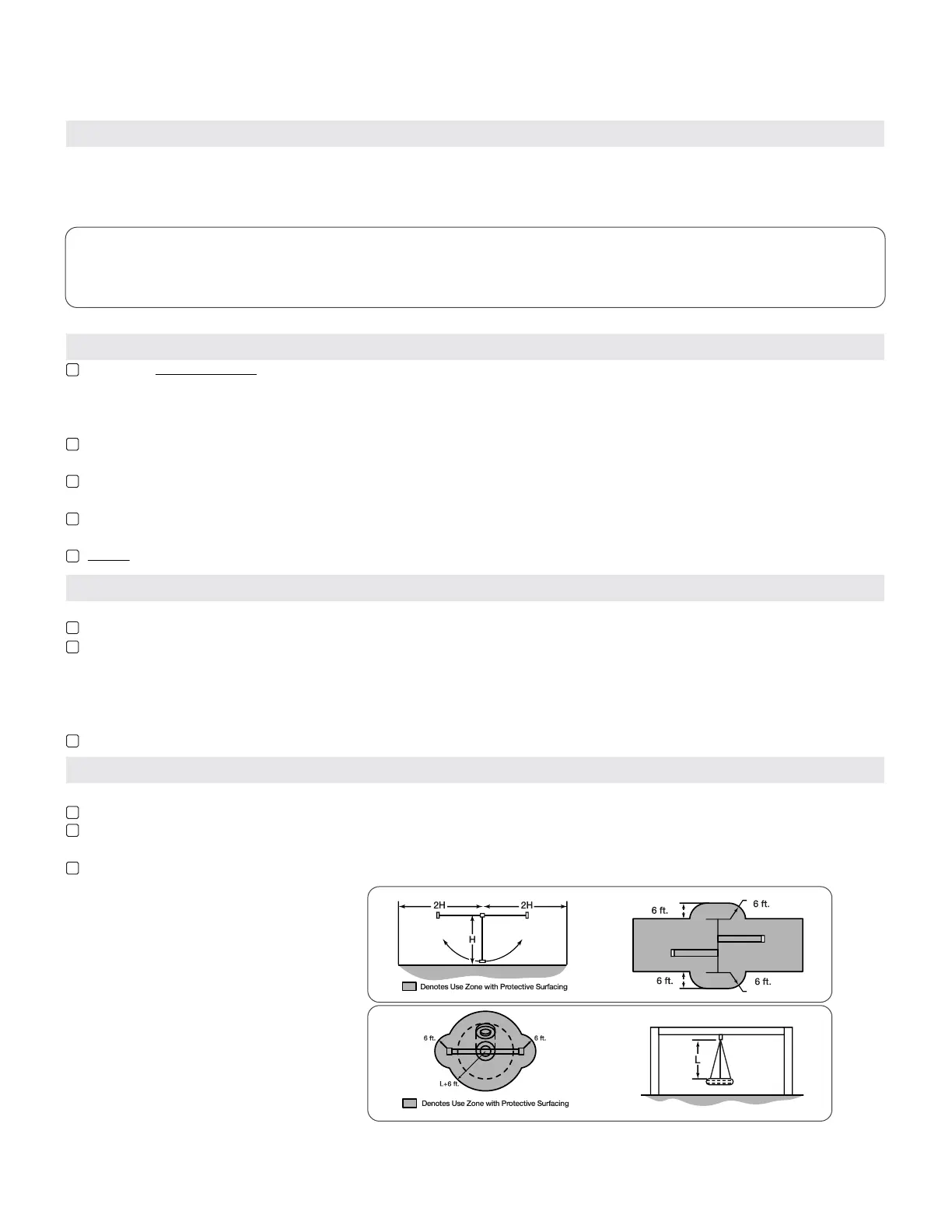
Extend surfacing at least 6 feet [1,8 m] from the equipment in all directions.
For to-fro swings, extend protective surfacing in front of and behind the swing to a distance equal to twice the height of the top bar
from which the swing is suspended.
For tire swings, extend surfacing in a circle whose radius is equal to the height of the suspending chain or rope, plus 6 feet in all
directions.
This information has been extracted from the CPSC publications “Playground Surfacing-Technical information Guide” and “Handbook for Public Playground
Safety” Copies of these reports can be obtained by sending a postcard to the: Office of Public Affairs, U.S. Consumer Product Safety Commission, Washington,
D.C., 20207 or call the toll-free hotline: 1-800-638-2772
Placement
Use Zone for Single-Axis Swings
Use Zone for Multi-Axis Swings
[1,8m]
[1,8m]
[1,8m]
[1,8m]
[1,8m]
[1,8m]
[1,8m]



 To Next Page
 Loading...