35
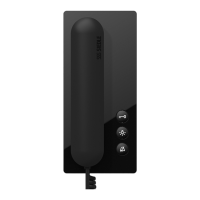
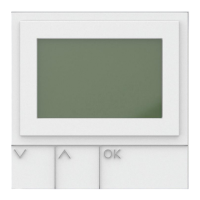
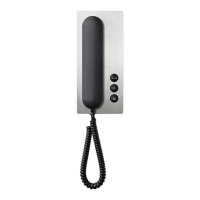
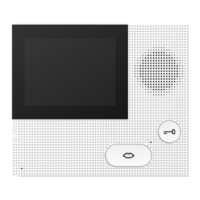
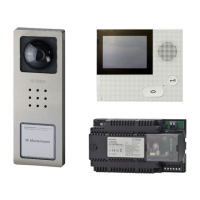
AS-TVHa-1/1 Siedle custom-t
door loudspeaker
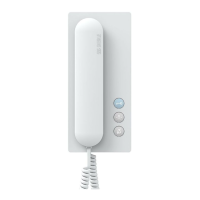
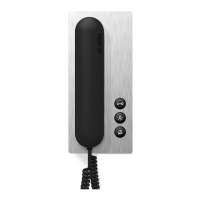
Mode of operation
Calling, speech and video between
the door station and the connected
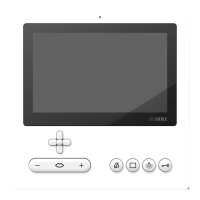
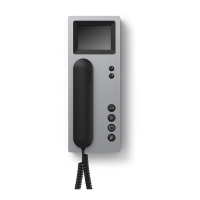
bus telephones BTSV/BFSV/BTCV/
BFCV 850-... with colour monitor.
Audio and video privacy of existing
calls is assured. Door release button
for the door release function, light
button for the light switching
function. Pressing the monitor
button will show the camera picture
from the door station which placed
the last door call. This function is
only possible if no call exists.
Connection of a storey call button
(ERT) for calling from an apartment
door. Ring tones can be selected for
calls from the front door, apartment
door or internal calls.
Connection of other bus telephones
with colour monitor when looping
through from one device to the next.
Other bus door loudspeakers with
video are connected with bus video
distributors BVVU 650-... or
BVVS 650-...
Supplementary functions
• Internal speech communication
possible between bus telephones
BTSV/BFSV/BTCV/BFCV 850-0.
• Connection of bus telephones
BTS/BFS/BTC/BFC 850-... or devices
for switching and control functions
via bus audio decoupler BAA 650-...
For more information, see chapter 6,
page 54-55.
• Switching and control functions
possible with bus switching modules
BSM 650-..., BSE 650-... and
BEM 650-... , feedback to bus
telephones BTC/BFC/BTCV/
BFCV 850-... programmable via LED.
For more information, see chapter 8,
page 89-91.
• Bus secondary signal unit
BNS 750-... possible, chapter 8,
page 96.
• Parallel door and storey call
Up to 8 bus telephones with colour
monitor can be called simultaneously
via one call button. From the second
bus telephone, each bus telephone
must be additionally supplied at the
terminals +M/-M.
• Selective dialling of the door
station possible via additional free
buttons.
• Video memory function
possible with the bus telephone
BTCV/BFCV 850-..., additional
installation required.
Remarks
a) The NG 602-... (12 V AC, 1.6 A)
can also provide a supply for
illumination of existing call buttons.
A voltage of 12 V AC max. 1000 mA
is available for illumination. With
a higher current consumption, an
additional transformer must be used.
Current consumers in the
AS diagram:
Door release appr. 600 mA
Illumination of existing call buttons
b) Door release contact load in the
bus video line rectier BVNG 650-...
max. 15 V AC, 30 V DC, 2 A.
• Light contact load in the bus video
line rectier max. 15 V AC, 30 V DC,
2 A.
c) Door release 12 V AC, use at least
20 Ohm, (e.g. TÖ 615-...), for
possible connection variants see
chapter 8, page 92.
d) Conductor length bus telephone -
storey call button ERT max. 50 m.
e) When using the internal video
memory module, the bus telephone
BTCV/BFCV 850-... must be supplied
by an additional direct voltage
(20 - 30 V DC, 350 mA).
NG 602-... or VNG 602-... can be
used for this purpose. Connection of
the supply at terminals +M/-M. For
more information, see chapter 8,
page 94.
f) The camera CEC 612-... can also
be supplied via BVS 650-... when
used indoors.
Installation
In each bus telephone with colour
monitor, there is a terminating circuit
board connected in the as-delivered
status in the centre of the
connecting terminals TaM and TbM.
This circuit board is an RC element
which comprises a resistor with 100
Ohm and a capacitor 1 nF.
When looping through from one
bus telephone to the next in the
installation, this terminating circuit
board must be removed. If, however,
bus distributors are used in the
installation, or if there is only 1 bus
telephone with colour monitor in
the line, the terminating element
remains in the bus telephone.
Terminal
BTSV/BFSV/BTCV/BFCV 850-...
Connection for one bus telephone
or the last bus telephone in the line.
Connection when looping
through from one bus telephone to
another.
Cable laying
Only signals from the In-Home bus
may be transmitted via the laid
conductor material. No additional
transmission is possible, for instance
to PBX extensions of a telephone
system or an S0 bus (ISDN).
The camera branch and monitor
branch must be laid in a separate
cable and must not be installed
inside the same conduit. This can
result in disturbance to the picture
composition.


 To Next Page
 Loading...