- 20 -
3. OPERATION
3.1 INTRODUCTION & OPERATING PRINCIPLE
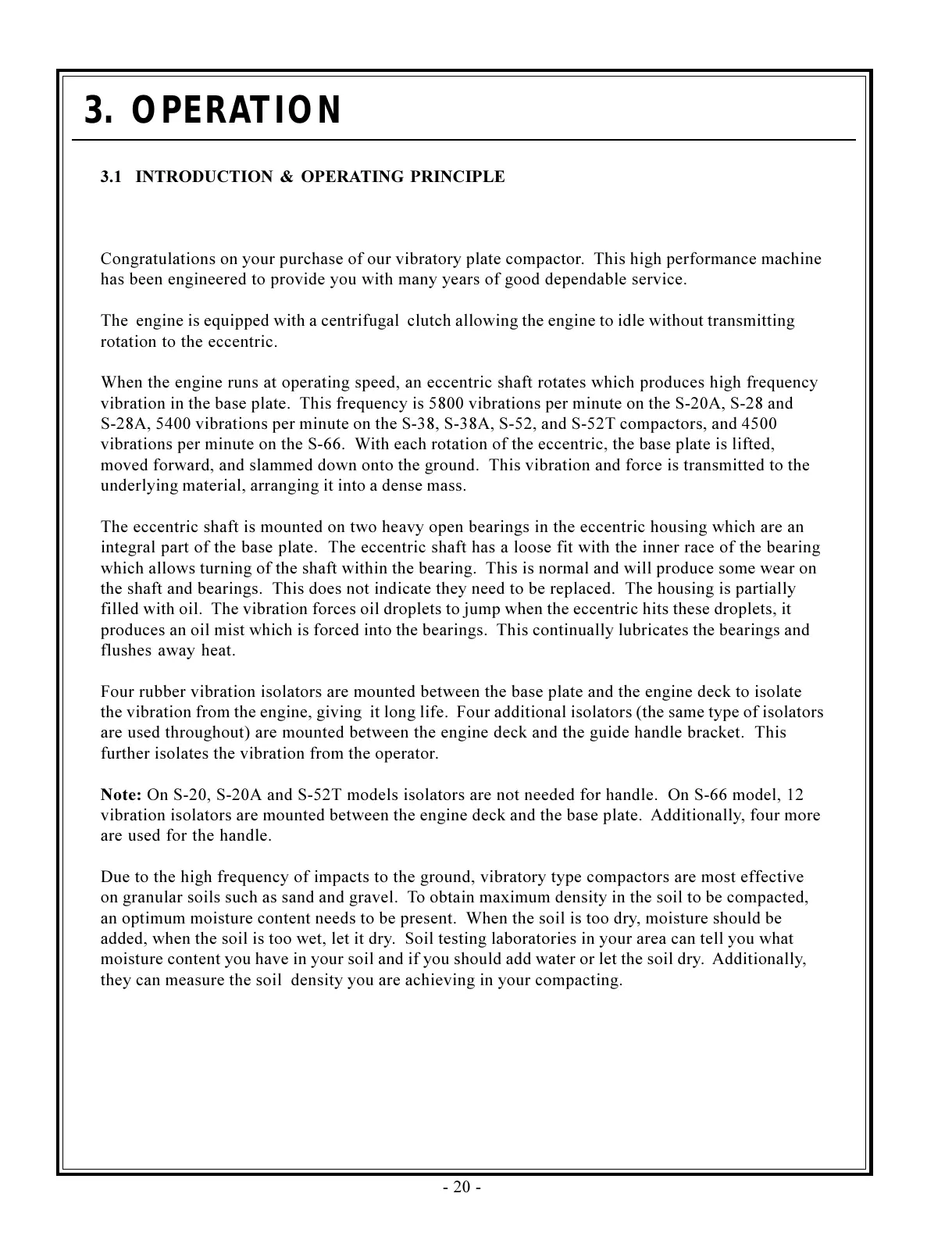
Congratulations on your purchase of our vibratory plate compactor. This high performance machine
has been engineered to provide you with many years of good dependable service.
The engine is equipped with a centrifugal clutch allowing the engine to idle without transmitting
rotation to the eccentric.
When the engine runs at operating speed, an eccentric shaft rotates which produces high frequency
vibration in the base plate. This frequency is 5800 vibrations per minute on the S-20A, S-28 and
S-28A, 5400 vibrations per minute on the S-38, S-38A, S-52, and S-52T compactors, and 4500
vibrations per minute on the S-66. With each rotation of the eccentric, the base plate is lifted,
moved forward, and slammed down onto the ground. This vibration and force is transmitted to the
underlying material, arranging it into a dense mass.
The eccentric shaft is mounted on two heavy open bearings in the eccentric housing which are an
integral part of the base plate. The eccentric shaft has a loose fit with the inner race of the bearing
which allows turning of the shaft within the bearing. This is normal and will produce some wear on
the shaft and bearings. This does not indicate they need to be replaced. The housing is partially
filled with oil. The vibration forces oil droplets to jump when the eccentric hits these droplets, it
produces an oil mist which is forced into the bearings. This continually lubricates the bearings and
flushes away heat.
Four rubber vibration isolators are mounted between the base plate and the engine deck to isolate
the vibration from the engine, giving it long life. Four additional isolators (the same type of isolators
are used throughout) are mounted between the engine deck and the guide handle bracket. This
further isolates the vibration from the operator.
Note: On S-20, S-20A and S-52T models isolators are not needed for handle. On S-66 model, 12
vibration isolators are mounted between the engine deck and the base plate. Additionally, four more
are used for the handle.
Due to the high frequency of impacts to the ground, vibratory type compactors are most effective
on granular soils such as sand and gravel. To obtain maximum density in the soil to be compacted,
an optimum moisture content needs to be present. When the soil is too dry, moisture should be
added, when the soil is too wet, let it dry. Soil testing laboratories in your area can tell you what
moisture content you have in your soil and if you should add water or let the soil dry. Additionally,
they can measure the soil density you are achieving in your compacting.



 To Next Page