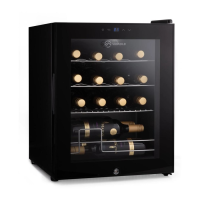
This document is an instruction manual for Subcold VIVA series wine coolers, covering models 16, 20, 24, and 28. It provides essential information for safe operation, installation, maintenance, and troubleshooting of these appliances.
Function Description
The Subcold VIVA wine coolers are designed for the exclusive storage of wine. They are refrigerating appliances, but not suitable for freezing operations. The units maintain a controlled temperature environment to preserve the quality of wine. The control panel features an automatic lock that activates 20 seconds after the last button touch, requiring a 2-second press of the unlock button to reactivate. Users can switch between Fahrenheit and Celsius temperature displays and adjust the desired temperature using up and down arrow buttons, with each press changing the temperature by 1°F or 1°C.
Important Technical Specifications
The VIVA series includes four models with varying capacities and dimensions:
-
Viva 16:
- Bottle Capacity: 16
- Net Capacity (L): 42
- Dimension (MM): 430x450x560
- Packing (MM): 505x525x585
- Net Weight (KG): 17
- Shelves: Three shelves and one display shelf.
-
Viva 20:
- Bottle Capacity: 20
- Net Capacity (L): 53
- Dimension (MM): 430x450x640
- Packing (MM): 505x525x665
- Net Weight (KG): 18
- Shelves: Four shelves and one display shelf.
-
Viva 24:
- Bottle Capacity: 24
- Net Capacity (L): 63
- Dimension (MM): 430x450x740
- Packing (MM): 502x524x770
- Net Weight (KG): 21
- Shelves: Five shelves and one display shelf.
-
Viva 28:
- Bottle Capacity: 28
- Net Capacity (L): 74
- Dimension (MM): 430x450x840
- Packing (MM): 520x540x875
- Net Weight (KG): 23
- Shelves: Six shelves and one display shelf.
Common specifications across all models:
- Rated Voltage: 220-240V~ 50Hz
- Refrigerant: R600a (inflammable)
- Max Lamp Power (LED): 1W
- Climate Class: N
- Foaming Gas: Cyclopentane
- Energy Consumption:
- Viva 16: 131kWh/annum
- Viva 20: 135kWh/annum
- Viva 24: 178kWh/annum
- Viva 28: 189kWh/annum
- Recommended operating temperature for optimal energy consumption is 12°C. At this setting, the energy consumption is 0.397kWh/24h. Higher settings reduce consumption, while lower settings increase it.
Usage Features
Installation:
The appliance should be placed on a completely flat, horizontal surface. A minimum clearance of 5-10 cm is required on each side and from the wall, and 30 cm from the top for proper ventilation. The location should be free from direct sunlight, high temperatures, or humidity. Adjustable front legs allow for stabilization on uneven surfaces; turning them clockwise raises the machine. It's recommended to slightly slope the appliance backward to ensure doors close tightly. If placed on carpet, a sheet underneath can improve heat emission. All adhesive transport tapes must be removed before use.
Placement of Items:
Allow space between items for air circulation. Food, if stored, should be in sealed packages to prevent drying. Hot food must be cooled before being placed in the appliance. Reducing the frequency of door openings helps lower electricity consumption. Electronic equipment should not be used inside the appliance.
Temperature Control:
The wine cooler features an "automatic" control panel lock. To unlock, press the unlock button for 2 seconds until a "BEEP" sound is heard. Temperature display can be toggled between Fahrenheit and Celsius by pressing the temperature display button for 2 seconds. The LED light can be turned on/off by pressing the light button. Temperature adjustments are made using the up (Λ) and down (V) arrow buttons.
Energy Saving Tips:
Place the cooler in a cool area away from heat sources. Avoid storing hot food. Ensure items are properly wrapped to prevent frost buildup. Do not line storage bins with aluminum foil or wax paper. Organize items efficiently to reduce frequent door openings.
Maintenance Features
General Maintenance:
The appliance should be cleaned frequently. Always unplug the power cord from the main source before cleaning.
Interior Maintenance:
Clean the interior with clean water and a non-hazardous cleaner, then wipe dry with a cloth.
Door Gasket Maintenance:
Ensure the door gasket is cleaned sufficiently to prevent damage.
Outer Maintenance:
Wipe dust off with a dry, clean cloth.
Defrosting:
Defrosting is necessary when frost thickness reaches 5 mm to prevent increased energy consumption.
Steps for manual defrost:
- Remove all items from the fridge.
- Remove shelves.
- Unplug the power cord.
- Open the doors and wait for the frost to thaw.
- Wipe the defrost water with a dry cloth.
Do not use any other equipment or methods to speed up defrosting, as this may damage the cooling system.
Disconnecting the Appliance:
- During Power Failure: The refrigerator can store food normally for several hours. Do not add new items and minimize door openings.
- During Vacation: For short vacations, remove all items and close the door firmly. For long vacations, disconnect the power, defrost, clean, wipe dry, and leave the door open to prevent odors.
- Not in Use: If the refrigerator will not be used for a long time, unplug it, clean it, and leave the door open to prevent unpleasant smells.
- Restarting: After disconnecting, wait at least 5 minutes before powering the appliance back on.
User Notifications/Safety Warnings:
- Avoid exposing the refrigerator to water to prevent oxidation and damage.
- Do not use abrasive cleaners, strong chemicals, or very hot water, as they can damage painted covers and plastics.
- Heat can damage interior plastic components.
- After maintenance, check for power damage/loss, ensure the plug fits securely, and verify the plug is not overheating.
- The circuitry wire cross-section must be larger than 0.75mm.
- The power plug requires its own grounded socket; adapters can cause overheating.
- Voltage and frequency should be 220-240V; 50Hz.
- Always disconnect power by pulling the plug, not the cord.
- Do not damage the refrigerant circuit.
- Persons with reduced physical, sensory, or mental capabilities, including children under 8, should not use the appliance without supervision. Children should be supervised to ensure they do not play with the appliance. Cleaning and user maintenance should not be performed by children without supervision.
- Keep ventilation openings clear of obstruction.
- When disposing of an old refrigerator, remove doors and leave shelves in place to prevent children from climbing inside.
- Do not store explosive substances or aerosol cans with flammable propellants.
- The appliance is intended for household and similar applications (staff kitchen areas, farm houses, hotels, motels, bed and breakfast, catering, non-retail applications).
- Do not use electrical appliances inside food storage compartments unless recommended by the manufacturer.
- Faulty parts, including the lamp, must be changed by a certified technician.
- Damaged supply cords must be replaced by the manufacturer, service agent, or a qualified person to avoid hazards.
- Do not expose to open flames, gas, or other harmful substances.
- Do not splash water on the rear of the appliance.
- Do not store inflammable materials like ether, benzene, or LP gas.
- Avoid placing magnetic, heavy, or water-filled objects on top of the appliance.
- Ensure the cooling system is not damaged during transport or installation due to the inflammable R600a refrigerant.
- For safe disposal, contact a WEEE waste removal company.
- Remove the door gasket before disposal, and ensure disposal is handled by trained personnel.
Troubleshooting Tips:
The manual provides a table of common problems, their possible causes, and solutions, such as checking power connections, temperature settings, door sealing, and unit clearances. It also clarifies that certain occurrences like moisture on the exterior in high humidity, refrigerant noises, and warm sides of the product are normal and not malfunctions.

 Need help?
 General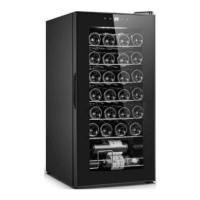

 To Next Page