3
33
3
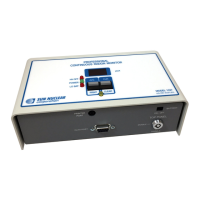
Ambient room air, laden with radon, diffuses into the monitor’s detection
chamber. Radon decay by-products emit alpha particles which are detected
by the photodiode.
At the end of the monitoring period, the results are available in any of three
forms: numerical display on the control panel, printed report on the accessory
printer, or computer display. Once down-loaded to the computer, a report can
be printed using standard programs.
After obtaining the report data, you can clear the memory and immediately
begin another test. The instrument is completely reusable and requires no
supplies except power and an optional backup battery.
The printer need not be present during testing. The radon monitor can be
moved from the test site, and the report printed later. If multiple tests must
be run simultaneously, a single printer or computer can support many radon
monitors.
Specifications
SpecificationsSpecifications
Specifications
Description Value
Power Supply Transformer converts 120 VAC, 1-phase, 60 Hz to
12 VDC, 200 mA
Measurement Range: 0.1 to 999 picocuries/liter (pCi/l)
Operating Range: 45 degrees F to 95 degrees F
Accuracy ±25% or 1 pCi/l, whichever is greater after 24
hours
Disturbance Sensor: Inertial switch
Data Port: RS-232, 9-pin, D-connector allows printer data to
be sent to PC
Detector: Diffused-junction photodiode
Measurement Interval: 1 hour (4, 8, or 24-hour intervals available by spe-
cial order)
Sensitivity: 2.5 counts per hour per picocurie per liter
Display: 3-digit display LED
Battery Backup: One 9V alkaline battery supplies approximately 20
hours of operation. LED indicates low battery.
Weight: 2 Lbs
Size: 8” x 4.7” x 2.5”
EPA Evaluation: US EPA accepted


 To Next Page
 Loading...