Sutron Corporation 8310 & 7310 Users Manual 8800-1125Rev. 2.7 (BETA) 4/16/2014 pg. 170
The ACCUBAR 5600-120 is an example of an SDI (Serial Digital Interface) device. It not only takes
measurements, but it processes them internally and sends data to the 8310 with units already
assigned. Since it does its own processing, the user must give instructions to the ACCUBAR
(through the 8310) on how often to take measurements and what units to deliver them in.
Below, you will find the commands required for a very basic setup, but for a full explanation of
SDI operations see the ACCUBAR manual.
Address
To set up a measurement, first find the address of the ACCUBAR. This address can be changed,
but the factory default is 0. If connecting more than one SDI device, they must each be assigned
their own unique address. To communicate with the ACCUBAR, enter the menu at
Diagnostics/SDI Tools. Select Find SDI Devices, and it should return the address of the sensor. If
connecting more than one SDI device, change the address by selecting Send SDI-12 Comand, and
enter the command 0An! in the Send SDI-12 Command field, where “0” is the current address
and “n” is the new address you wish to assign to the ACCUBAR. As a standard format, every
command begins with the device address and ends with an exclamation mark.
Take Measurements
Taking measurements is a two step process. First, send the measurement command aM! (where
“a” is the address). The ACCUBAR will return a value in the form of “atttn” where “a” is the
address, “ttt” is the amount of time (in seconds) the ACCUBAR needs to make the
measurements, and “n” is the number of measurement values it will return to the 8310. After
waiting at least “ttt” seconds for the ACCUBAR to collect and process the measurements,
request the data with the command aD0! where “a” is address. (Note: 0 is the number zero, not
the letter O.)
The measurement will be delivered in the format of “avn”, where “a” is address, “v” is the value,
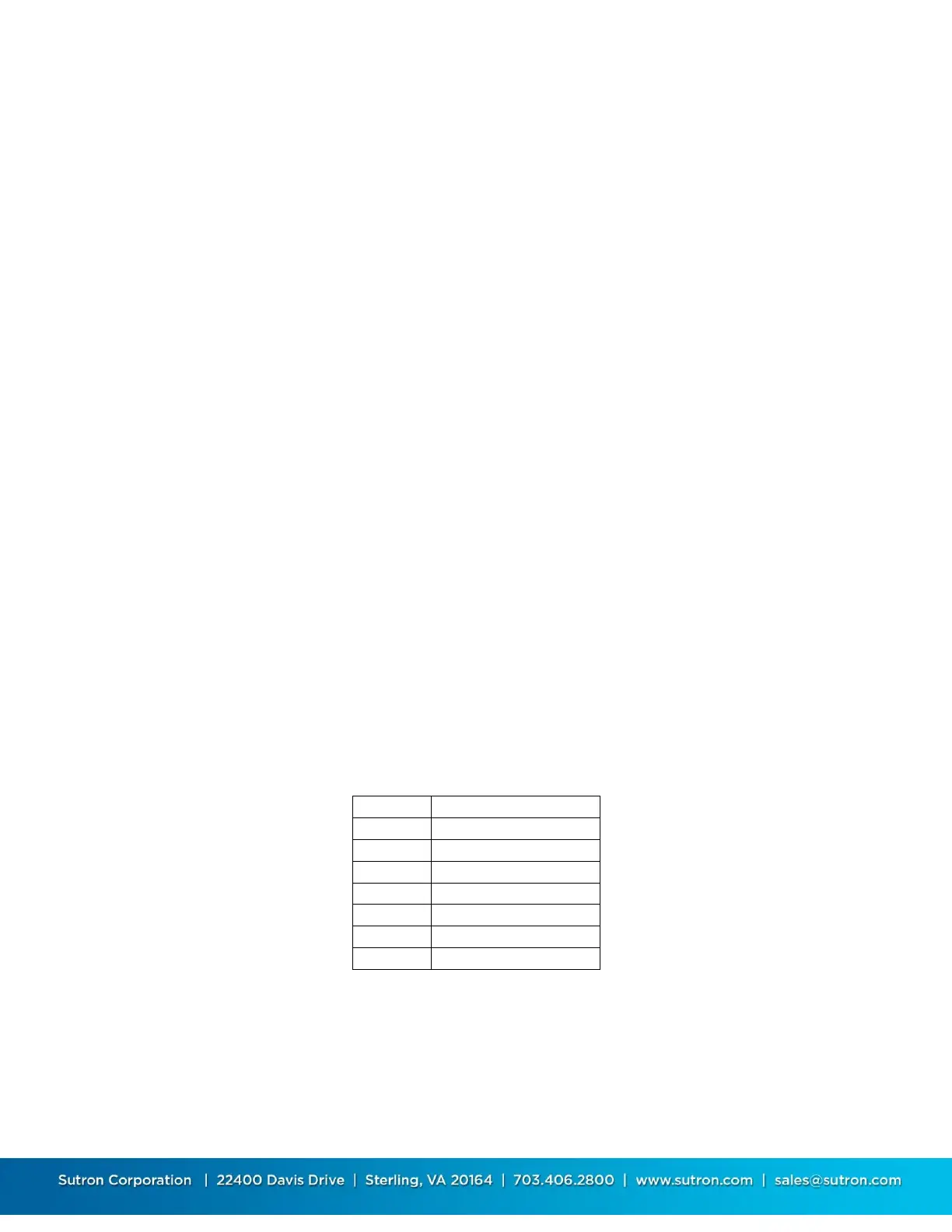
and “n” is a number that corresponds to a set of units, as shown below. For example,
“0+101.33+2” would mean that the device at address 0 measured the pressure to be 101.33
kPa.
Setting Measurement Preferences
To change the units or decimal places of the measurements, use the command aXUP+n+d!
where “a” is address, “n” is the units desired (same values as in previous table), and “d” is the
number of decimal digits desired.
To set the sampling duration, use the command aXT+t! where “a” is address, and “t” is the
number of seconds the over which samples will be taken and averaged. Unlike other, non-SDI,


 To Next Page
 Loading...