Sutron Corporation 8310 & 7310 Users Manual 8800-1125Rev. 2.7 (BETA) 4/16/2014 pg. 38
Positioning within the menu tree
Positioning within the menu tree is controlled by the 4 arrow keys. Pressing the (down
arrow) key causes the display window to move one step down in the menu. Similarly the (up
arrow) key causes the display window to move up within a menu. The (right arrow) key is
used to "move into" a sub-menu. For example, when the display window has been moved down
the main menu until Logged Data is shown, pressing will shift the display to show Select Log
(the first item of the Logged Data sub menu). If the menu item has no sub-menu, pressing
will have no effect. The key moves you left or up one menu level each time it is pressed. If
you are in a sub-menu, pressing will return you to the previous higher menu level. No
matter where you are in the menu tree you can return to the top of the main menu by pressing
repeatedly.
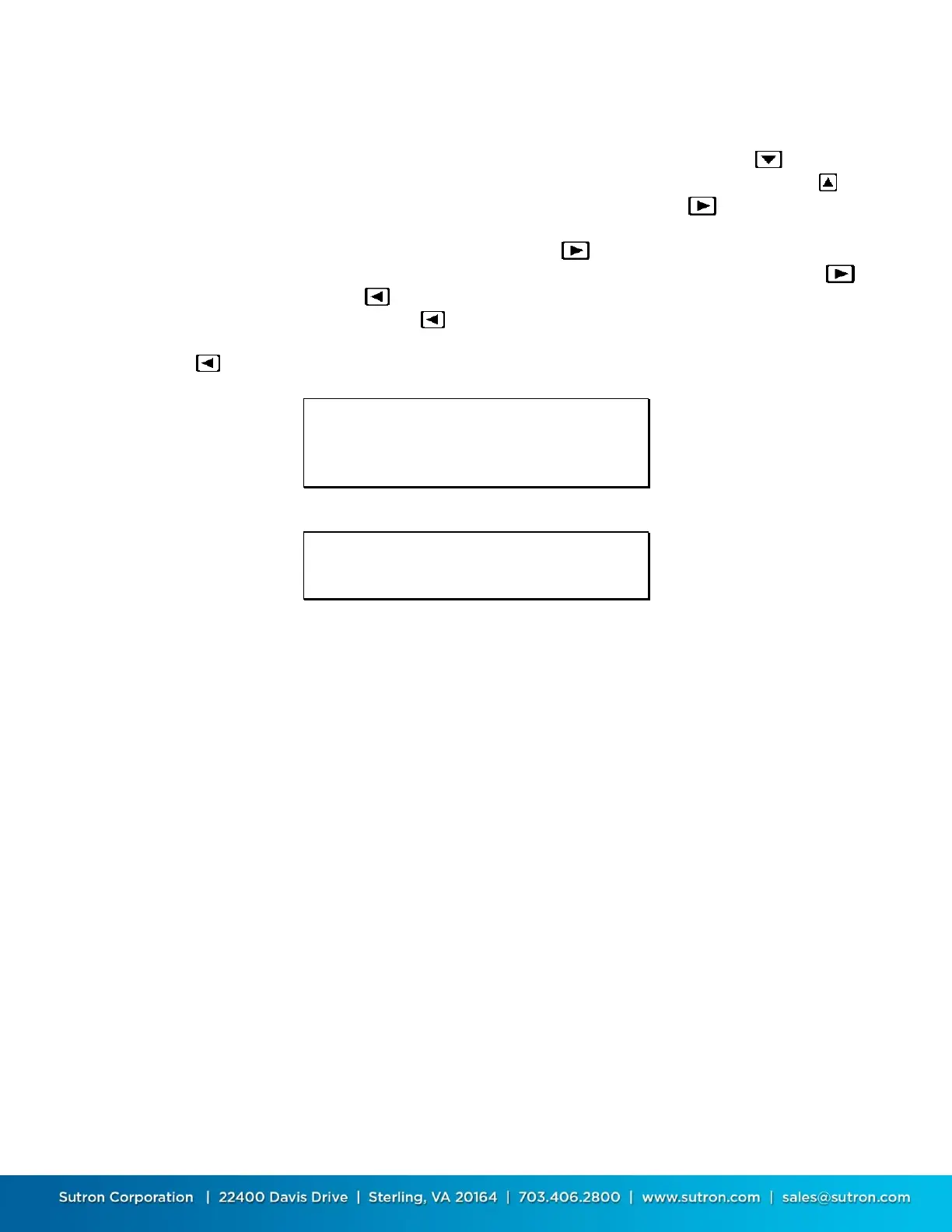
Special Tip: the second line of the display will
flash a hint describing what will happen when
RIGHT or SET is pressed. Look for the hint to
help you operate the 8310.
Special Tip: If you hold one of the arrows down
for more than a half second, it will
automatically repeat.
Now that you can navigate through the menus, let us introduce a few terms or conventions we
have adopted to help describe the 8310 menus.
MAIN MENU -- We will use the term main menu to describe all those items that appear by
pressing only the down arrow from the top of the tree. These items are UnitID, Date, Time,
Recording, Alarm status, Sending Alarm Txs, Logged Data, Station Setup and so forth. (When
using a PC, all these items appear in a single menu which makes the concept of a MAIN MENU
clearer.
MENU, SUBMENU -- There are also other menus and submenus in the 8310. Like the main
menu, they contain all the items that appear by pressing only the down arrow. The Station
Setup menu has the items Measurements, Communications, Logs, LAN settings, etc.
FIELD -- We will use the term field to describe any item in the menus that accepts a value. You
will always see the value displayed next to the name of the field. Time is a field (which holds the
value of the time) as is Recording and many others. You set the 8310 by changing the values of
the fields.
FUNCTION -- Some items in a menu look like fields but do not have a value displayed. These are
functions that cause the 8310 to do something. An example of a function is Station
Setup/Import Setup that causes the 8310 to read in a new setup file.
MENU PATH -- A final convention that we have developed is what we call the menu path. The
menu path is a concise way of explaining the menus and sub menus used to go to a specific


 To Next Page
 Loading...