Sutron Corporation 8310 & 7310 Users Manual 8800-1125Rev. 2.7 (BETA) 4/16/2014 pg. 66
Figure 1 Sampling and Averaging
VectAverage
The Vector Average is important to any sensor that has a circular discontinuity, such as a wind
direction sensor with the crossover from 0 to 359 degrees. In these cases, simple averaging does
not work -- the mean of 0 and 359 is 179.5 , which is clearly incorrect. Calculating a vector
average provides a way around this problem.
Vector Average uses the same values that Average uses (Interval, Time, SampleInterval and
SampleDuration) to control when measurements are made.
There are several types of vector averages, explained below, each conveying slightly different
information. This block is, in fact, geared toward wind sensors, but it could be used any time
performing a vector average is desired. When wind speed is described (e.g. “23 mph out of the
northwest”, this is often an expression of the Mean Speed Scalar and the Mean Direction Unit.
The outputs of Vector Average are as follows, with vector math shown below.
Mean Speed Scalar – This is the scalar wind speed, not taking direction into account. The scalar
average of 10mph for an hour and 20mph for an hour is 15mph, regardless of changing
direction.
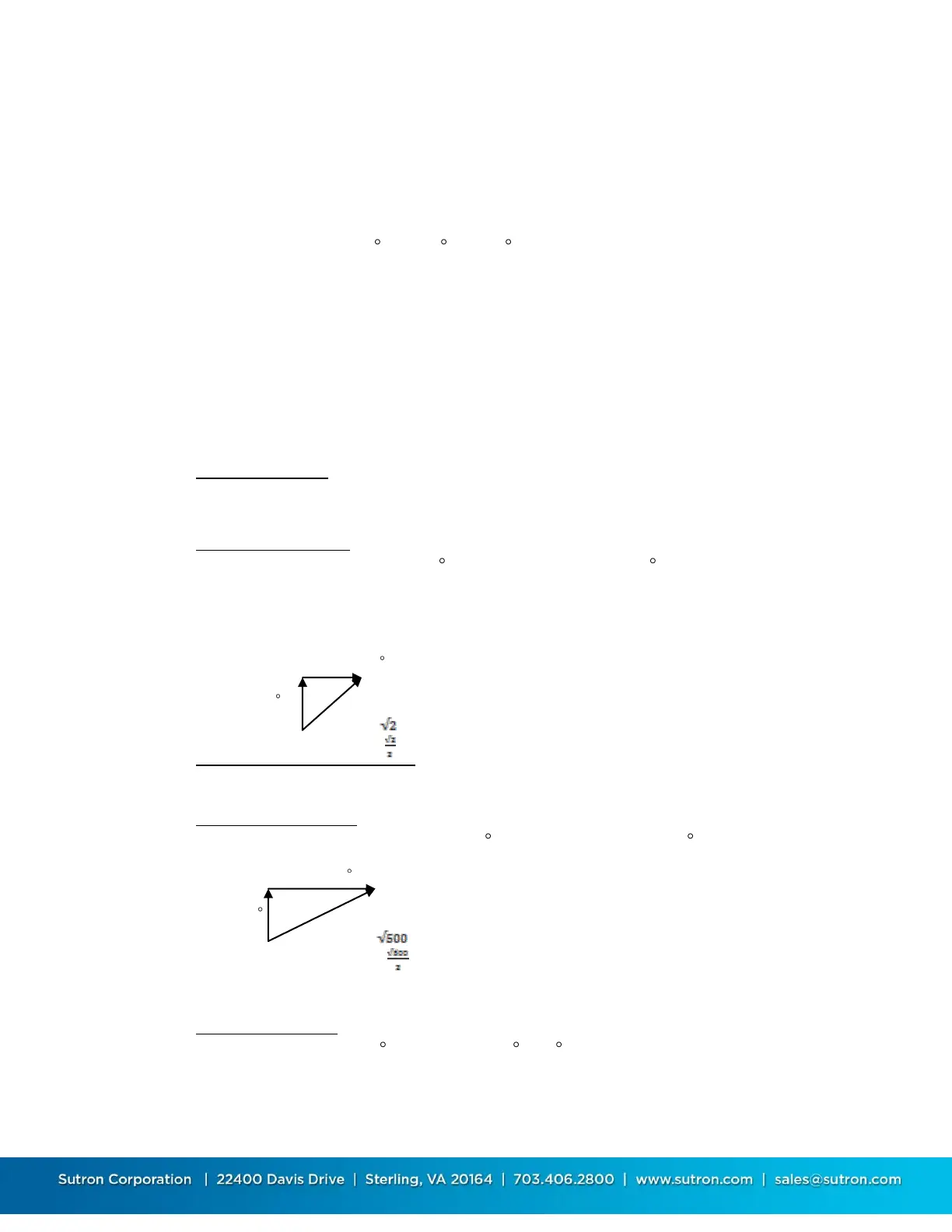
Mean Magnitude Unit – This is the vector average of the wind speed using unit vectors. The
mean magnitude unit of 5mph at 0 for 1 hour and 100mph at 90 for 1 hour is 0.707. This is
found by adding the two vectors, finding the magnitude of the resultant vector, and dividing by
the number of vectors in the average (two, in this case). Since the mean magnitude unit is an
average of unit vectors, it will always be between 0 and 1.
Mean Magnitude Wind – This is the vector average of the wind speed which takes direction into
account. Here, the average of 10mph at 0 for 1 hour and 20mph at 90 for 1 hour is 11.2 mph.
Mean Direction Unit – This is the wind direction (in degrees) not weighted for wind speed. Here,
the average of 10mph at 0 with 20mph at 90 is 45 .


 To Next Page
 Loading...