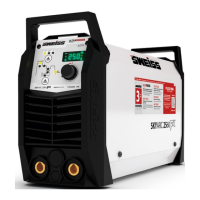
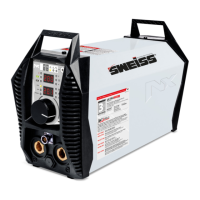
The SWEISS SKYMAX 1550 (110V/220V) is an Inverter DC MMA Arc Welding Machine, designed for both professional and hobbyist use. This manual provides comprehensive information for its safe and effective operation, maintenance, and troubleshooting.
Function Description
The SKYMAX 1550 is a general MMA (Manual Metal Arc) welder that incorporates the latest Pulse Width Modulation (PWM) technology and an Insulated Gate Bipolar Transistor (IGBT) power module. It converts the work frequency to a medium frequency, allowing for a more compact design compared to traditional bulky work frequency transformers. This results in a portable, small-sized, and low-consumption welding machine.
The welder offers excellent performance characteristics, including constant current output for stable welding arcs, fast dynamic response to minimize the impact of arc length fluctuations on current, and accurate stepless current adjustment with a pre-setting function. It also features automatic protection functions for under-voltage, over-current, and over-heat conditions. When these issues occur, an alarm pilot lamp on the front panel illuminates, and the output current is automatically cut off, protecting the machine and extending its lifespan.
A notable feature is its automatic input voltage detection, allowing it to distinguish between 110V and 220V without manual switching, making it versatile for various power environments. The SKYMAX 1550 can also be used for TIG (Tungsten Inert Gas) welding operations.
Important Technical Specifications
The SKYMAX 1550 (110V/220V) welder has the following key parameters:
Input Power:
- Single phase, 110V ±10%, 50/60Hz
- Single phase, 220V ±10%, 50/60Hz
Rated Input Current:
- 55A (for 110V input)
- 33A (for 220V input)
Rated Input Power:
- 4.8KW (for both 110V and 220V input)
Power Factor:
- 0.82 (for 110V input)
- 0.67 (for 220V input)
Welding Current Range: 5-160A
Max No-Load Voltage: 58V
Efficiency: ≥80%
Duty Cycle (at 40°C, 10 minutes):
- 155A/26.0V at 50%
- 80A/23.2V at 100%
Protection Class: IP23
Insulation Class: F
Dimensions (LxWxH): 330×140×230 mm
Weight: 7 Kg
The volt-ampere characteristic of the SKYMAX 1550 is designed for stable performance. In MMA welding, the relationship between the rated loading voltage (U2) and welding current (I2) is defined as:
- When I2 ≤ 600A, U2 = 20 + 0.04 I2 (V)
- When I2 > 600A, U2 = 44 (V)
The duty cycle, denoted by "X," indicates the proportion of time the machine can operate continuously within a 10-minute period. For instance, a 50% duty cycle at 155A means the machine can weld for 5 minutes at 155A and then needs 5 minutes to cool down. If the machine overheats, the IGBT protection unit will cut off the output current, and the over-heat pilot lamp will illuminate. In such cases, the machine should be allowed to cool for 10 minutes, and the welding output current or duty cycle should be reduced for subsequent operations.
Usage Features
The SKYMAX 1550 offers several features to enhance usability and welding quality:
Front Panel Controls:
- Power Pilot Lamp: Indicates when the machine is on.
- Alarm Pilot Lamp: Illuminates when a protection function (e.g., over-heat) has been activated.
- Welding Current Regulation: A knob to adjust the welding current from 5A to 155A. Turning clockwise increases the current. When operating on 110V, the machine automatically restricts the maximum welding current as per customer requests.
- Conversion Switch: Allows selection between MMA (right position) and TIG (left position) welding modes.
- Output Connectors: One for negative polarity output and one for positive polarity output.
Rear Panel Controls:
- Cable Clamp: For fastening the mains cable.
- Mains Switch: To turn the machine on/off.
Welding Polarity Connection:
- The choice between DCEN (Direct Current Electrode Negative) or DCEP (Direct Current Electrode Positive) depends on achieving stable arc burning and the specific electrode requirements. Users should refer to the electrode manual for guidance.
MMA Operation Features:
- Hot Start Function: Facilitates easier arc striking.
- Arc Force Function: Helps prevent electrode sticking and enhances arc power.
- Anti-Stick Function: If the electrode touches the workpiece for more than two seconds, the welding current automatically drops to a minimum to protect the electrode.
- Striking Arc Way:
- Knocking Arc: Involves touching the workpiece with the electrode upright, then quickly lifting it 2-4mm to ignite the arc. This method is more challenging but preferred for brittle or hard steel.
- Lifting Arc: Involves scraping the workpiece with the electrode to strike the arc. This may cause arc scratches and should be avoided in grooves.
- Manipulation of Electrode: Involves three coordinated motions: moving the electrode towards the molten pool along its axis, swinging it right and left, and moving it along the welding path. The operator selects the manipulation technique based on joint shape, welding position, electrode specifications, current, and skill.
- Arc Length: Typically 0.5-1.0 times the electrode diameter. Short arc welding is generally recommended for basic electrodes, while acid electrodes should use an arc length equal to their diameter.
TIG Operation Features:
- Shielded Gas Input: Shielded gas is directly supplied to the welding gun.
- Lift Arc Method: When the tungsten electrode touches the workpiece, the short-circuit current is limited to 10A. After arc generation, the current rises to the preset welding current. If the tungsten electrode touches the workpiece during welding, the current drops to 10A within 2 seconds, reducing tungsten spoilage and prolonging electrode life.
Operation Environment:
- Altitude: Below 1000m.
- Temperature: -10°C to +40°C.
- Humidity: Below 90% (+20°C).
- Placement: The machine should be placed at an angle not exceeding 15° from the floor.
- Protection: Protect from heavy rain and direct sunlight.
- Air Quality: Dust, acid, and corrosive gas content should not exceed normal standards.
- Ventilation: Ensure sufficient ventilation with at least 30cm free distance between the machine and walls.
Maintenance Features
Regular maintenance is crucial for the high-efficiency and safe operation of the SKYMAX 1550, extending its service life and reducing fault rates.
Safety Precaution:
- Always shut off the power supply and wait for 5 minutes before maintenance to allow the capacitor voltage to drop to a safe level (below 36V).
Maintenance Items:
Daily Examination:
- Panel Knobs and Switches: Check for flexibility and correct placement. Replace if damaged or inflexible.
- Machine Operation: After power-on, listen for unusual shaking, whistling, or smells. Identify and resolve any issues; contact service if necessary.
- LED Display: Verify the display values are intact and accurate. Replace damaged LEDs or display PCBs if needed.
- Fan Operation: Check if the fan is damaged or rotating normally. If damaged, replace it. If it doesn't rotate after overheating, check for obstructions. If the fan still doesn't work after clearing obstructions, replace the start capacitor or the fan itself.
- Fast Connectors: Check for looseness or overheating. Fasten or replace if problematic.
Monthly Examination:
- Output Cable: Inspect for damage. Wrap, insulate, or replace if damaged.
Quarter-Yearly Examination:
- Internal Cleaning: Use dry compressed air to clean the inside of the machine, especially the radiator, main voltage transformer, inductance, IGBT module, fast recovery diode, and PCBs.
- Bolts: Check for looseness, skid, or rust. Tighten loose bolts, replace skidded ones, and remove rust to ensure proper function.
- Current Accuracy: Verify that the actual output current matches the displayed value using an adjusted plier-type ampere meter. Regulate if there are discrepancies.
Yearly Examination:
- Insulation Impedance: Measure the insulation impedance between the main circuit, PCB, and case. If it is below 1MΩ, the insulation is considered damaged and needs to be changed or strengthened.
Troubleshooting Guidelines:
- The power pilot lamp will turn off several seconds after the machine is switched off due to the switch power source design.
- The machines are factory-debugged; unauthorized modifications are prohibited.
- Maintenance must be performed carefully. Loose or misplaced wires can pose a safety hazard.
- Only authorized professional maintenance personnel should overhaul the machine.
- Always ensure the machine's power is off before opening its casing.
- For any problems not resolvable by the user, contact the local company agent or branch.
Common Welding Defects and Prevention:
The manual provides a detailed table of common welding defects (e.g., undercut, incomplete penetration, blowhole, hot crack, cold crack) with their causes and corresponding prevention methods. This includes advice on choosing proper groove angles, assembly gaps, welding parameters, electrode manipulation, and material preparation. For instance, to prevent blowholes, ensure the workpiece surface and groove are clean, use dry electrodes, and maintain appropriate arc length and welding speed. For hot cracks, control the percentage of S and P in welding material and adjust the welding material structure.
This comprehensive approach to operation, technical specifications, and maintenance ensures that users can effectively and safely utilize the SWEISS SKYMAX 1550 for various welding tasks.

 Need help?
 General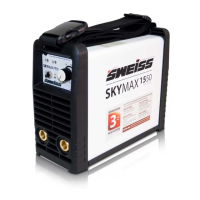

 To Next Page