Need help?
Do you have a question about the SWFT VOLT and is the answer not in the manual?
Key safety guidelines and precautions for operating and maintaining the e-bike.
Instructions for cleaning, protecting, and maintaining the e-bike's components.
Illustrates the electrical connections of the e-bike components.
Steps to prepare the e-bike for assembly after unpacking.
Instructions for safely removing the e-bike and its components from the packaging.
Guidance on installing and positioning the e-bike handlebars.
Procedure for securely attaching the front wheel to the e-bike fork.
Instructions for correctly installing the left and right pedals.
Information on checking and adjusting the e-bike's braking system.
Steps for adjusting the seat height and angle for rider comfort.
Guidance on checking and maintaining proper tire pressure.
Essential safety checks to perform before operating the e-bike.
Procedure to power on and prepare the e-bike for use.
How to select pedal assist levels and begin riding.
Instructions for turning the e-bike's headlight on and off.
Overview of the e-bike's LCD display and its functions.
Explanation of the different pedal assist levels and their operation.
How to use the throttle and engage cruise control for riding.
Steps for safely charging the e-bike battery.
Important considerations and warnings related to battery charging.
Details about the non-removable battery pack and its components.
Tips for extending battery life and proper disposal methods.
Checks for the proper functioning and condition of brakes.
Inspection of wheels, tires, spokes, and axle nuts for safety.
Ensuring handlebars, stem, and grips are secure and aligned.
Checking the frame and fork for damage like bends or breaks.
Ensuring the chain is lubricated, clean, and runs smoothly.
Regular checks of the rear suspension connection.
Ensuring bearings are lubricated and move freely.
Checking pedals and cranks for secure tightening and alignment.
Verifying derailleur adjustment and lubrication of control cables.
Ensuring reflectors and other fittings are secure and functional.
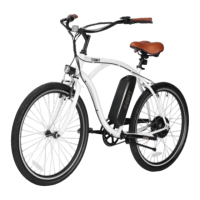
The SWFT Volt E-Bike is an electric bicycle designed for enjoyable and safe riding, offering pedal assistance and a motor to aid in propulsion. It combines traditional cycling with electric power, making it suitable for various riding conditions and distances.
The e-bike's primary function is to provide an assisted cycling experience. It is driven by a motor embedded in the hub of the rear wheel, powered by a battery. The motor's assistance is controlled by the rider through power-assisted modes, which adjust the accelerating force. Unlike some e-bikes, the SWFT Volt does not feature a direct throttle drive; instead, it relies on pedal assistance to engage the motor. This design ensures that the rider is always actively pedaling, with the motor providing supplementary power.
The e-bike is equipped with an LCD control display that monitors various riding parameters, including motor assist level, current speed, odometer, trip distance, riding time, and battery energy level. This display allows riders to keep track of their ride statistics and the e-bike's status. The motor assist level can be adjusted using dedicated buttons on the display, offering different levels of power output to suit varying terrains and rider preferences.
For safety and convenience, the e-bike includes a headlight, which can be turned on and off by pressing and holding an arrow button on the display. This feature is crucial for riding in low-light conditions, enhancing visibility for both the rider and others on the road.
The SWFT Volt also features a cruise control function. To activate it, the rider must first pedal at a speed faster than 5 mph, then press and hold the down arrow button for three seconds. Once engaged, the motor and battery work together to maintain the set speed. Cruise control can be disengaged by accelerating with the throttle or squeezing the brake lever.
Before riding, it is essential to perform a pre-ride checklist to ensure safety. This includes checking the handlebars for secure attachment and stability, verifying that the front wheel is tight and does not wobble, confirming the seat is tight, inspecting pedal connections, testing brakes, and ensuring all accessories and reflectors are firmly attached and in position. Wearing a CPSC-approved helmet is always recommended for safety.
To start the e-bike, the power button on the monitor display needs to be pressed for three seconds. The display and battery will then turn on. Riders should check the battery charging indicator to ensure sufficient charge for their ride. It is important to turn off the bike and battery power when not in use or during recharging.
Once riding, the pedal assist function activates the motor when the rider pedals forward. There are three levels of assistance available. Level 1 provides approximately 20% motor power, while level 3 utilizes 100% of the motor's power. If the monitor display is powered off, the bicycle operates without motor assistance. The assistance level resets when the bike and monitor are powered off. Riders are encouraged to experiment with different levels to find what suits their riding conditions.
The e-bike's battery pack is integrated and not removable by the user. However, the bike can still be ridden as a regular bicycle even if the battery is dead. This provides flexibility for riders who may run out of charge during a ride.
Regular maintenance is crucial for the longevity and safe operation of the SWFT Volt E-Bike. The manual provides a comprehensive inspection checklist covering brakes, wheels and tires, steering column, frame and fork, chain, rear suspension, bearings, cranks and pedals, derailleurs, and accessories.
Brakes: Riders should ensure that front and rear brakes work properly, brake shoe pads are not overly worn and are correctly positioned, brake control cables are lubricated and adjusted, and brake levers are lubricated and securely tightened.
Wheels & Tires: Tires should be inflated within the recommended limit (70 PSI maximum for the VOLT) and checked for bulges, excessive wear, or cracks. Rims should run true without wobbles or kinks, and all wheel spokes should be tight. Axle nuts must be tight, and quick-release levers (if fitted) should be sufficiently resistant and in the closed position.
Steering Column: Handlebars and stem need to be correctly adjusted and tightened to allow proper steering. Handlebar grips should also be properly positioned and tightened.
Frame & Fork: The frame and fork should be checked for any bends or breaks, and replaced if damaged.
Chain: The chain should be oiled, clean, and run smoothly. Adjusting chain tension should be done by a qualified technician.
Rear Suspension & Bearings: The rear suspension connection should be checked regularly. All bearings should be lubricated, run freely, and show no excessive movement or grinding.
Cranks & Pedals: Pedals and cranks must be securely tightened to the cranks and axle, respectively, and checked for bends.
Derailleurs: Front and rear derailleur mechanisms should be adjusted and function properly. Control levers should be securely attached, and derailleurs, shift levers, and control cables properly lubricated.
Accessories: All reflectors and other fittings must be properly fitted, not obscured, securely fastened, and functioning.
Battery Care: The battery should be fully charged before the first ride and after any operation, especially long-distance rides. It is recommended to charge the battery when it reaches 50%-70% depletion rather than fully exhausting it. Overcharging (in excess of 10 hours) should be avoided, especially in hotter climates. The battery should be recharged once a month, even if the bike is in storage. Charging should occur in a dry, well-ventilated area with adequate power supply, using only the original charger. The charger should be kept away from liquids, foreign substances, and extreme temperatures. It is also advised to charge the e-bike through a surge protector to prevent damage to electrical components.
Troubleshooting: The manual includes a troubleshooting guide for common issues such as the battery gauge not lighting up, reduced speed/range, intermittent power, and display errors. This guide helps riders identify potential causes and provides steps for resolution, often recommending professional assistance for complex issues.
The SWFT Volt E-Bike is designed for ease of use and maintenance, but emphasizes the importance of adhering to safety guidelines and seeking professional help when in doubt about assembly, repair, or maintenance.
 General
| Motor | 350W |
|---|---|
| Tire Size | 10 inches |
| Motor Power | 350W |
| Brakes | Rear disc brake |
| Max Range | 25 miles |
| Weight Capacity | 265 lbs |
| Max Load | 265 lbs |

 To Next Page