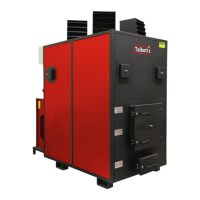
The document describes the Talbott's T-Range Manual Feed Space Heaters, a series of biomass energy systems designed for burning waste wood. These heaters are of British manufacture and feature a double heat exchange system for maximum efficiency.
Function Description
The primary function of the T-Range heaters is to provide space heating by burning waste wood. They are manually fed, meaning fuel is loaded through a loading door at the front of the appliance. Combustion air is supplied by a small fan and distributed evenly throughout the combustion chamber via a heavy gauge steel tube, ensuring balanced combustion. The flue gases then pass through a triple-pass secondary heat exchange system before exiting, maximizing heat extraction from the burning wood. Each heater comes standard with swivel louvered air distribution heads, which can be rotated and adjusted to optimize hot air flow direction.
The T-Range heaters are designed to burn wood off-cuts, chipboard, MDF, softwood, hardwood, and pallets. They are not suitable for burning plastics, other foreign matter, or sawdust. Fuel must not exceed 20% moisture content and dimensions of 500mm x 100mm x 200mm.
Important Technical Specifications
The T-Range series includes models T75, T150, T300, and T500, with varying specifications:
- Length:
- T75: 1230mm
- T150: 1450mm
- T300: 1970mm
- T500: 2295mm
- Width:
- All models: 914mm (T75, T150), 1170mm (T300, T500)
- Height:
- T75: 1000mm
- T150: 1700mm
- T300: 1830mm
- T500: 1995mm
- Weight:
- T75: 535kg
- T150: 950kg
- T300: 1388kg
- T500: 1880kg
- Heat Output:
- T75: 25kW/Hr
- T150: 50kW/Hr
- T300: 100kW/Hr
- T500: 150kW/Hr
- Flue Diameter:
- T75 & T150: 180mm (7")
- T300: 200mm (8")
- T500: 255mm (10")
- Air Volume:
- T75: 750 CFM
- T150: 1500 CFM
- T300: 3000 CFM
- T500: 5000 CFM
- Power Consumption:
- T75: 0.22 kW
- T150: 0.26 kW
- T300: 0.75 kW
- T500: 2.24 kW
- Power Supply:
- T75, T150, T300: Single phase (13 Amp for T75/T150, 16 Amp for T300)
- T500: 3 Phase + Neutral 20 Amp
- Loading Door Size:
- T75: 360x360mm
- T150: 420x360mm
- T300: 470x470mm
- T500: 540x540mm
The combustion chamber is fully ceramic-lined with stainless steel retention, protecting it up to 1,500°C (2,700°F).
Usage Features
- Initial Lighting: A small fire is started in the center of the firebox using paper or cardboard and small wood lengths. Once ignited, the size of the material can be gradually increased.
- Refuelling: Refuelling should be done onto a sufficient quantity of glowing embers and ash to ensure new fuel ignites quickly, preventing excessive smoke. If embers are few, kindling should be added. The loading door should only be opened for refuelling.
- Combustion Fan: Essential for clean combustion, this fan increases airflow. It operates on a 230V supply (except T75 model) and must remain on permanently. The appliance cannot run without this fan, as it would lead to smoke, hot spots, and damage to the heat exchange and fan itself.
- Thermostat: Monitors and regulates heat exchange temperature using the main fan. Older models use Fahrenheit, newer ones Celsius. It has settings for fan activation (typically 60°C/150°F), fan cut-off (typically 30°C/100°F), and an over-temperature setting (typically 90°C/200°F). A red reset button is present on newer models for over-temperature events. The thermostat can operate in automatic mode (pull knob out) or manual mode (push knob in) for constant fan operation.
- Main Fan: Located at the rear, activated by the thermostat. It distributes hot air and cools the heat exchange to prevent overheating. The appliance cannot be used if the main fan is not operational.
- Summer Heat Dump & Additional Ducting: Ducted boxes can replace standard vented heads to distribute heat to other locations or vent it outside during warmer periods. Various sizes are available, custom-built to customer requirements, and feature gates to control airflow. Consult the manufacturer before adding additional ducting to avoid damage and safety risks.
- Flue Installation: A straight vertical flue is most efficient. If bends are necessary, use no more than two, with angles not exceeding 45 degrees. Adhere to minimum distances from combustibles, ensure adequate chimney height (1 meter above the building's apex), and proper support. Joints within floor or ceiling constructions are prohibited. Flues must meet building regulations (Part J), HETAS, or equivalent standards. Never attempt to run the flue horizontally.
- Safety: The manual emphasizes the importance of reading and understanding the manual, receiving training, wearing PPE (protective clothing, safety shoes, gloves, goggles, light breathing protection), and conducting risk assessments. Persons under 18 should not operate the machine without supervision during training.
Maintenance Features
- Regular Cleaning: The appliance should be turned off and cleaned every 40-60 hours of operation (typically weekly). This involves ensuring the appliance has cooled, wearing appropriate PPE, opening the front loading door and ash pan door, raking out all material, unblocking grate holes, and cleaning out material from heat exchange inspection hatches (2-4 hatches depending on model).
- Daily Checks (Before Lighting):
- Check operation of the Combustion Fan.
- Check operation of the Main Fan by pressing the Thermostat manual button.
- Within the Firebox: Ensure brickwork and roofing tiles are intact, top tube is not warped or undamaged (excluding T75), and grates are unblocked with a clear ash pan.
- Monthly Checks:
- Inspect main fan belts for tightness (initially 1 week after first operation, then monthly for belt-drive versions; smaller units have direct-drive fans).
- Inspect chimney for solid structure and no damage.
- Annual Checks:
- Check all cabling for damage and loose connections.
- Check tightness of all fixing bolts.
- Servicing: If faults cannot be identified using the manual or for technical questions, contact Talbott's Service Department. Servicing by a qualified Talbott's engineer is recommended every 3-12 months, depending on appliance and usage.
- Replacement Parts: Only purchase replacement parts from the manufacturer or authorized dealers. Provide model and serial number when ordering. Digital photos are advised for email inquiries. Modifications without manufacturer's permission are prohibited.
- Warranty: All components are covered by a 12-month guarantee, with some items (fire cement, door cement, ceramic tiles, ceramic blocks, ceramic slabs, high temperature fire bricks) covered for 6 months. Warranty is voided by failure to follow instructions, misuse, neglect, unauthorized retrofitting, use of non-original parts, or burning unauthorized fuels.
The manual also includes a Hazard Analysis covering mechanical, electrical, thermal, noise, vibration, material, and ergonomic hazards, along with actions for design/safeguarding and information to mitigate risks. It also details Limitations of Liability and Warranty Terms and Conditions.

 Need help?

 To Next Page
 General