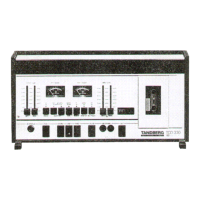
The Tandberg Huldra 8 is a sophisticated audio receiver designed for versatile sound reproduction and communication. It combines AM/FM radio, tape recorder, and turntable functionalities, offering both mono and stereo operation.
Function Description
The Huldra 8 is equipped with two transistorized main amplifiers (Class B, or more accurately, Class AB quasi-complementary push-pull amplifiers with a 30 mA quiescent current), each capable of delivering 10 Watts of output power. These amplifiers can operate in parallel for a single program or independently for two mono programs or one stereo program, with individual volume control for each channel.
The unit supports five program sources:
- AM Radio: Covers long wave (150-350 kHz), medium wave (510-1610 kHz), coastal wave (1.6-5.9 MHz), and short wave (5.9-23 MHz).
- FM Radio: Designed for frequency-modulated stations, offering high-quality reception within the line-of-sight of the transmitter. It is prepared for FM stereo multiplex reception, with dedicated space and connection points for an optional decoder, and a stereo indicator light.
- Tape Recorder: Supports both mono and stereo playback and recording.
- Turntable: Accommodates mono and stereo playback. It features a dedicated 2-channel pre-amplifier with four transistors, ensuring full utilization of the power amplifier with magnetic pickups. The pre-amp includes a selector with correction curves for magnetic, ceramic, or crystal pickups.
- "Listen and Talk" (Lytt og Tal) Function: This unique feature enables internal communication between rooms, using the left main and separate speakers as both microphones and loudspeakers.
Usage Features
- Power Control: The unit powers on by pressing any program source button (except "Fjern" and "Mono") and powers off by pressing the "AV" (Off) button.
- Tuning: A single tuning dial is used for both AM and FM, automatically switching to the selected waveband. Five movable markers on the FM scale help remember favorite station frequencies.
- Automatic FM Fine Tuning (AFK): This function automatically fine-tunes the frequency when a station is selected. It can be disabled, which is useful for tuning in weak stations near strong ones to prevent the stronger signal from dominating.
- Selectivity: The "Fjern" (Distant) button enhances selectivity for distant AM/FM stations, simultaneously reducing treble and disabling AFK for FM reception.
- Volume Control: Separate concentric knobs control the volume for the left and right channels.
- Tone Controls: A tone selector offers six positions:
- "Mørk" (Dark): Provides normal bass and reduced treble, useful for reducing noise.
- "Tale" (Speech): Reduces bass for clearer speech reproduction, particularly at high volumes with large speakers.
- "Normal": Reproduces the entire frequency range at even levels.
- "Normal + Bass": Activates physiological bass correction (loudness), boosting bass at lower volumes.
- "Variabel Bass og Diskant": Allows independent adjustment of bass and treble with continuous controls. When both are set to 0, a flat frequency curve is achieved.
- "Variabel Bass og Diskant + Bass": Combines independent bass/treble adjustment with physiological bass correction.
- Speaker Selector: Offers seven settings for speaker configuration:
- App. 1/Sep. 2: Left channel to main (App.) speakers, right channel to separate (Sep.) speakers.
- Sep. 1/App. 2: Left channel to separate speakers, right channel to main speakers.
- Sep.: Only separate speakers are active.
- Alle (All): Both main and separate speakers are active.
- App.: Only main speakers are active.
- Lytt (Listen): Left separate speaker acts as a microphone, left main speaker as a loudspeaker for intercom. Radio/tape/record playback continues on the right channel. Useful as a babysitter function.
- Tal (Talk): Left main speaker acts as a microphone for intercom. Other programs are automatically muted.
- Double Programs: Allows simultaneous listening to two different sources (e.g., radio on channel 1 and tape/turntable on channel 2). The outer volume knob controls the radio, and the inner knob controls the second program. The speaker selector determines which program plays in which room.
- Recording: The tape recorder is always ready to record from the radio, independent of volume, tone, and speaker settings. Recording from a turntable is also possible.
- Stereo Indicator: Lights up during stereo playback from tape, records, or FM (with an optional decoder).
Important Technical Specifications
- Vacuum Tubes: 5 (ECH81, EAF 801, EF 89, ECC 85, EM 87).
- Transistors: 20 (including SE 1002, U 3962/SE 4010, SE 4001, SE 6001, AC 127, AC 128/AC 152, AS 150/AD 149).
- Diodes: 6 (1N 542/AA 113, 1S 920, OA 81, BA 124).
- Rectifiers: 3 (B40 C 2200, BY 112, 2.8 ST. 1).
- Wave Bands:
- Long Wave: 150 - 350 kHz (2000 - 857 m)
- Medium Wave: 510 - 1610 kHz (590 - 186 m)
- Coastal Wave: 1.6 - 5.9 MHz (187 – 50.9 m)
- Short Wave: 5.9 - 23 MHz (50.9 - 13 m)
- FM Band: 87.5 – 108 MHz (3.43 – 2.78 m)
- Frequency Range (Amplifiers): 20-20000 Hz (-3dB at 30 and 17000 Hz).
- Output Power: 2 x 10 Watt.
- Optimal Speaker Load: 4 Ohms per channel (supports 2-8 Ohms with minimal impact on power).
- Power Supply: Selectable for 115, 130, 150, 220, 240 Volts AC, 50/60 Hz.
- Power Usage: 55 W (normal output), 85 W (full output).
- Connections: DIN and Phono connectors for tape recorder and turntable. Diode output for radio recording. Two sets of 2-pin DIN speaker connections per amplifier (main and separate), with some units also having banana sockets.
Maintenance Features
- Antenna Connections: Sockets for AM wire antenna and FM dipole antenna (240-300 ohm impedance). A 15-20m wire antenna is recommended for AM. For FM, an indoor folded dipole can be made from unshielded flat cable (135 cm loop), or an outdoor antenna for better reception. Earth connection to a cold water pipe is recommended.
- Speaker Cabling: Twisted speaker cables are recommended, especially for the left channel when using the intercom function, to prevent hum induction.
- Speaker Polarity: Correct polarity is crucial when speakers are close to each other to avoid bass attenuation due to out-of-phase cone movement.
- Voltage Selector: Located at the rear of the unit, it must be set to the correct mains voltage before connecting to power. Access requires removing the backplate.
- Pickup Selector: A switch at the rear (operated with a screwdriver or coin) allows selection of magnetic, ceramic, or crystal pickup types for optimal turntable performance.
- Printed Circuit Boards: The use of printed circuit boards ensures improved stability and reliability of the unit.

 Need help?

 To Next Page
 General