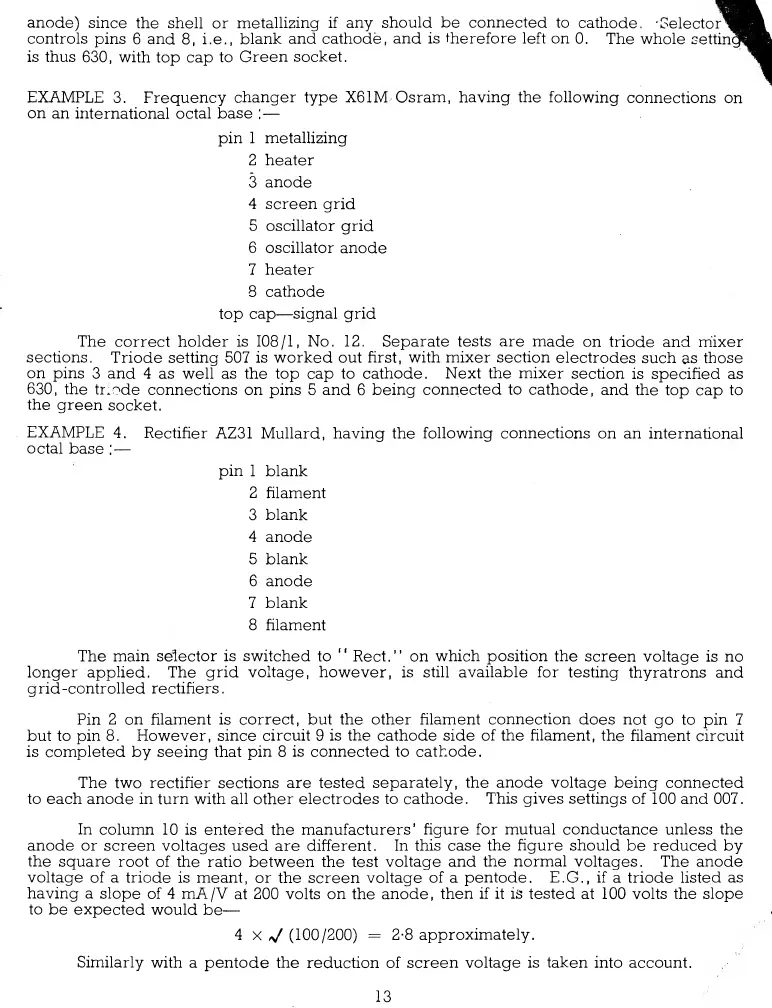
anode)
since
the shell or
metallizing if
any should
be connected
to
cathode.
'Selector
controls
pins
6 and
8,
i.e.,
blank
and cathode,
and is
therefore
left on
0.
The whole
setting
is thus
630,
with
top cap
to
Green
socket.
EXAMPLE
3. Frequency
changer
type X61M Osram,
having the
following
connections
on
on
an
international
octal
base
:
—
pin 1 metallizing
2 heater
3
anode
4 screen grid
5
oscillator
grid
6
oscillator
anode
7 heater
8
cathode
top
cap—signal grid
The
correct
holder is
108/1,
No. 12. Separate
tests are
made
on
triode and mixer
sections.
Triode setting 507 is worked out
first, with mixer section
electrodes
such
as
those
on pins
3
and
4 as well as the top cap to cathode.
Next
the mixer
section
is specified as
630,
the
triode
connections on pins
5
and
6
being
connected to cathode,
and
the top cap to
the
green
socket.
EXAMPLE
4.
Rectifier
AZ31 Mullard, having the
following connections
on an international
octal
base
:
—
pin
1 blank
2
filament
3
blank
4 anode
5
blank
6 anode
7 blank
8 filament
The
main
selector
is switched
to
“
Rect.” on
which position
the
screen voltage is no
longer applied. The
grid voltage, however,
is
still available for
testing
thyratrons and
grid -controlled rectifiers.
Pin
2 on filament is correct, but the other filament
connection
does not
go
to pin 7
but to
pin
8.
However, since circuit
9
is
the
cathode side
of the filament,
the
filament circuit
is completed by seeing that
pin
8
is connected to cathode.
The two rectifier sections are tested
separately, the
anode
voltage being connected
to each anode in turn with all other electrodes to cathode.
This gives settings
of 100
and 007.
In
column 10 is entered
the
manufacturers’
figure for
mutual
conductance unless the
anode or screen
voltages used are different.
In this case
the figure
should be reduced by
the square
root of
the ratio between the test
voltage and
the normal
voltages. The
anode
voltage of a triode
is meant, or
the screen
voltage of a
pentode. E.G., if
a triode
listed as
having a
slope of 4 mA/V
at
200
volts
on
the
anode,
then if it is tested
at 100 volts the
slope
to be
expected would
be
—
4
x
V
(100/200)
= 2-8
approximately.
Similarly
with a
pentode the reduction of screen
voltage is
taken
into account.
13



 To Next Page