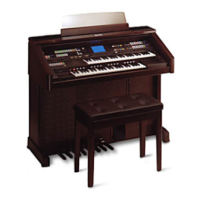
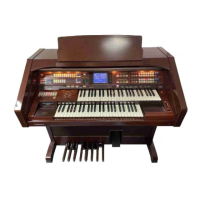
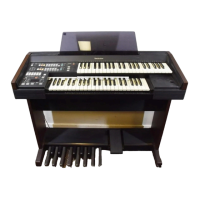
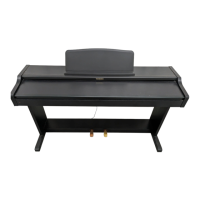
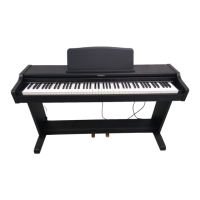
This is a Technics SX-G5/SX-G7/SX-F3 electronic musical instrument, likely an organ or keyboard, with various features for sound generation, effects, rhythm, and performance programming.
General Operation and Controls
The device features buttons and tablets, each equipped with LEDs that light up when active. Tablets turn off when pressed and light up when their function is active. Most levels and effects are controlled by 3- or 4-stage buttons, except for the rhythm tempo control. Harmonic control buttons increase or soften the sound's brilliance. Volume and effect buttons adjust levels; pressing the right button maximizes the level, the left button decreases it, and pressing both simultaneously returns to a normal or intermediate level. The power switch turns the organ on, and the main volume control adjusts the overall loudness.
Musical Display (G7-F3)
The LCD display shows musical content and selected functions. It has three primary modes: Tempo, Stopwatch, and Computation.
- Tempo Mode: Displays tempo and rhythm beat. A metronome icon swings when the rhythm starts. When the function button is pressed, accompaniment of lower and pedal keyboards, and bass notes (except for roots) are displayed. Chord names (C#, D#, Gb, G#, A# as Db, Eb, F#, Ab, Bb) are also shown. Pressing the function button again reverts to displaying only rhythm tempo and beat.
- Stopwatch Mode: Measures performance time up to 59 minutes and 59 seconds. The display shows " " and " " marks flashing when on standby. It starts when the rhythm section or a note is played and stops 2 seconds after play stops, resuming when play resumes. The display resets when the function button is pressed.
- Computation Mode: Calculates relationships between tempo, number of bars, and performance time. It can also perform arithmetical operations. White keys 0-9 and black keys on the lower keyboard are used for numerical input and calculations. This mode can display performance time for a given tempo and number of bars, and vice versa. It can also be used to determine the number of bars using arithmetical operations. Up to 3 digits can be displayed without decimal fractions. Numbers greater than 999 result in an error display.
Secondary Display Modes
When storing harmonic coupler, organ presets, Transpose, Tuning, and Program Chord Computer settings, the stored contents are displayed.
Record Function
The "Record" button is used to store functions like Organ Presets, Voice Setting Computer, and Program Chord Computer. When pressed, its light turns on, and lights of all programmable features flash quickly. Selecting a feature makes its light flash slowly, while others turn off. If no selection is made within five seconds, all lights turn off. Stored contents remain in memory for about a week even after the power is turned off.
Upper Keyboard Split Functions
When recording certain functions, the lower manual keyboard is used for program information entry. Lower manual voices can be monitored using the lower half keys of the upper keyboard (G5/G7: 19 keys, F3: 31 keys). The upper keyboard can be used to check lower and upper keyboard tones and effects, while the lower keyboard is used for storage operations.
Initial Key
This key sets tones and effects to the factory preset state. To use it, press the Fullband Setting Computer button, then the initial key on the lower keyboard. If pressed during storage, only the function involved returns to its factory preset state or is cleared.
Orchestral Conductor
This is the central control for setting up voice groups or instrumental effects. Each button acts as an on-off switch for a voice group, with an indicator light.
- Tab voices: Sets up complete voice tab combinations for upper or lower keyboards. Must be pressed to use flute or string voices.
- String ensemble: Adds rich, shimmering string sounds.
- Orchestral presets: Adds sounds like wah brass, clarinet, and trombone.
- Percussive presets: Adds sounds of plucked or struck instruments like piano, harpsichord, and vibraphone, utilizing PCM technology for realistic sounds.
- Solo synthe presets: Adds contemporary effects to instrumental sounds.
- Vocal ensemble: Adds choral effects.
- Organ presets: Stores favorite organ sounds.
All these buttons are self-cancelling; pressing one deactivates another. Sounds can be combined by pressing multiple buttons simultaneously. Tab voices and organ presets cannot be used together. Percussive, orchestral, solo synthe, and vocal ensemble voices can be used independently on each keyboard but not on both simultaneously. Presets are designed to reproduce true instrumental effects, including treble and bass sounds outside the real instrument's range. Bass range tones start slowly, so treble range is recommended for fast playing.
Upper Tab Voices
These voices are based on pipe organ footage marks (e.g., Flute 16', 8', 5-1/3', 4', 2-2/3', 2', 1-3/5', 1-1/3', 1', String 8', 4'). Larger numbers indicate lower tones. Flutes provide clear, mellow sounds for voice combinations. Strings add sparkle and brilliance, forming the basis for many theater organ sounds. String 8' can create an entire string section when playing three- or four-note chords on the upper keyboard or using Techni-Chord. Volume buttons adjust the volume. Flute volume levels are preadjustable and can be adjusted in 7 steps using the record button, upper tab voices button, and the flute tabs. On G7 and F3, volume levels appear on the Musical Display. The initial key returns to factory preset mode.
Lower Tab Voices
These voices are for the lower keyboard, mainly for accompaniment. Flute 8', 4', 2-2/3', 2', 1-1/3', 1' are common for accompaniment, especially brighter solo voices. String 8', 4' add brilliance. Volume buttons adjust the volume.
Pedal Voices
These buttons use the PCM system for realistic bass sounds.
- Bass 8': Useful for rhythmic music and defining pedal notes with Bass 16'. Can be used alone for light bass tones.
- Bass 16': A deep, flute-like organ voice for a solid foundation, effective for sacred and classical music.
- Ensemble bass: Suitable for orchestral accompaniment (G7-F3).
- Acoustic bass: Realistic acoustic bass sound.
- Chopper bass: Exciting electric bass voice (G7-F3).
- Electric bass: Suited for contemporary music.
- Pipe bass I: Full voice pipe organ sound (G7-F3).
- Pipe bass II: One of the 16' principal voices (G7-F3).
- Tuba: Broad, full voice with a more defined sound than bass 16'.
- Synthe bass: Good accompaniment for contemporary electric orchestral and synthesized sounds.
Volume adjusts pedal tone loudness relative to keyboard voices. Harmonic control buttons adjust tone brilliance.
Upper Percussive Tone
Adds a fast initial attack tone to upper voice tab sounds or can be used alone. Creates an effect like striking a piano key or plucking a banjo string, useful for jazz or rock organ sounds. Tabs with footage numbers create tones of specific pitch levels. "Click" provides a "pop" effect on each upper keyboard key press. "Long" causes percussive tones to decay slowly. Volume buttons adjust the volume.
Harmonic Coupler
Adds "phantom voices" not built into voice tab groups. For example, with Flute 8' on the upper keyboard, pressing "upper harmonic coupler 2-2/3'" adds a high G note to a C note. Can be combined with upper or lower tab voices and Upper Percussive Tone, effective for up to four notes simultaneously. Deactivated when mixed with other voice groups (organ presets take priority). Custom harmonic couplers can be stored using the "program" button. The lower part of the upper keyboard monitors the lower harmonic coupler, and the upper part monitors the upper harmonic coupler effect. The "cancel" button returns to ordinary playing.
Percussive Presets
Utilize PCM technology for realistic instrument sounds.
- Acoustic piano: Authentic voice.
- Electric piano: Commonly used, good for jazz and pops.
- Harpsichord: Quaint, dry sound for classical or popular favorites.
- Clavi: Suited for "funky" music.
- Vibraphone: Rich, mellow sound.
- Glocken: Reproduces glockenspiel sound (G7-F3).
- Acoustic guitar: Soft, delicate voice.
- Jazz guitar: Good for solo or combined sounds.
- Steel drum: Indispensable for calypso (G7-F3).
- Banjo: Used for country and western music.
Harmonic control buttons adjust tone brilliance. Volume buttons adjust the volume. The "Banjo" preset may be silent on the C key of the lower keyboard, with silent keys increasing with higher transpositions (SX-F3 only).
Orchestral Presets
Used as solo instruments or in combination with other sounds.
- Trombone: Full-bodied, useful as a solo instrument.
- Trumpet: Dominates voice combinations with brilliant, sparkling tone (G7-F3).
- Saxophone: Tenor sax sound on lower half of upper keyboard.
- French horn: Broad, soft, rich sound (G7-F3).
- Clarinet: Suited for soft, mellow solo.
- Accordion: Blends well with other voices.
- Wah brass: Ranges from "wha-wha trumpet" to modern sounds.
- Synthe brass: Brass voice with phaser effect.
Harmonic control buttons adjust tone brilliance. Volume buttons adjust the volume.
Solo Synthesizer Presets
These are PCM-produced synthesizer effects.
- Violin: Full, rich sound on lower upper keyboard, brilliant on upper (G7-F3).
- Harmonica: Bright, delicate solo voice.
- Trombone: Smooth, round tone, blends well with strings or flutes.
- Trumpet: Dominates voice combinations.
- Saxophone: Real tenor sax tonal characteristics.
- Clarinet: Suited for soft, mellow solo.
- Flute: Pure, free voice.
- Oboe: Thin yet soft tone (G7-F3).
- Pan flute: Realistic, with breathy attack and mellow tone.
- Whistle: Novelty voice, often used in synthesizer performances (G7-F3).
- Rock guitar: Powerful voice for rock and fusion music (G7-F3).
- Cosmic: Recreates electric guitar sound with fuzz-tone effect.
- Synthe chopper: Percussive voice with "key pop" effect, ideal for jazz or rock organ sound.
- Key bender: Effect that lowers the pitch of a pressed key by a halftone when playing legato (G7-F3).
Harmonic control buttons adjust tone brilliance. Volume buttons adjust volume levels. All these sounds are monophonic, meaning only one key sounds at a time, allowing them to remain solo sounds even when combined with others.
String Ensemble
Creates shimmering string sounds as a solo voice or a full section. Cello or violin sounds can be selected, or both simultaneously (G7-F3). Upper volume adjusts loudness on the upper keyboard, lower volume on the lower keyboard.
Vocal Ensemble
Creates choral effects on upper or lower keyboards. "Ah" tone with ah/humming button off, humming when on (G7-F3). Volume can be adjusted.
Organ Presets
Stores favorite organ tones for anytime use. Tones and effects are storable. Four types (I-IV) for the upper keyboard and one type for the lower keyboard can be stored. To store, set the desired tone, press the record button, then the organ presets I-IV button (or lower organ preset button for lower keyboard). To change combinations, repeat the process.
Factory Preset Organ Sound: Choose from 20 factory preset organ tones on the lower keyboard and store them in I-IV buttons. To use, press record, then I, II, III, or IV. Select sounds using keys 1-20 on the lower keyboard. Playing the upper keyboard allows checking sounds and effects due to split function. Selected sounds can be amended. Pressing the preset button again completes storage. Preset organ tone groups include Pop (1-5), Jazz and Rock (6-10), Classical (11-15), and Special (16-20) organs. These include unique sounds and effects.
Digital Drawbars
Adjust flute levels individually. To adjust, press record, then I, II, III, or IV organ presets (or lower organ preset button). Set desired tone, including strings 8' and 4', percussive tone, and slow attack. For flutes, adjust footage levels using their tabs. Volume levels can be adjusted in 7 steps. On G7 and F3, volume levels appear on the Musical Display. Pressing the initial key turns off all tablets and buttons. The footage is displayed by 5 bars.
Full Bass Pedal
Automatically selects the lowest tone played on the lower keyboard. Bass notes sound only when the full bass pedal is pressed. Tones, volume levels, and effects are the same as those from the pedal keyboard button. All lower keyboard tones are regulated in 16' steps, so Bass 8' and Bass 16' produce the same pitch.
Bass solo: If the full bass pedal is pressed with the bass solo button, lower keyboard tones die out, and only the bass solo is heard.
Walking Bass: Create a walking bass using Jazz Wood bass by playing the lower keyboard with the full bass pedal down. The full bass pedal can also turn other functions on and off.
Techni-Chord
Transfers chord tones played on the lower keyboard to melody notes played on the upper keyboard, creating a professional organist sound. Set up the organ using one-finger mode or form your own chords. The "close/open" button plays harmony style in open position (brass ensemble, choral). Techni-Chord works for any sound except Solo Synthe. Cannot be played using the lower part of the upper keyboard (an octave for G7, two octaves for F3).
Effects
Multi-tremolo/Vibrato
- Tremolo: Rapid change in volume (loudness).
- Vibrato: Rapid change of pitch (high and low tones), adds a warm, wavering quality. Heard in singers' voices and wind/string instruments.
- U tab voices: Brings upper tab voices into tremolo or vibrato effect.
- L tab voices: Brings lower keyboard voices into tremolo or vibrato effect.
- Slow/fast: Off position gives slow tremolo (religious/classical music). On position gives faster effect (other music).
- Vibrato priority: Vibrato takes priority over multi-tremolo. Pressing vibrato during tremolo turns on vibrato and cancels tremolo. Pressing vibrato again turns it off.
Multi-tremolo Speed Adjustment: Adjust speed in fast multi-tremolo position. Fast and slow speeds are adjustable. To adjust, press record, then upper tab voices button (for fast speed) or lower tab voices button (for slow speed) of multi-tremolo. Tap lower part of slow/fast button to increase frequency, upper part to decrease. Frequency is indicated on musical display. Multi-tremolo automatically turns on for both keyboards during adjustment. Press record again to turn off. Vibrato and slow multi-tremolo speeds are unaffected. Adjustment range: Fast speed 8.4-30.5 Hz, Slow speed 4.9-8.1 Hz. Initial key returns to factory preset speed (20.3 Hz, 6.4 Hz).
Effect Conductor (G7-F3)
Chorus, celeste, and phaser effects are available in 5 tone groups. Chorus and celeste provide beautiful, extended sound. Phaser provides a slow, gradual tone change. These effects do not apply to percussive tones. Buttons allow applying chorus, celeste, or phaser effects to specific tone groups (U tab voices, U&L percussive presets, U&L orchestral presets, U&L solo synthe presets, L tab voices).
Sustain Controls
Sustain allows notes to fade gradually. Pedal sustain is always active, its length adjustable by the sustain control. Can be combined with upper tab voices, lower tab voices, or percussive presets by pressing respective buttons. Does not work with orchestral presets or organ presets.
Knee Lever
With sustain button ON, the knee lever (under keyboards) can quickly turn sustain ON/OFF during performance. Pushing left turns off sustain, raising turns it on. Operates sustain for tab voices, percussive presets, and any group other than percussive presets and solo synthe presets of the orchestral conductor. Can also turn other functions on/off.
Reverb (G5)/Digital Reverb (G7-F3)
Reverb (reverberation) electronically replaces natural echo lost in furnished rooms. Effective with most general settings.
Slow Attack
When off, upper tab voices respond instantly. When on, a slight hesitation occurs between key press and tone, useful for imitating instruments with natural slow attack (accordion, harmonica, pipe organ).
Expression Pedal
Regulates loudness of all organ voices. Pushing down with toe makes organ louder, with heel makes it softer. Halfway down is medium volume.
Glide Control
Switch on left side of expression pedal. Pressed left with foot, lowers pitch/tuning by about one half-step, creating a Hawaiian guitar effect.
Left foot switch:
- When button is off, provides glide effect.
- When button is on, starts and stops automatic rhythm.
Right foot switch: Turns Fill in & Intro I on/off.
Foot switches can also turn other functions on/off.
Voice Setting Computer
Programs voices and effects. Note: Slide control settings cannot be recorded. "Cancel" button shuts off VSC and changes to standard organ sounds. Buttons I-VII store voices and effects for both keyboards and pedals. To store, set registration, hold record, and press I. To change, set new tabs, press record, and desired button. Memory contents remain unchanged when changing selected voice/effect by pressing another button.
Factory-Preset VSC
Allows choosing from 20 factory-preset voice combinations and storing them in I-VII buttons. To use, press record, then I. Select voice from keys 1-20 on lower keyboard. Playing upper/pedal keyboards checks voices/effects. Pressing I again turns off record and stores voice. If II is pressed instead of I, voice is stored in I, and storage continues for II. Preset voices include theater organ, church organ, pop organ, rock organ, jazz organ, classical strings, symphonic ensemble, soft brass, big band brass, marching brass, synthe brass, fusion guitar, new wave, funk rock, jazz guitar combo, mix combo, modern baroque. These include unique tones and effects.
Transpose
Changes the key of a song to a comfortable vocal range. To use, press record, then transpose. Press a key in the lower keyboard section marked " " to automatically transpose. Play on the upper keyboard to find a comfortable key. Display indicates correct key signature only if initial key is "C". Press transpose again to "lock in" the new key signature (light stays on). Pressing transpose again returns to original key. Useful for playing with instruments "built in different keys". Pedal keyboard notes are lowered one octave when 8' notes are transposed higher than a major 3rd, and become one octave higher when 16' notes are transposed to lower than C. When transposing lower keys, the lowest keys equal to the number of transposed keys may not emit sound for G5/G7/F3 solo synthesizer presets, F3 upper voices, and G5/G7/F3 lower percussive presets/whistle/bass (full bass pedal).
Tuning
Adjusts pitch for ensemble playing. With "free set" button off, pitch is standard 440 Hz. To adjust, press "free set" on, then "+" to increase pitch or "-" to decrease. Adjust to match other instruments. LED on "+" or "-" illuminates if pitch is higher or lower than 440 Hz. Pitch is stored when "free set" is turned on. Adjustable range: 438 Hz to 446 Hz. LED flashes at limits. Musical display shows pitch and indicates decimal numbers with bars.
Drum Percussion (Automatic Rhythm)
Uses PCM system for realistic drum sounds. Includes rhythm selector buttons, start/stop, downbeat light, volume, and speed controls. Rhythm buttons are self-cancelling. Pressing two adjacent buttons selects the rhythm between them. Start/stop instantly starts/stops rhythm on the first beat. LED flashes on first beat. "Synchro" starts rhythm only when a pedal or lower keyboard key is pressed. Volume adjusts drum loudness. "Drum percussion on" button turns on drum percussion. "Mellow" button softens drum sounds. Sliding tempo control adjusts tempo.
Tempo Set
Stores two favorite tempos for quick recall. To store, press tempo set buttons I and II simultaneously (to turn off), adjust tempo with sliding control, then press record and tempo set button I. Can store another tempo in button II. "Fine" button allows more precise adjustments. Pressing I and II simultaneously switches to manual mode.
Arrange Percussion
Changes patterns and adds percussion instrument sounds to 23 rhythms. I is simplest. II adds enriched bass (e.g., conga). III (I and II simultaneously) adds enriched treble (e.g., tambourine). Try for individual rhythms. Automatic rhythms change patterns based on performance conditions (number of keys pressed).
Fill In & Intro
Uses a one-measure drum solo ("fill") as an introduction or to connect song sections.
- Intro: Press bossa nova 1, then fill in & intro (indicator lights up). Start rhythm; intro plays, then bossa nova. Indicator light goes out after intro.
- Fill-in: Press bossa nova 1, start rhythm. Press fill in & intro; fill-in plays for one measure, then bossa nova resumes.
Two patterns (I and II) are available.
Solo: Pressing fill in & intro I and II simultaneously produces solo effects. Solo slightly affects automatic rhythm when constant keyboard movement, but brilliant drum solo when notes are held or keyboard is not played. Returns to normal after one measure. If rhythm starts after I and II are pressed simultaneously, an 8-measure solo introduction plays before normal rhythm.
Rhythmic Orchestra
Works with automatic rhythms. Provides chordal accompaniment synchronized with rhythm. Rhythmic and melodic buttons allow chordal and melodic accompaniment. I/II button changes accompaniment pattern. Lower harmonic coupler (2', program) enhances sound from rhythmic button.
Auto Play Chord
Musical aid for creating orchestral and full organ sounds with one finger. Helps learn organ playing.
- Fingered button: Automatically selects One Finger mode (one key on lower keyboard) or Fingered mode (3+ keys).
- One Finger mode: Plays full chord and bass tone by pressing single key. Major chords (C, Eb) by letter key. Seventh chords (G7, Bb7) by long, light-colored bass pedal. Minor chords (Am, F#m) by short, black bass pedal. Minor seventh chords (Dm7, Gm7) by lower manual key with appropriate letter name and long/short bass pedal.
- Fingered mode: Forms own chords on lower keyboard; correct bass tone automatically provided. Pressing any bass pedal produces relevant key sound, allowing bass playing regardless of APC system.
- Memory: Sustains chord and bass tone even after releasing lower manual key(s). Continues until another chord or rhythm stops.
- Walking Bass: Automatically recreates professional bass parts with pedal voice and automatic rhythms.
- Cancel: Shuts off Auto Play Chord, allowing normal playing.
To use, set lower keyboard and pedal voices, then play chord example. Use One Finger mode for chord key, Fingered mode for chords with left hand. Use Memory to find correct notes.
Program Chord Computer
Programs and stores chord accompaniment for entire songs.
- PCC button: Prepares computer for chord storage (after Record).
- Eight keys: Store chords.
- Stores a chord for an entire measure (one chord per measure).
- Stores a chord for a half measure (two chords per measure).
- Stores a chord for a quarter measure (two keys at a time).
- Amend keys ( ) correct individual chords or change existing chords.
- Start programming: Can be pressed to restart programming.
- End: Pressed when entire chord sequence is stored.
- Complete storage: Two keys at one time completes storage for automatic repetition.
- Pause: Inputs a pause during recording, reproduced during playback.
- D.S. key: Stores chords according to music.
It's possible to store Major, Minor, Seventh, Minor Seventh, Augmented, Diminished, Minor Seventh Flat Fifth, Major Seventh, and Suspended Fourth chords. Some chord types are not available in one-finger mode but can be mixed with Fingered mode.
Storing Chords: Press Record, then PCC. Hold chord on lower keyboard (one-finger or fingered), press " " key. Hear a "beep" when stored. For C# diminished, form it yourself. For Dm7, press one-finger D and add short/long bass pedal. Continue for remaining chords. Press "End" to close memory and turn off record switch.
Other facts: "No chord" (N.C.) stored by pressing " " or " " without playing a chord. Programmed chord sequence stops after one play. For repeat play, press " " key (D.S. and " " simultaneously). Specify repetitions (1-8) by holding D.S. and pressing keys 1-8 on lower keyboard, then " " key. Sequence stops at first beat of next chord if " " key pressed during storage. Start/stop resumes sequence.
Playing Programmed Chords: Start automatic rhythm. Stored chords repeat in sequence. To replay a part, press start/stop; program returns to beginning.
Modifying/Correcting Programmed Chords
- Using Automatic Rhythm: Press Record, PCC. Start rhythm. Stop rhythm at A7 chord. Play/hold new chord (Eb7), press " " key. New chord is in position. Press PCC again.
- Using Forward/Back Keys: Press " " key once for each chord from start of program (A7 is seventh, press 7 times). Stop when desired chord is heard.
- Using & D.S. keys: After pressing symbol keys, chord is stored.
Other facts: " " and " " keys operate only when rhythm is stopped and record/PCC are pressed. Each press advances/moves sequence one unit. Wrong chord: press " " once, enter correct chord.
Limitations: Cannot store music where " " and "to" are same, 2 repeats overlap, or " " and D.C./D.S. are same.
Voice, Fill in & Intro Storage
Stores chords, VSC voices, Fill in & Intro, and arrange percussion.
- Voice storage: Before chord, press VSC button. Stores selected voice at beginning of next measure. Voice continues until next voice selected.
- Fill in & Intro storage: At beginning of song, stores intro. After chord, stores fill-in for one measure.
- Arrange Percussion storage: Before chord, press arrange percussion button. Stores selected arrange percussion at beginning of next measure.
When chord sequence is over, playing continues with last voice. Stops after six seconds, first voice returns. Voice changes half beat ahead of rhythm.
Up to 8 selections of voice, Fill In & Intro, arrange percussion can be stored. Can also store after chord sequence.
Procedure: Store only chords first. Then press record, PCC. Press fill in & intro II, arrange percussion II, VSC I. Advance chord to G7 (4 times with forward key). Press fill in & intro I, arrange percussion I, VSC II. Press PCC.
Program Rhythm Computer
Creates and stores custom drum rhythms.
- Composer I, II, III: Store rhythms (in memory). Indicator light shows active button. Plays back stored rhythms.
- Rhythm Instruments: 14 voices for rhythm patterns: Closed hi-hat, Open hi-hat, Cymbals, Snare drum, Tom-tom, Rim shot, Bass drum, Hand clap, Shaker, Tambourine, Agogo bell, Cowbell, Conga, Bongo.
- Lower keyboard keys: Used for programming rhythms.
- Clear: Cancels all voices assigned to a track. To cancel individual voice, press voice button, then Clear.
- Beat: Programs non-four-beat rhythms.
- 2nd bar: Stores two-measure rhythms (bossa nova, rock, disco). Rhythm alternates with first measure.
- Triplet: Black key stores four-beat triplet rhythms (rock ballad 12/8).
- Accent/pitch: Accents voice or changes pitch.
- I, II, III: Frequently-used rhythms for storage/replay (salsa rock, Latin-disco).
Programming with Presets: Chart shows patterns for three preset keys.
Modifying Preset Combinations: Change any voice in any rhythm pattern. Press record, then " ", then Preset III (e.g., hi hat pattern to eighth notes). Press record, composer, rhythm start/stop to hear changes. Cymbal sounds: " " and " " keys simultaneously. Rim shot sounds: " " and " " keys simultaneously. Same timing cannot be set for Open Hi-hat, Closed Hi-hat, Cymbals, Snare drum, Tom-tom, Rim shot. For Latin percussions, only one upper/lower button can be used. Factory preset state stores metronome sound in composer I, II, III.
Lower Keyboard: Keys 0-15 store percussion voices relative to beats. Keys 0-11 for three-beat rhythms, all 16 for four-beat. Each key 0-15 corresponds to one-sixteenth note.
Programming Rhythms:
- Rock rhythm: Press record, composer I, II, or III. Clear. Closed hi-hat, Preset III. Rhythm start/stop. Snare drum, Preset I. Bass drum, lower keys 0, 2, 5, 8. Record.
- Jazz Waltz: Three-beat, two-measure pattern. Keys 0-11 used. Press record, composer I, II, or III. Clear. Triplet, Beat. Open hi-hat. Lower manual keys 0, 8. Closed hi-hat, lower keys 4, 7. Bass drum, lower manual key 0. Snare drum, lower manual keys 3, 8. Hold white 2nd Bar key, enter snare drum on lower manual key 4. Record.
Storing Rhythms Other Than Four-Beat Rhythms:
- Three-beat: Record. Composer I, II, or III. Clear. Beat. Store pattern for each instrument. Record.
- Two-beat: Instead of step 4, hold beat key and press 2 on lower keyboard. Store 2-beat patterns.
- Five-beat: Record. Composer I, II, or III. Clear. Hold beat and 2nd bar keys, press 2 on lower keyboard. Store two-measure pattern. Record.
- Seven-beat: Store two-measure pattern of four- and three-beat rhythms.
Accent/Pitch Key
Accents rhythm pattern or changes pitch. Accents hi-hat, cymbals, snare drum, rim shot, bass drum, shaker, tambourine. Lowers pitch for these. Accents tom-tom, agogo bell, conga, cowbell, bongo. Not available for hand claps. To use, press record, composer I, II, or III. Press instrument button. Hold accent/pitch key, press white key for timing. Repeat for all instruments. Record. Rhythmic Orchestra patterns, rhythmic and melodic, can be stored similarly. Bass voice sounds in rhythm patterns of bass drum.
Rhythm Sequencer
Stores rhythms for playback in sequence. Applies to Composer memory, drum percussion selector (23 patterns), Arrange Percussion, Fill In & Intro.
- Rhythm Sequencer button: Pressed before entering rhythms, again to play back.
- Lower manual keys 1-20: Each key number represents measures for sequencing.
Sequencing example (16 measures): Bossa Nova I (4 measures), Mambo + Arrange Perc II (4 measures), Swing (4 measures), Bossa Nova + Fill-In (4 measures).
To use, press record, rhythm sequencer. Press Bossa Nova I, then lower key 4. Mambo and Arrange Percussion II, then lower key 4. Swing, then lower key 4. Bossa Nova I, then key 4. Fill in button twice for final section (if Fill In pressed once, half measure in 4/4 or third in 3/4). Press " " key to close memory.
Repeat sequence: Press D.S. and " " simultaneously.
Specify repetitions: Hold D.S., press keys 1-8 (on lower keyboard), then " " key.
Play sequence: Press rhythm start/stop.
Other rhythms: Press Rhythm Sequence button.
Storage: 48-measure designations. " ", " ", " " keys store 3/4, 1/2, 1/4 measures. " " and D.S. keys store music segments for repetition. Tempo set button settings, rhythmic orchestra, volume can be stored. Tempo control and fine button functions cannot.
Stop at point: Pressing " " key during storage stops music at that point during playback. Start/stop resumes.
Interchanging measures: If " " key pressed while recording two-measure pattern, preceding and succeeding measures interchange.
Program Function Switches
Stores functions (knee lever, left/right foot switches, full bass pedal) to change tone/effect with foot/knee.
- Knee lever: Sustain ON/OFF. Storable: VSC (I-VII), Multi-tremolo Slow/fast, Techni-Chord Fill in & intro (I, II, solo).
- Left foot switch (with glide/rhythm button on): Start/stop for drum percussion. Storable: VSC (I-VII), Multi-tremolo Slow/fast, Techni-Chord Drum percussion start/stop Fill in & intro (I, II, solo).
- Right foot switch: Fill in & Intro I. Storable: VSC (I-VII), Multi-tremolo Slow/fast, Techni-Chord Drum percussion start/stop Fill in & intro (I, II, solo).
- Full bass pedal (with bass solo button on): Bass solo. Storable: PCC, Fingered, Memory, Play Sequencer (solo, upper, lower, bass).
For Storage: Press record. Press function switch (e.g., knee lever right). Hear beep, LEDs flash. Press button for function to store (e.g., VSC I). Record button turns off, storage complete. Tones/effects change only when knee lever/full bass pedal remain on. Foot switches change with every press. To return to original function, press initial key on lower keyboard.
Play Sequencer
Stores all parts (bass, lower, upper, solo) at once, or separately and synchronized. Example: Record bass line, add chords with lower keyboard, add melody with upper keyboard. Solo synthesizer presets can be used. Combined recording or elements can be retrieved.
Solo button: Stores a different melody from upper button using solo synthesizer presets. Automatic performance with lower, upper, solo buttons produces three keyboards played at once.
Bass notes: Stored using full bass pedal and lower keyboard. May not be heard or pitch changed if transposed. For accurate transposition, use only pedal keyboard.
For Storage:
- Memory Pack Preparation and Registration: Set mode selector to PS, turn off memory protector, insert memory pack. Set tones/effects. Turn on Fill in & Intro if intro needed. Store VSC, Organ Presets, PRC.
- Storage of Ordinary Performances: Press record. Press Play Sequencer buttons for parts to store (bass, lower, upper). Buttons flash slowly. Turn off solo button. Play song. After playing, press record (or Play Sequencer button) to turn off.
Memory Pack Capacity: SY-P2: Upper/Lower 200 tones (*400), Solo Synthe 150 tones (*300), Bass 150 tones, Control **35 steps. SY-P3: Upper/Lower 500 tones (*1000), Solo Synthe 350 tones (*700), Bass 350 tones, Control **60 steps. (*Doubled if used alone).
Ensemble-like Playing During Manual Performance: During automatic performance, play upper/lower keyboards for ensemble effect (max 8 tones, 4 with harmonic coupler). Top priority to manually played tones. Bass and Solo are monotone, no simultaneous automatic/manual performance. Manual performance possible for solo part only when solo synthe preset button is selected.
Memory Pack Precautions: Do not drop/hit, touch connector, disassemble, subject to extreme temperatures/humidity. If battery runs out, stored contents cleared. Store in protective case.
Fullband Setting Computer
Sets tones, effects, rhythm combinations. Stores information for playing songs (PCC, PRC) in digital memory pack. Retrieved when needed.
- Play Sequencer employed: Memory pack stores one song.
- Without Play Sequencer: SY-P2 stores up to 4 songs, SY-P3 stores up to 8 songs.
For Storage in Memory Pack:
- Set switches on memory pack (rear).
- Insert memory pack.
- Store tone/effect combinations in VSC. Perform storage for organ presets/harmonic coupler.
- Store PCC functions.
- Set tones, effects, rhythms at song beginning. Press Fill in & Intro if intro desired.
- Press record, then Fullband Setting Computer.
- Press key 1, 2, 3, or 4 on lower keyboard (1-8 for SY-P3) within 5 seconds. Stores contents in track. For Play Sequencer, press key 1.
Connection Terminals
- Phones: For silent practice with headphones (16 ohm impedance). Organ speaker system automatically switches off.
- Mic: Input level 7.5 mV 10kΩ. Uni-directional microphone reduces feedback.
- Mic Volume: Balances mic input with organ sounds.
- Aux: Input level 150 mV, 10kΩ. Connects tape/disc pre-amps, portable synthesizers.
- Line Out: Output level 300 mV, 600Ω. For high-power amplifier, tape recording. 2-channel (LR) or 3-channel (1, 2, 3) output.
- Ext. I/O (FD): Connects optional digital disk recorder for longer performances/groupings.
- Light (off-on) (F3): Turns panel/foot light on/off.
Symptoms of Trouble
- Flute tablets not sounding: Flute volume levels may be set to 0. Adjust to desired levels.
- Error buzzer on lower keyboard: Mode button may be set to computation mode. Set to metronome or stopwatch mode.
- Different voices on upper keyboard: Lower portion of upper manual keyboard used for lower manual voices in programming.
- No rhythm/rhythm not starting: Drum percussion button may be off. PCC button may have no stored chords (press cancel). Composer button may have no stored rhythm patterns (select other rhythm buttons).
- Rhythm tempo control inoperative: Tempo set button may be on. Fine button may be off. If fine button is on, fine adjustment is possible. Press tempo set I and II simultaneously to turn off.
- Knee lever, foot switches, fullbass pedal not operating: Functional on/off operations can be stored in these switches. Store favorite functions.
- Fast multi-tremolo speed improper: Preadjustable. Adjust to favorite speed.
- Contents not stored (Transpose, PCC, FSC): Record button not pressed within 5 seconds, or record button turns off after 5 seconds. Press record again.
- Wrong voices stored in VSC: When storing created tones/effects, press I-VII buttons of VSC while record button held down. When selecting factory-preset voices, press record button, then I-VII buttons of VSC, then key 1-20 on lower keyboard, then I-VII button again.
- Storage not possible with PCC: PCC button may be slowly flashing. Fingered Mode button turns off record button. Do not release left hand (chord designation) before pressing measure keys.
- Quick rhythm tempo delayed with Play Sequencer: Too many tones played. Slow down tempo or reduce tones.
- Different tones/effects stored in FSC: VSC function selected, stored contents in FSC. Change tones/effects in VSC, store again in FSC.
- Cabinet/slide cover heated: Normal, due to internal power source.
- Buttons, tablets, keyboards malfunction: Press FSC button, then initial key on lower keyboard. If not normal, turn power switch off, then on again.
Cautions for Safest Use
- Installation: Well-ventilated place, away from direct sunlight, excessive heat, humidity, vibration, dust.
- Power Source: Ensure voltage selector matches local voltage. No DC power.
- Power Cord: Never touch with wet hands, don't pull. Do not use damaged cords. Do not forcibly bend or lengthen without professional electrician.
- Metal Items Inside: Do not allow metal articles inside. Keep children away. If metal gets inside, disconnect power cord and contact store.
- Water Inside: Disconnect power cord and contact store. Do not place liquid containers on unit.
- Abnormal Operation: Turn off power, disconnect power cord, contact store. Discontinue use to prevent damage.
- Inside Parts: Do not touch high voltage parts. Do not remove panels or replace fuses yourself. Contact qualified person.
Maintenance
- Switch off after use, avoid quick on/off.
- Clean keys/tabs with clean, damp cloth, then soft, dry cloth. Polish can be used, but not thinners/petro-chemical polishes.
- Wax-based polish can be used on cabinet. Store memory pack in protective case.

 Need help?
 General

 To Next Page