2. UNITS OF MEASUREMENT OF VACUUM & THEIR EQUIVALENTS..
For our purposes, vacuum is negative pressure, or pressure which is below atmospheric pressure at
sea level which is equal to the pressure exerted by a column of mercury (Symbol: Hg) with a height of
about 76 cm. Atmospheric (or “barometric”) pressure can be expressed in various different units :-
1 atmosphere = 76 cm Hg= 1,013 bar = 1013 mb (millibar)= 101,3 kPa (kiloPascals)= 14.7 psi (Ib/in²).
1 psi = 5,17 cm Hg = 68,95 mb = 6,895 kPa. 1 cm Hg = 1,333 kPa = 13,33 mb = 0,193 psi
Examples : 10 cm Hg = 133 mb. 20 cm Hg = 3,86 psi. 200 mb = 15,0 cm Hg. 5 psi = 25,85 cm Hg.
Most service manuals today give the vacuum settings in cm Hg so this is the unit used on the
VacuumMate’s synchronising scale displays. So when the displayed vacuum value is 20 cm Hg, this
means the intake pressure = atmospheric pressure at the place you are working, less 20 cm Hg
.
3. AVERAGE (“AVE”) & DYNAMIC (“DYN”) VACUUM MEASUREMENT MODES.
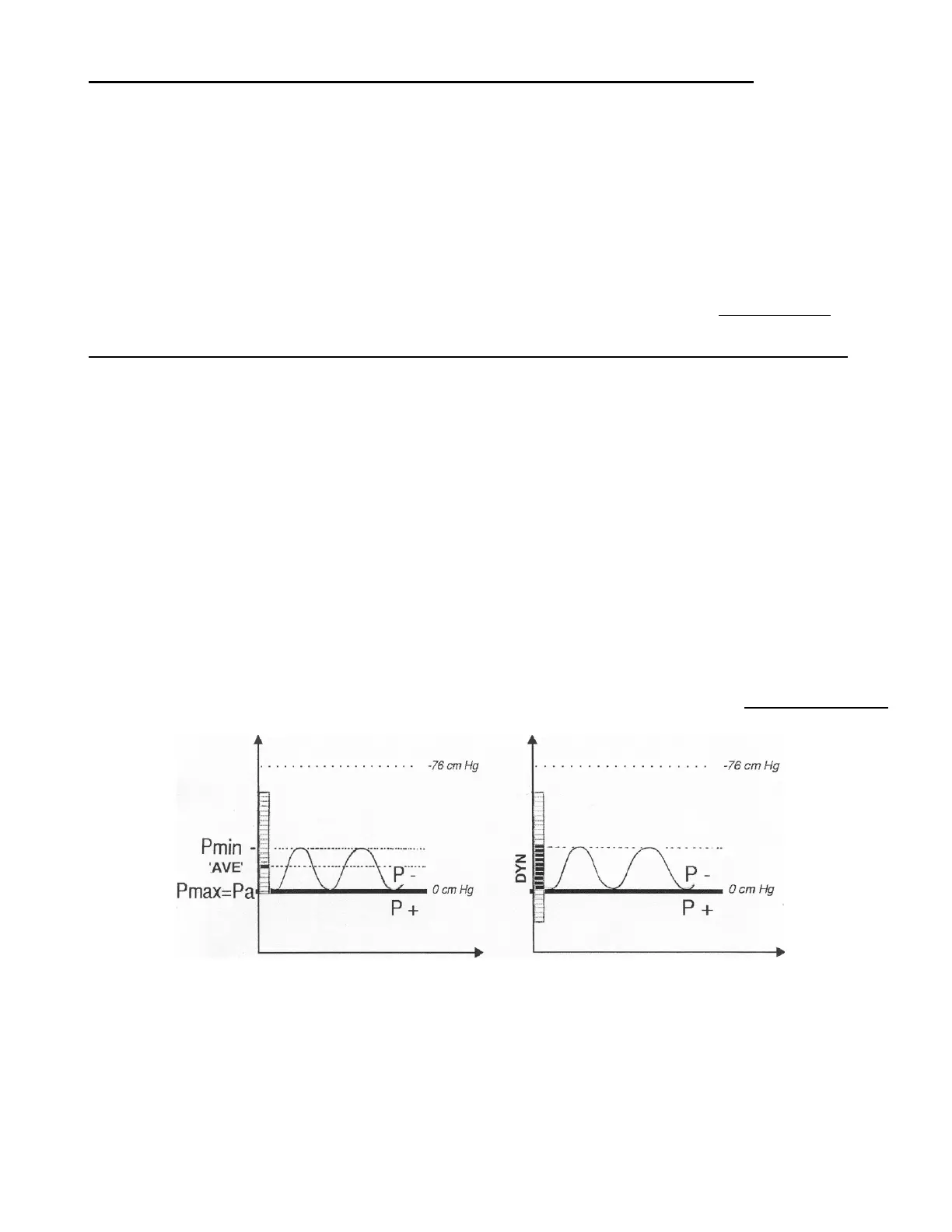
The pressure in the intake system of an engine is not constant, as it is caused by piston movement
which causes the vacuum to oscillate between a minimum and maximum level in the form of a wave,
called the vacuum waveform. Mechanical (& some other electronic) vacuum gauges display only the
AVERAGE value (“AVE”) of the vacuum waveform. This is the parameter used for the synchronisation
of throttle valves on carburettors or injection systems. However such instruments lack the speed &
precision needed to follow DYNAMICALLY the very fast fluctuations of the vacuum waveforms
themselves so as to monitor the heights and relative positions of the crests and troughs of the
waveforms of each cylinder. And it is only by monitoring and displaying these DYNAMIC
characteristics that one can reveal the existence and nature of engine seal defects which will distort &
thwart attempts at synchronisation.
The VacuumMate’s electronics & LED bar-graph displays react extremely fast, fast enough to show in
DYNAMIC (“DYN”) mode the vacuum waveform heights and relative positions for each connected
channel. This is displayed as a column of light on each LED display channel, extending between the
crests and troughs of the waveforms. By comparing the relative heights and positions of the columns
of light for each channel one can detect various problems which would normally require disassembly
and detailed investigation of engine components such as valves & pistons. See § 8. DIAGNOSTICS
below.
AVERAGE (“AVE”) & DYNAMIC (“DYN”) VACUUM DISPLAY MODES COMPARED
Use the AVE / DYN selector switch (#10, illustration, inside front cover) to select AVE or DYN mode as
required. In AVE mode the VacuumMate measures average vacuum in 3 ranges : 5-25 / 20-40 / 35-
55 cm Hg, selected by the 3-position selector switch (#9, illustration, inside front cover). The
overlapping scale ranges help to avoid “losing sight” of the display on one or other channel if the
measured values are somewhat out of synchronisation and close to the end of the scale range.
Resolution is a precise 0,5 cm Hg on all scales.
2



 To Next Page
 Loading...