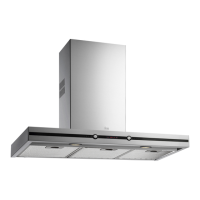
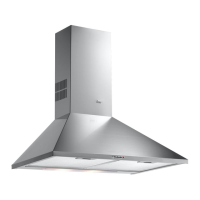
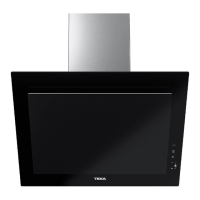
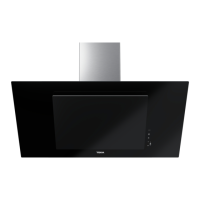
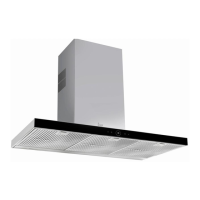
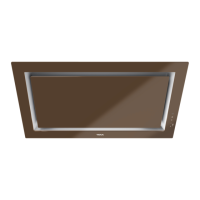
This document is a user manual for a Teka kitchen hood, specifically the DX ISLA Vr. 03 model, and its variants. It provides instructions and technical information in multiple languages, including English, German, French, Portuguese, Greek, and Turkish.
The primary function of this appliance is to extract and purify fumes produced during food preparation in a domestic kitchen environment. It is designed for both extraction (venting outside) and recirculation (using active charcoal filters) modes.
Important Technical Specifications:
The manual provides a table of technical specifications, which includes:
- Network Tension (V): 220-230V (50Hz) or 110-120V (60Hz) depending on the region.
- Lights/Motor Power (W): 2 x 20W for lights and 250W or 270W for the motor.
- Motor Volume/Aspiration Capacity: 850 m³/h or 750 m³/h.
- Minimum Installation Height: At least 50 cm over electric hobs and 65 cm over gas or mixed hobs. Users are advised to follow the hob manufacturer's minimum recommendations if they are higher.
- Duct Diameter: The external conduct should have a diameter of at least Ø120 mm.
- Duct Length and Angles: For optimum performance, the external conduct should not be more than four meters long and have no more than two 90° angles.
- Lamp Type: G-4, 20W maximum power.
Usage Features:
The kitchen hood is controlled via an electronic programmer control box with TOUCH CONTROL technology. Key usage features include:
- Speed Control: Users can increase or decrease the extraction speed.
- Light Control: The hood includes integrated lighting.
- Timer Function: A timer allows users to set the hood to run for a specific duration (5 to 20 minutes, in 5-minute increments) after cooking, then automatically turn off. This helps expel remaining grease, smoke, and smells.
- Power Indicator: A visual indicator shows when the hood is operating.
- Pre-cooking Activation: It is recommended to switch on the extractor fan a few minutes before cooking to establish a steady airflow and prevent fumes from spreading.
- Post-cooking Operation: The hood should run for several minutes (3 to 5 minutes) after cooking to clear the air.
- Recirculation Mode (Optional): If external gas extraction is not possible, the hood can purify air by recycling it through active charcoal filters. These filters have a life of three to six months and must be replaced as they cannot be washed or regenerated.
Maintenance Features:
Regular maintenance is crucial for the appliance's performance and safety.
- Cleaning the Hood Body:
- For stainless steel hoods, proprietary cleaners recommended in the product instructions should be used.
- Metallic scourers, abrasive, or corrosive products must never be used.
- The hood should be dried with a non-fibrous cloth.
- Cleaning the Metal Filters:
- Metal filters should be extracted using their designated handles.
- They can be cleaned by soaking in hot water with neutral detergent until fat dissolves, then rinsed under the tap or with special anti-grease products.
- Alternatively, they can be washed in a dishwasher, preferably stacked vertically to prevent food residues from sticking.
- Dishwasher cleaning may blacken the metallic surface, but this does not affect fat retention capacity.
- Filters must be dried before refitting.
- Excessive fat accumulation is a fire risk, so filters should be cleaned at least once a month.
- Changing Light Bulbs:
- To change a bulb, metal filters must first be removed.
- EASYCLEAN panels (A) need to be loosened (without unscrewing completely) and moved aside.
- Supports (C) are then dismounted by loosening screws (B).
- The broken/burnt-out lamp (D) can then be replaced with a new G-4, 20W lamp.
- Reassembly follows the reverse order.
- Active Charcoal Filters (Optional): These filters cannot be washed or regenerated and must be replaced every three to six months, depending on usage.
Safety Instructions:
The manual emphasizes several safety precautions:
- Compliance with local regulations for electrical fittings and gas eduction.
- Verification of network tension and frequency matching the label inside the hood.
- Connection to the network via a break switch with universal cut-off and minimum 3mm contact separation. The net cable must not be substituted.
- Ensuring the mains cable does not contact live metal edges after installation.
- Avoiding connection to conductors used for fumes from non-electric energy sources (boilers, chimneys).
- Ensuring sufficient room ventilation if the extractor fan is used simultaneously with non-electric cooking equipment (e.g., gas cookers).
- Never leaving gas hobs lit without a container underneath the hood, as accumulated fat can drip or catch fire.
- Avoiding cooking under the hood if metal filters are not fitted.
- Prohibiting the production of flames under the kitchen hood.
- Disconnecting the appliance before any interior manipulation (cleaning, maintenance).
- Recommending the use of gloves and extreme caution when cleaning the hood's interior.
- The hood is designed for domestic use only for fume extraction and purification during cooking.
- Repairs should only be carried out by TEKA Technical Assistance Service using genuine spare parts. Unauthorized repairs can cause malfunctions or damage and endanger safety.
- The appliance is marked according to European directive 2002/96/EC (WEEE) for waste electrical and electronic equipment recycling.

 Need help?
 General

 To Next Page