Maintenance— Type 544/RM544
off one side of each stud holding the strip. This frees the
strip, and the remainder of the stud can then be pulled free
of the chassis with a pair of pliers. The spacers may come
out with the studs; if not, they can be pulled out separately.
If they are not damaged, the spacers may be used with the
new strip assembly. Ceramic strips are supplied with studs
attached, so it is not necessary to salvage old studs.
After removing a damaged strip and stud assembly, place
the spacers into the holes in the chassis and insert the studs
into the spacers. If necessary, use a soft-faced mallet to tap
the studs into the spacers. Tap the studs in equal increments
to prevent strains on the ceramic strip.
Troubleshooting Techniques
If the instrument is not operating, first check that the
power cord is plugged in and that there is power at the
socket. Then check that the pilot lamp and tube heaters aie
lit. If necessary, check the line fuse.
Attempt to isolate the trouble by a quick operational and
visual check. Make sure that any apparent trouble is actu
ally due to a malfunction within the instrument and not to
improper control settings or to a faulty plug-in unit or probe.
Instructions for the operation of the Type 544 and general
information concerning plug-in operation are contained in
Section 2. Operating instructions for a specific plug-in unit
or probe will be found in the manual for that unit.
Check the settings of all controls on the Type 544 and the
vertical plug-in preamplifier unit. A control set to the wrong
position may cause what appears to be a trouble symptom.
Operate the controls to see what effect, if any, they have on
the trouble symptom. The normal or abnormal operation of
each particular control helps in establishing the nature of
the trouble.
When vertical-system troubles are encountered, isolate the
trouble to the Type 544 or to the vertical plug-in preamplifier
unit. The best way to determine this is by substituting another
vertical plug-in preamplifier unit. If the trouble appears lo
be in the plug-in unit, refer to the Maintenance section of
the plug-in unit instruction manual.
If other plug-in units are not available, and the symptoms
are not definite, check the power-supply resistances and volt
ages since a failure in one of the regulated power supplies
frequently presents unusual symptoms. Table 5-2 in the Cali
bration Procedure lists normal resistances to ground for
each power-supply lead. Typical voltages in the power sup
plies are shown on the power-supply schematic. The voltages
shown may vary slightly from instrument to instrument.
All wiring in the Type 544 is color coded to facilitate cir
cuit tracing. In addition, all regulated power-supply leads
are coded with specific color combinations for easy identifi
cation. In general, three stripes are placed on the wires of
the regulated supplies. The first color (widest stripe) indicates
the first number of the voltage on that lead. The second color
indicates the second number of the lead voltage, and the
third color is a multiplier. The method is similar to that used
in color coding resistors. Thus, the + 100-volt leads are
coded brown, black, brown. The voltage is positive if the
body Color of the wire is white and negative if the body
color of the wire is tan.
Reference voltage for the regulated supplies is obtained
from the —150-volt supply. If it is not operated properly, the
other low-voltage supplies will be affected. For this reason,
the —150-volt supply should be checked first when trouble is
suspected in the low-voltage supplies. If the output of the
—150-volt supply is correct, then check the outputs of the
other supplies.
Most troubles that might occur in Tektronix instruments
result from the failure of vacuum tubes or semiconductors.
Once the trouble has been isolated to a particular area or
circuit, check the tubes and semiconductors in the trouble
area. It is preferable to check them by substitution rather
than with a tester, since testers frequently fail to indicate
certain troubles which can affect oscilloscope performance.
Remember that when a tube or semiconductor fails, associ
ated circuit components can be damaged.
Circuit Troubleshooting
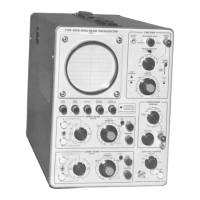
The Type 544 consists of six main circuits plus the Cali
brator. The six main circuits are the:
1. Low-Voltage Power Supply
2. Crt Circuit (including the High-Voltage Power Supply)
3. Vertical Amplifier and Delay Line
4. Sweep-Trigger Circuit
5. Sweep Generator
6. Horizontal Amplifier
The crt display can often be used to identify a defective
circuit. For example, if there is no vertical deflection when
the intensity and horizontal deflection appear normal, the
trouble can be open signal connections, no signal source, the
plug-in unit or even loose crt connections. Other abnormal
characteristics in the crt display similarly point to a defective
circuit or group of circuits.
Once the nature and approximate location of the trouble
has been determined, further isolate the trouble by perform
ing the steps in the calibration procedure for the circuits in
which trouble is suspected. The voltages and waveforms to
be expected in each circuit are shown on the schematics.
Refer to Section 3 for an explanation of the operation of the
defective circuit.
IMPORTANT
When it is desired to operate the plug-in unit from
a plug-in extension, the plug-in sensing switch
(SW673, located at the top rear of the plug-in
compartment) must be manually operated. To man
ually operate the switch, pull the plastic plunger
outward to the stop position.
4-4


 To Next Page
 Loading...