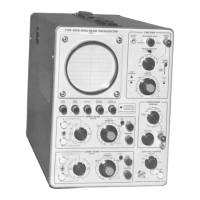
4. Lay the oscilloscope on its left side for access to the bot
tom of the instrument, (and later in the procedure for
access to the —150 VOLTS control).
5. Using the VOM, check the resistance at the regulated bus
of each power-supply lead to ground at the test points
shown in Fig. 5-1. The values of resistance should be
approximately as indicated in Table 5-1, once the capaci
tors are charged by the VOM internal battery.
Calibration— Type 544/RM 544
Fig. 5-1. low -vo lteg* pow tr-iu p p ly test point location! (bottom of
initrum vnl n»or th* power trom forrntr).
TABLE 5-1
Power Supply Lead Resistance to Ground
— 150 volts 1 k to 2 k
+100 volts
1 k to 2 k
+ 225 volts
3 k to 4 k
-h 350 volts
Over 40 k
6. Check the fuse at the rear of the instrument for correct
value.
7. Connect the instrument and ac voltmeter to the auto
transformer output. Connect the autotransformer to the
power line.
8. Turn the INTENSITY control on the instrument fully coun
terclockwise and turn on the power to all the equipment.
Adjust the autotransformer output voltage to 115 volts
(or the design-center voltage for which the instrument
is wired),
9. Set the oscilloscope front-panel controls to the positions
listed in Table 5-2.
TABLE 5-2
INTENSITY 0
FOCUS As is
ASTIGMATISM
As is
SCALE ILLUM
5
TRIGGERING LEVEL
ccw, knob pushed in
TRIGGERING—
MODE
TRIG
SLOPE
+
COUPLING
AC
SOURCE NORM INT
VARIABLE (TIME/CM) CALIBRATED
TIME/CM
.5 mSEC
HORIZONTAL DISPLAY NORMAL
Single Sweep Switch
NORMAL
HORIZONTAL POSITION
VERNIER (HORIZONTAL
Midrange
POSITION) Midrange
AMPLITUDE CALIBRATOR OFF
10. Set the Type TU-7 front-panel controls to those settings:
Vertical Position Centered
Test Function Low Load
Other Controls As is
11. Allow obout five minutes warm-up time. Check thol the
EXTERNAL CRT CATHODE-to-GND shorting strop is in
place on the terminals and the CRT CATHODE SELECTOR
switch is at EXTERNAL CRT CATHODE position.
12. Rechcck the autotransformer output for proper design
center voltage as soon as the instrument is warmed up.
CALIBRATION PROCEDURE
1. Check Voltage Accuracy— Power Supply
(If necessary, adjust — 150 VOLTS R616)
a. Establish tho conditions given in the Preliminary Pro
cedure,
b. Check that the oscilloscope is placed on its left side
for access to the bottom and right side of the instru
ment.
c. Check the voltage accuracy of each power supply
output using the VOM (item 4) according to tho infor
mation given in Toble 5-3 The location of the test
points is shown in Fig. 5-1.
TABLE 5-3
Power Supply
Tolerance
Maximum Peak-to-
Peak Ripple
— 150v
—147 to -15 3 v
10 mv
+ 100v
+ 98 to +102 v
15 mv
4- 225 v +220.5 to +229.5 v
10 mv
+ 350 v + 343 to +357 v
25 mv
d. If necessary, adjust the —150 VOLTS R616 control
(see Fig. 5-2) so oil power supply voltages are within
tolerance.
5-2


 To Next Page
 Loading...