10
ENG
9. Maintenance
WARNING
Before commencing any operation, shut o the
power supply to the machine.
WARNING
Scheduled and extraordinary machine
maintenance must be performed only by
authorised and qualied personnel using
appropriate PPE.
WARNING
Wait for the surfaces of the internal components
to come to ambient temperature.
CAUTION
DO NOT use acidic or ammable detergents to
clean the product.
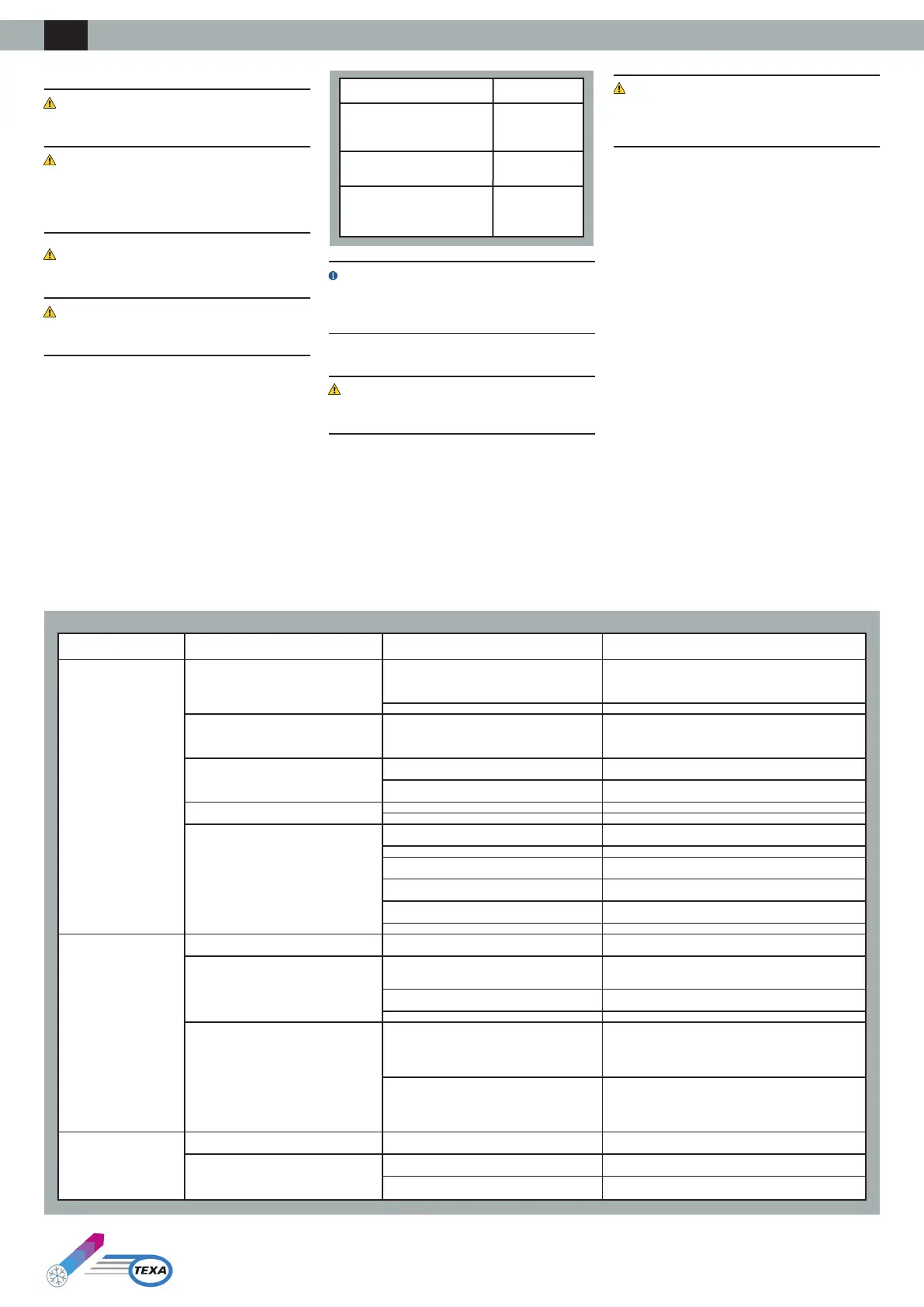
The cooling unit is the low maintenance type, so
no lter change is required. The only maintenance
required is for the internal components, which
should be checked regularly, as indicated in the
following table, and cleaned with compressed air
at a maximum pressure of 4 bar (gure F.11).
NOTICE
Increase the frequency of these operations if
the machine is operated in very dusty and dirty
environments.
10 Removal and Dismantling
WARNING
Before commencing any operation, shut o the
power supply to the machine.
WARNING
Removal and dismantling of the machine must
be performed only by authorised and qualied
personnel using appropriate PPE.
The cooling unit contains R134a refrigerant and
small quantities of lubricating oil. These are
polluting substances and must not be dumped.
Have personnel certied per Regulation (EU)
517/2014 recover the refrigerant so that it can be
reused, regenerated or destroyed.
Job
Check the external air
heat exchanger and clean
if necessary.
Check eectiveness of the
condensate discharge.
Check the fans for any
overheating or excessive
vibrations.
Frequency
Every 3
months
Every 3
months
Every 6
months
Remedy
This is not a malfunction of the cooling unit.
To verify functioning when testing, lower the thermostat setting until
the compressor and external fan start working and then reset the
thermostat.
Change the adjustment (or antifreeze) thermostat
This is not a malfunction of the cooling unit.
Make sure the power cable has been connected well to the
terminals.
Check that the cubicle doors and switches are closed
Call a refrigeration expert or the Manufacturer’s Technical Assis-
tance Service
Call a refrigeration expert or the Manufacturer’s Technical Assis-
tance Service
Change the internal fan’s capacitor
Change the internal fan
Change the amperometric protector
Change the relay or PTC for compressor starting
Change the capacitor for compressor starting
Call a refrigeration expert or the Manufacturer’s Technical Assis-
tance Service
Call a refrigeration expert or the Manufacturer’s Technical Assis-
tance Service
Change the contactor
Change the cooling unit with another of greater capacity
Clean the evaporator coil
See if there are any obstacles inside the enclosure to hinder the
ow of recycling air
Call a refrigeration expert or the Manufacturer’s Technical Assis-
tance Service
Check thermostat setpoint
Ventilate the premises where the enclosure is installed to keep
ambient temperature lower.
Clean the exchanger with compressed air and detergent
Ventilate the premises where the enclosure is installed to keep
ambient temperature lower.
Clean the coil with compressed air and detergent
This is not a malfunction of the cooling unit. Close the enclosure
door or disable the cooling unit
This is not a malfunction of the cooling unit. Seal enclosure open-
ings, e.g. for passage and upward path of wires
Check seal and remedy
Causes
The temperature inside the enclosure is lower than what
is set on the adjustment thermostat.
The adjustment (or antifreeze) thermostat has failed
No electricity getting to the unit.
Cooling unit empty of uid
Compressor mechanical failure
Internal fan capacitor failed
Internal fan failed
Compressor’s amperometric protector failed (external to
the compressor, where present)
Relay or PTC for compressor starting failed
Capacitor for compressor starting failed (where present)
Compressor motor electrical failure
High pressure safety switch failed
Compressor contactor failed (where present)
Cooling unit under sized for the heat dissipated inside
the enclosure
Antifreeze thermostat triggered (where present)
Insucient gas in the cooling unit
Thermostat set point incorrect
High pressure safety switch triggered:
Ambient temperature over the maximum working
limit
Heat exchanger coil (condenser) either dirty or
clogged
Thermal protector inside the compressor triggered:
Ambient temperature over the maximum working
limit
Heat exchanger coil (condenser) either dirty or
clogged
Too much ambient air inside the enclosure
Enclosure protection level is below IP54
The enclosure/cooling unit connecting seal has been t-
ted incorrectly
Conditions
The internal fan works, the external fan and com-
pressor do not work.
No component works
Compressor, external and internal fan work
Compressor and external fan work, internal fan
does not work
External and internal fan work, compressor does
not work
External and internal fans work, compressor works
all the time
Inside fan works, external fan and compressor
work irregularly
External and internal fans work, compressor works
irregularly
Enclosure door open
Enclosure door closed
Malfunction
It fails to cool
It is not cooling enough
Too much condensate forming
•
•
•
•
•
•
•
•
12. Troubleshooting
•
•
•
•


 To Next Page
 Loading...
