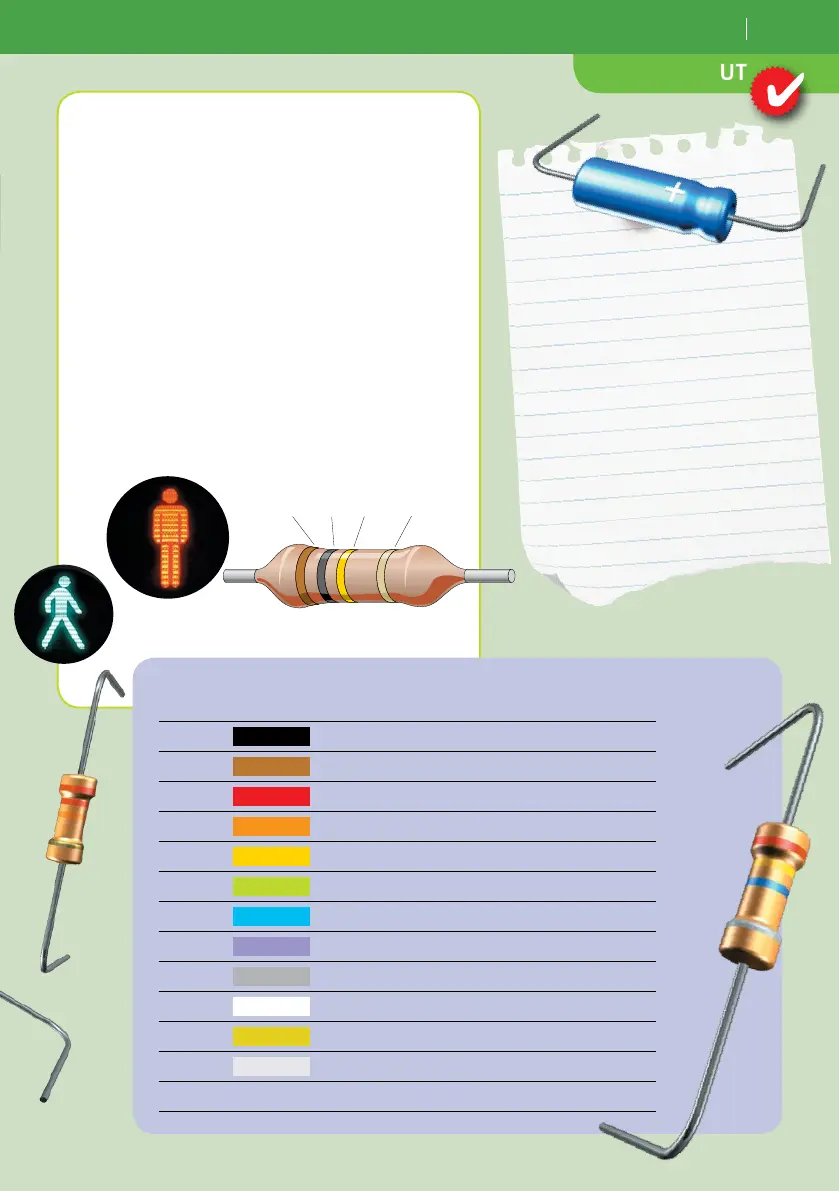
THE RESISTOR COLOR CODE
Rather than having their resistor values printed
on them in numbers, these tiny components use
colored rings. That means that they are easy to
read regardless of their orientation.
Depending on their position, the individual rings
designate the first or second digit of the number
value along with the number of zeros that follow.
The table below shows which ring stands for
which digit or for the following zeros, and what
each color means in terms of numbers.
CHECK IT OUT
Timer Switches
Black 00 -
Color
1st Ring
1st Digit
2nd Ring
2nd Digit
3rd Ring
Zeros
4th Ring
Tolerance
Brown 11 0 1 %
Red 22 00 2 %
Orange 33 000
Yellow 44 0 000
Green 55 00 000
Blue 66 000 000
Purple 77
Gray 88
White 99
Gold x 0.1 5 %
Silver x 0.01 10 %
No Ring 20 %
brown
Example: 100 Kiloohm = 100,000 Ohm
(1) (0) (0000) (5 %)
black yellow gold
red red orange gold
Black 00 -
Color
1st Ring
1st Digit
2nd Ring
2nd Digit
3rd Ring
Zeros
4th Ring
Tolerance
Brown 11 0 1 %
Red 22 00 2 %
Orange 33 000
Yellow 44 0 000
Green 55 00 000
Blue 66 000 000
Purple 77
Gray 88
White 99
Gold x 0.1 5 %
Silver x 0.01 10 %
No Ring 20 %
brown
Example: 100 Kiloohm = 100,000 Ohm
(1) (0) (0000) (5 %)
black yellow gold
Caution:
Note the polarity!
Because the insulation layer of
an electrolytic capacitor is
produced electrochemically,
this component is sensitive to
reverse polarity. So you have to
be careful to install your 100-µF
the right way around — look
for the (+) sign!



 To Next Page