EXPERIMENT
Flashing alarm
system
YOU WILL NEED
your flasher circuit from
Experiment 14
short wire bridge
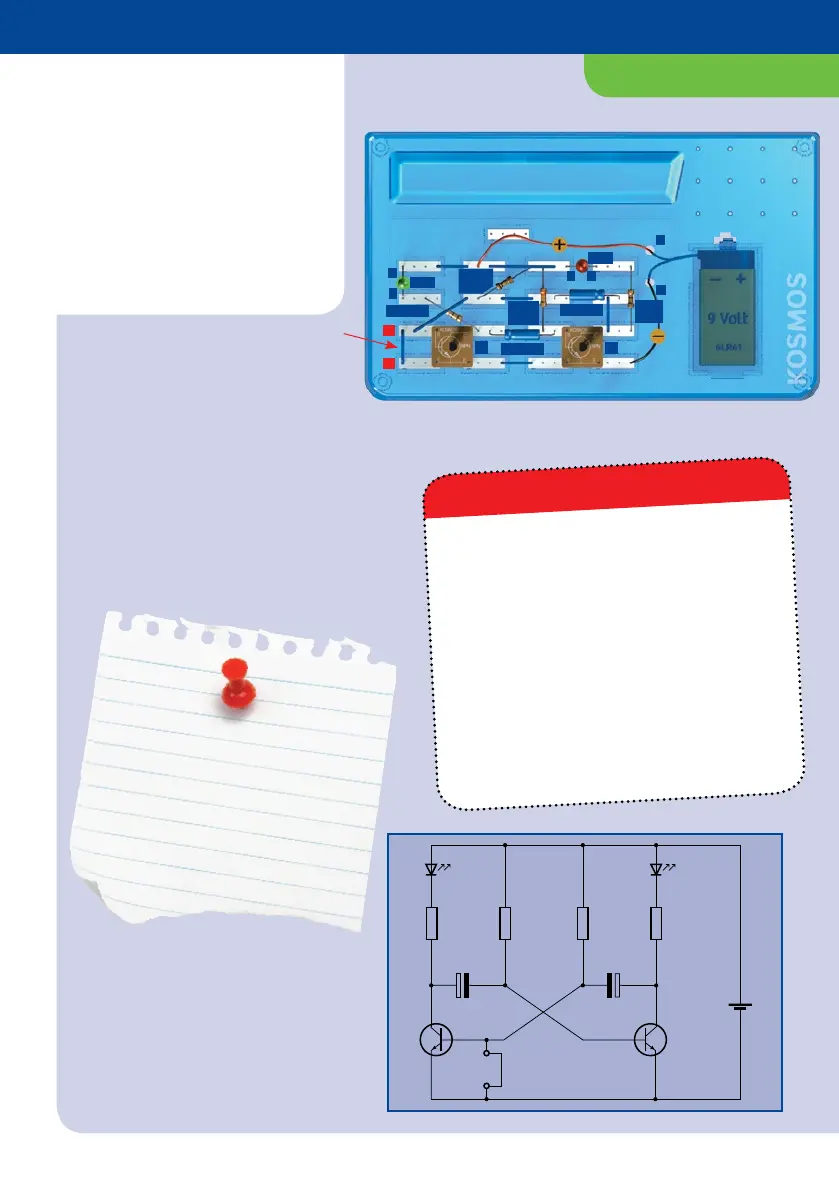
As soon as you mount the wire bridge on
your flasher circuit, the base (B) and
emitter (E) terminals of transistor T1 are
short-circuited, and the transistor can’t
work. The flashing immediately stops,
and the red LED shines uninterruptedly.
When you pull the wire bridge back out
again, the circuit starts to flash: Alarm!
That’s how easy it is to turn your flasher
circuit into an alarm system…
WHAT’S HAPPENING?
HERE’S HOW
1. Insert a small wire bridge into the
contact clips at the bottom left.
What change do you notice?
2. Remove the wire bridge again.
+
–
9V
T2
T1
A
B
R 2
220 kΩ
+
10 µF
C 2
+
100 µF
C 1
LED 1
R 4
470 Ω
R 3
470 Ω
R 1
100 kΩ
LED 2
Tip
Instead of the small wire
bridge, of course, you could try
using a tripwire or a door
contact, as you did in the alarm
system in Experiment 5.
LED1
LED2
T1
+
–
T2
A
A
C
C
C1 µF
R3 Ω
C2 µF
R
Ω
R2
kΩ
+
+
A
B
R
kΩ



 To Next Page