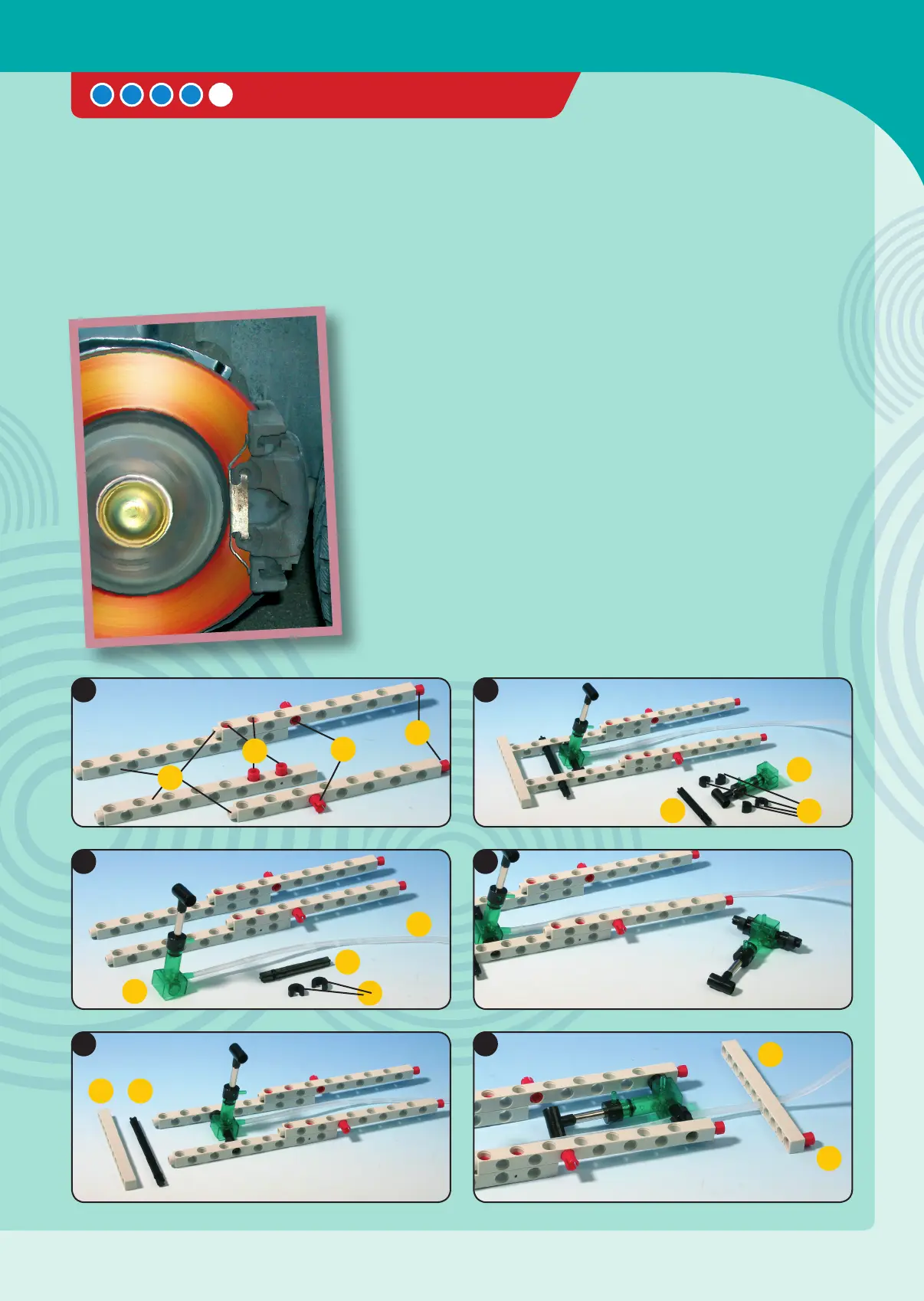
CAR WITH HYDRAULIC BRAKES
Every vehicle should be able to brake. As
their main braking device, passenger cars
have a hydraulically activated foot brake.
Its hydraulic mechanism consists of a
cylinder that transfers force from the
YOU WILL NEED
› 8 Anchor pins 1
› 4 Joint pins 2
› 2 Shaft plugs 3
› 10 Axle locks 5
› 8 Washers 6
› 1 Short frame 8
› 4 Long rods 9
› 6 Short rods 10
› 4 Long axles 11
› 3 Medium axles 12
› 2 Medium pulleys 14
› 2 Large gear wheels 16
› 2 Small gear wheels 18
› 1 XL (extra long) axle 21
› 1 Rubber band (medium) 25
› 2 Wheels 28
› 2 Tire rings for pulleys 29
› 2 Hydraulic cylinders 42
› 1 Piece of narrow tubing 43
brake pedal to the main cylinder. From
there, the braking force is transferred
equally by separate pathways to the
braking cylinders on the wheels. Big and
heavy vehicles, e.g. a tour bus or dredger,
have so-called servo brakes, which
amplify the braking force through a
pump.
This model is like the racing car model
(page 89) — but without the drive spring.
Test the hydraulic brake by pushing
against the car’s brake pedal (the front
pair of rods). Push the pedal down to
activate the brake. That pulls the rear pair
of rods down onto the tires. Water will
serve as the hydraulic fluid. You will see
in Experiments 1 and 2 (on pages 10 and
11) how to fill it without air bubbles.
> See Pages 10-11 and 20-22
4
10
1
2
1
1
9
12
42
42
12
43
5
10 11
1
2
3
5
6
5
Let‘s Build Models
65
Physics Pro 2014 Part 2.indd 65 8/1/14 1:24 PM


 To Previous Page