Need help?
Do you have a question about the Thames & Kosmos TK2 Scope and is the answer not in the manual?
General safety warning for age suitability and parts.
General safety guidelines for experimentation.
Guidance for adults supervising children.
Specific warnings regarding battery usage.
Warning about sharp parts and injury risk.
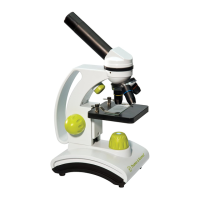
Description of the microscope itself.
List of items like slides, pipette, etc.
Mention of batteries.
Introductory notes for adults.
Detailed safety rules.
Introduction to cells and their commonality.
General introduction to using the microscope.
General instructions for microscope operation.
Initial steps for viewing.
Using the microscope in macro mode.
Details on macro-view.
Common issues when viewing.
Preparing for transmitted light viewing.
Adjusting focus and magnification.
Tips for lens care.
Explanation of the pointer feature.
Explanation of how light works.
How the image appears upside down.
Essential preparation materials.
Pipette, dissecting needle, tweezers.
How to clean lenses.
Using stains for better visibility.
Other useful tools.
Safe use of razor blades.
Using styrofoam/carrot for cutting.
For cleaning and absorption.
Differences in animal cells based on function.
Preparing animal cells (e.g., cheek cells).
General method for wet mounts.
Technique for avoiding air bubbles.
Managing water under the cover slip.
Preparing and observing plant cells.
Role of cell walls.
Function of the cell membrane.
Plant cell wall structure.
Method for changing liquids.
Experiment with salt solution.
Background on plant energy.
Role in photosynthesis.
Studying chloroplasts in egeria.
Color changes during ripening.
General advice for cutting.
Observing chromoplasts in fruits.
Carbon dioxide and dextrose.
Testing food for starch with iodine.
Observing starch.
Banana ripening and starch.
Observing starch breakdown.
Introduction to aquatic organisms.
Locating specimens in ponds.
Method for collecting.
Studying settled organisms.
Preparing a hay infusion.
Observing paramecia.
Identifying pollen.
Preparing and examining honey.
Historical analysis.
Growing salt and sugar crystals.
Differentiating crystals.
Why insects are small.
Reasons for insect size limitations.
Structure and function of wings.
Insect mouthparts.
Observing mouthparts.
Detailed structure of legs.
Basic leg segments.
Role of fungi in decomposition.
Comparing fungus texture to plants.
Microscopic structure of fungi.
How fungi spread.
Observing mushroom caps.
Fungi as pathogens and symbionts.
Symbiotic relationship.
Observing mold fungi.
Root absorption of water.
Observing root hairs.
Vascular tissue.
Observing water ducts.
Structural principles.
Stability and flexibility.
Preparing thin sections.
Observing grass blade cross-sections.
Root function.
Preparing root samples.
Lotus effect.
Making surface impressions.
Leaf epidermis function.
Preparing leaf sections.
Stomata and water regulation.
Leaf cell layers.
Advanced leaf sectioning.
Observing conifer leaves.
Function of hair.
Forensic use of hair.
Observing hairs and fibers.
Cotton plant fibers.
Observing stinging nettle hairs.
Examining bird feathers.
Preparing feathers for viewing.
Atoms and electrons.
How SEM works.
Dead specimens, vacuum.
Creating a logbook.
Techniques for drawing.
 General
| Brand | Thames & Kosmos |
|---|---|
| Model | TK2 Scope |
| Category | Microscope |
| Language | English |

 To Next Page