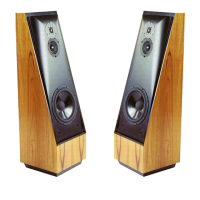
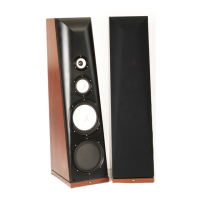
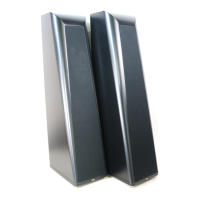
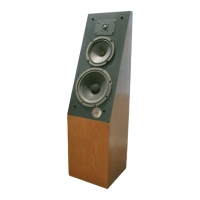
Congratulations
on your
purchase
of the THIEL model
CSl.2
loudspeaker
system.
It is
the result of a
long
and dedicated effort to
provide very
accurate music
reproduction. We
have used only the highest
quality
components and taken
great
care in its construction. Properly set up and used with
good
asso-
ciated equipment, the CS1.2s
will provide you
with a
great
deal of musical enjoyment for many
years.
Speaker
Placement
The CS l-2s are relatively non-crhical to roorn
placernent
and
w;ll
provide good
resuhs from
almost anywhere. However,
here
are
some
guidelines
to help
you
achieve the
best sound
from youi
speakers. Spealer
placemenr
will
affect the accuracy
oftimbre, spat;al
performance.
and bass
performance.
Distance from
walls:
THIEL speakers. and most others. sound best if they are
placed
well away from all walls. Such
placement
optinizes imaging and depth. and musical limbres are reproduced with the leasl coloration
because
i!allows
the
initial sound coming from ihe speaker ro be distincdy separaled in time from the secondary sound
of
wall reflections.
If
reflections are heard too
quickly
rfter the
primary
sound.
your
brain
tends to interpret them
as
part
ofthe initial sound,
causing
the
perceived
timbre to
be
altered and the
spatial characteristics to be confused.
Ifyou experiment,
you will notice
a
major improvement
in openness
when
the speakers arc even two feet from the r€ar wall
instead ofone.
We
like to see the speakers thrce feet from the rear
wall
and five feet fron the side wall. Also. it is not
desnable for large objects to be
placed
near the speakers since these will also be a source ofunwanted early reflections that
r€duce imaging accuracy.
Spacing:
Because oftheir very wide, even dispersion
ofenergy,
THIEL spealers should usually
be
placed
fanher apart
than most. Oprimum imaging is usually achieved when the spealers and the listenerform an equilateral
triangle. although
this will depend on the
width
ofthe room a narow room
will
requirc closer
placement.Ifthe
speakers are too far apart for a
given
environment. there will lend io be a "hole in the middle ofthe sound staget ifthey are too close together, the image
will be compressed and willnot achieve optimum width.
Aiming: We usually
prefer
the imaging obtained when the spealcrs are
pointed
straighl ahead rarher than
po;nting
toward
the
listener. This
placement produces
the largest, most narural
soundslage.
However, toeing rhe
speakers;n somewhat may
produce
more specific
placements
ofinstruments.
Also, if
it
is
nor
possible
to
get
the speakers far enough away from the side
walls, a toed-in
position
can be helpful to reduce the strength of wall reflections.
Bass:
Bi$s response is also affected by spealcr
placernenl-
In
general,
when a speaker is close to
a
wallthe
bass response
is
stronger
and
placing
a speaker in acomer will rnale it even rnore so.In order to achieve
properly
balanced bass,
ir is
necessary for the speaker
to
be used
in the environment for which it was
designed.
THIEL speakers
are designed to
provide
accurate bass
when positioned
away
from
all
walls
the same
position
that
provides the
best
imaging.
Listener
position:
The CS l.2s
provide
broad dispersion of energy al all frequencies and therefore
provide good
results
throughout a
large listening area. Best imaging is
provided
for a listener centered in front of the
speakers. Optimun
phase
and time alignment is
provided
only
for
a seated
listener who
is ejght o.
more feet
away
from
the speakers.
AIIaspects oJ speaker
placement
are dependent an the
particklar
roon. Sin':e ewry raom is differen!, o haftlnles catl b?
Biren,and
erperin?
tatbnis eftssxt
)^
tu a,:hiere th? best ftsltlts.
Connecting
the
Speakers
The CSl.2's input lerminals are located on the bottom of the speaker. To
gain
access to these the spealer should be laid on
irsba.k. Make tu-? thxt all o necth sarctipht.
Ii is essentialfor
proper performance
that both spealers in a stereo system be wired in the same
polarit].
The input
terminals are colorcoded
to facil;tate this. The wire connected to thc red input terminal of each spe.ker
should connect to the
respective
pos;tive
output
terminals
ofthe
amplifier. The
speakers should be
connected 1o the amplifier w;th high quality
cable to insure minimal loss ofpower and
proper
control by the amplifier. If the speakers a.e being connected to a vacuum
tube amplifier with various impedance laps, the 4 ohm tap
will probably give
the best results.
If ihe amplifier has a speaker fuse or if a fuse is used in line to the speakers,
we
recommend a value of 2 amps of th€ normal
blow type
(type
3AG-2 amp). Although fuses offer some
protection,
they do not necessarily
protecl
the speaker against alt
types of overload
and also inlroduce audible degradation of the signal. The CSl.2 is a rugged loudspealcr that can
only be
damaged
by extrerne overloading and fusing is noi necessary.


 To Next Page
 Loading...