Copyright © 2007 by Calculated Industries, Inc.
and Thomson Delmar Learning
Construction Master® Pro Workbook and Study Guide
Placed atop framed walls, rafters support the roof of a structure. There are
many types of roof styles, such as gable, gambrel, shed, Mansard, and hip,
and several types of rafters, including those to be discussed here: common,
hip, valley, and jack rafters.
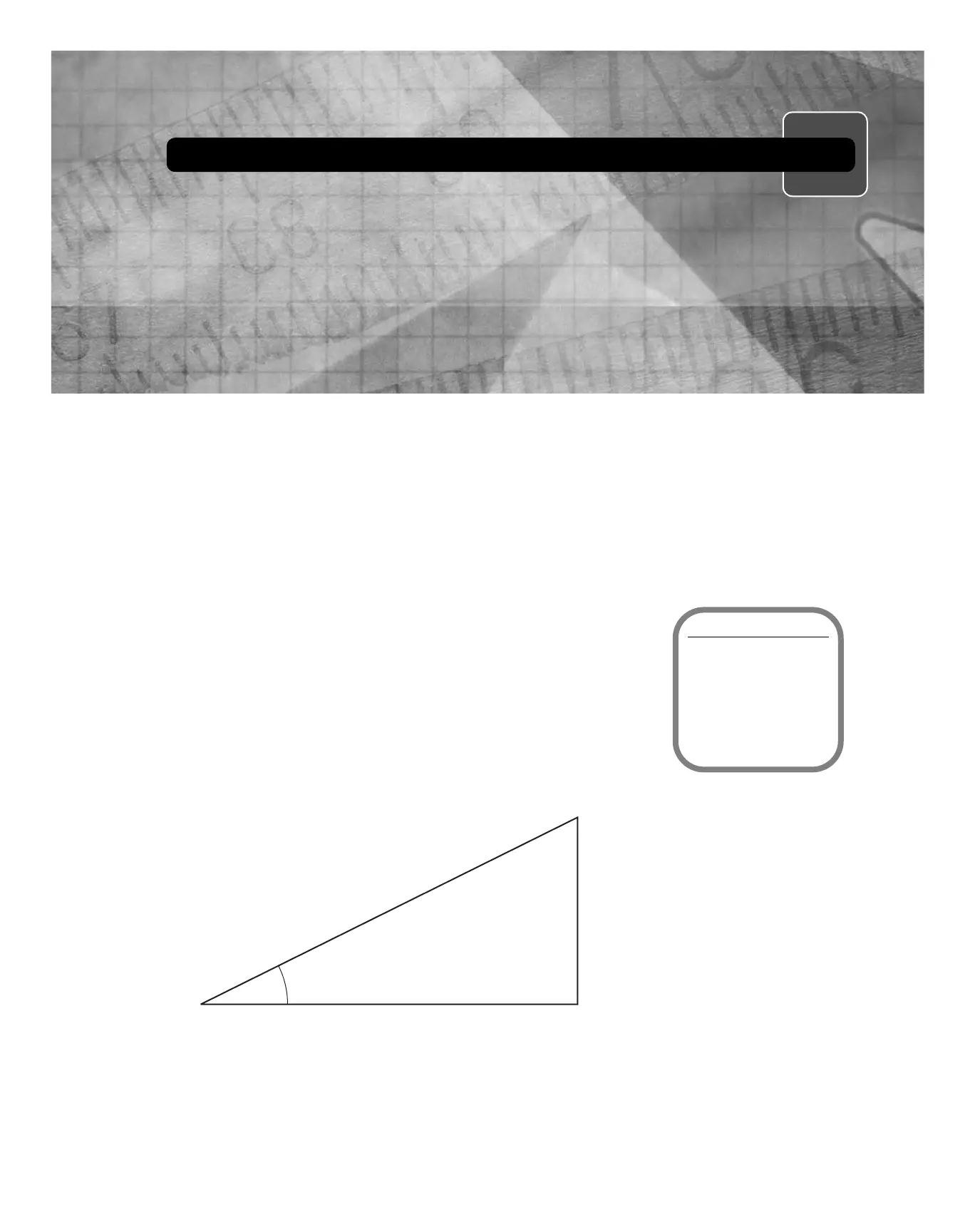
Common rafters connect the top plate of a wall with the ridge, and are
perpendicular to the ridge. Like the grade of a land area (see Chapter 2), the
incline of such rafters may be specified several different ways using the quan-
tities shown in Figure 6-1. The slope of a rafter (also called the pitch ratio) is
a decimal value that results from dividing the rise by the run, keeping both di-
mensions in feet or both dimensions in inches. Pitch of a rafter is the rise, in
inches, divided by the run, in feet, and is usually stated simply in inches. Pitch
may also be expressed as angle A in the figure, that angle between the rafter
and a horizontal line, and is given in degrees.
59
CHAPTER 6
Rafters
Warning
Material Adjustments:
The rafter length
calculations are the
point-to-point
measurements and do
not account for material
thickness.
Rafter Length (DIAG)
A
Run
Rise
Figure 6-1


 To Next Page
 Loading...