Need help?
Do you have a question about the THOR T35106SKW and is the answer not in the manual?
Common sense safety rules for electrical appliances, danger of injury or death.
Important notes on appliance use, warranty, children, water leakage, and electrical shock.
Voltage checks, plug suitability, earthing, and avoiding extension leads.
Safe installation practices, packaging removal, and positioning.
Instructions for connecting the drain hose to a sink or standpipe.
How to connect the water inlet hose to a tap and the machine.
Explains the On/Off, Start/Pause, Pre Wash, Delay, and Programme Knob functions.
Describes icons for Wash, Rinse, Spin, Door Lock, and Child Lock status.
Details the three compartments: Pre-Wash, Main Wash, and Softener.
Guidance on using detergents and softeners for different fabrics and cycles.
Steps for loading clothes, selecting programs, and starting the machine.
Actions upon cycle completion, door release, and unloading laundry.
Explanation of the balance control device and manual load redistribution.
Instructions for cleaning the detergent drawer to remove residue.
Recommendations for cleaning the drum and external casing.
Steps to clean water inlet filters and clear the pump filter.
Advice on handling laundry items, sorting colors, stains, and zippers.
Recommendations for efficient washing, load size, and temperature.
Lists common machine faults and their potential causes for troubleshooting.
Guidelines on where the appliance can and cannot be used.
Precautions regarding the power cord and its placement.
Warnings about hot water, electric shock, supervision, and user capabilities.
Information on registering the guarantee and its terms.
Details of specific conditions under which the guarantee is void.
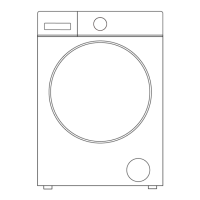
This document outlines the installation, operation, and maintenance instructions for a Thor 6 kg Washing Machine, model T35106SKW, designed for household and residential use.
The Thor washing machine is designed to clean machine-washable laundry items. It operates by filling with water, agitating clothes with detergent, rinsing, and spinning to remove excess water. The machine offers various wash programs tailored for different fabric types and soil levels, including Cotton, Synthetic, Delicate, Mix, and Tub Clean. It also features options for pre-wash, delay start, and adjustable spin speeds. The appliance is equipped with a balance control device to ensure stability during the spin cycle by redistributing the load.
Installation and Setup: Before first use, it is crucial to remove all packaging, including the foam base and four transit bolts with their rubber washers from the back of the machine. Blanking caps should be inserted where the transit bolts were removed. The machine must be installed on a flat, stable surface, ensuring it is level by adjusting the feet with a spanner and pipe wrench. A minimum distance of 10cm from the wall is recommended. The water inlet hose connects to a 3/4" threaded tap, and the drain hose can be directed to a sink or a standpipe. If draining into a sink, a loop should be formed in the hose to prevent waste water from entering the machine. For standpipe drainage, the standpipe should be between 60cm and 90cm above floor level and have an internal diameter of approximately 38mm, with an air break between the drain hose and the standpipe. The appliance requires a grounded A.C. electricity supply, and a 5 amp BS1362 fuse should be fitted if the existing plug is unsuitable. An extension lead should not be used.
Control Panel and Programs: The control panel features an On/Off button to power the machine, a Start/Pause button to initiate or temporarily halt a cycle, and a Pre Wash button for heavily soiled clothes. A Delay button allows users to set a delayed start time from 3 to 18 hours. The Programme Knob is used to select from various wash cycles, including Cotton (Cold, 20°C, 40°C, 60°C, 90°C), Synthetic (Cold, 40°C), Delicate (Cold, 20°C), Mix (Cold), Tub Clean (60°C), Spin, Quick 15' (Cold), and Rinse+Spin (Cold). Status indicators on the panel show the current phase of the wash cycle: Wash, Rinse, Spin, Door Lock, and Child Lock.
Loading and Detergent: Laundry should be loaded into the drum one by one. The detergent drawer has three compartments: Pre-Wash, Main Wash, and Softener. Different detergents are recommended for coloured, white, and woollen laundry, with quantities specified by the detergent/softener packaging. Tablets may not be suitable for short cycles. Detergent and softener should be added before washing, and the drawer should not be opened during operation. If a program does not require pre-wash, no detergent should be placed in that compartment.
Safety Precautions: Users are advised not to immerse the appliance body in water, hose it down, or allow electrical connections to get wet. The loading door should never be forced open, as it releases automatically at the end of a cycle. The filter should not be removed while there is water in the drum. Children should be kept away from the appliance during use and detergent/softener stored out of reach. The appliance is not suitable for use by persons with reduced physical, sensory, or mental capabilities unless supervised. It should not be used outdoors, in a bathroom, or in unheated, cold rooms like garages or sheds. The power cord should not be replaced by the user.
Energy Saving Tips: To conserve energy, avoid overloading the appliance, follow detergent packaging instructions, and wash lightly soiled laundry at low temperatures. Pre-wash or high temperatures are not necessary for lightly soiled items.
Cleaning the Detergent Drawer: The detergent drawer should be cleaned every 4-5 weeks to prevent residue buildup. It can be removed and cleaned with a soft brush before being replaced.
Cleaning the Door and Drum: A Sterilisation program should be run every 3 months to clean the drum. After each wash, the drum should be wiped clean. A mild, non-abrasive cleaning agent or soap and water can be used to clean the external casing, followed by wiping dry with a soft cloth.
Cleaning Water Inlet Filters: Water inlet filters prevent dirt from entering the machine and should be cleaned if the machine is not receiving sufficient water. This involves unscrewing the water inlet hose, pulling out the filter from the inlet valve using pliers, cleaning it with a soft brush and soapy water, rinsing, and re-inserting. A second filter located at the tap end of the inlet hose also requires cleaning.
Draining Water and Clearing the Pump Filter: If the machine fails to drain, the pump filter may be clogged. To clear it, place a container under the filter cover to collect water, then pull the cover to expose the filter. Remove any foreign objects, clean the pump with a soft brush, rotate the pump by hand, and then re-fit the filter by inserting and turning clockwise before closing the cover.
Moving the Washing Machine: Before transporting the appliance, it must be unplugged, water drain and supply connections removed, and any remaining water drained. The transportation safety bolts should be re-installed. The machine should not be turned upside down or on its side, and at least two people are required to carry it.
 General
| Loading Type | Front Load |
|---|---|
| Capacity | 10 kg |
| Color | Silver |
| Energy Rating | A+++ |
| Noise Level (Washing/Spinning) | 72 dB |


 To Next Page