Need help?
Do you have a question about the Thule ezHitch and is the answer not in the manual?
Read and understand all warnings. Trailer use changes bicycle handling. Incorrect use may cause serious injury or death.
Step-by-step guide for installing the Thule ezHitch™ on a bicycle's quick-release skewer.
Instructions for attaching the Thule ezHitch™ to a bicycle with a solid rear axle.
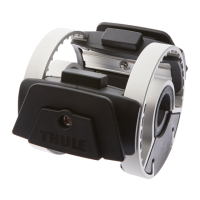
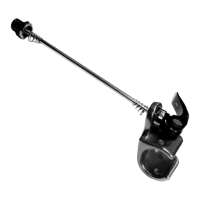
The Thule ezHitch™ is a trailer hitch system designed to connect a Thule child carrier to a bicycle, enabling the safe transport of children. This system is an integral component for converting a bicycle into a towing vehicle for a child trailer, providing a secure and reliable attachment point.
The primary function of the Thule ezHitch™ is to provide a robust and secure connection between a bicycle and a Thule child carrier. It acts as the interface that allows the child carrier to be towed, ensuring stability and safety during transit. The hitch is designed to accommodate various bicycle types, specifically those with quick-release skewers or solid axles, making it a versatile solution for many cyclists.
When installed, the ezHitch™ creates a pivot point that allows the child carrier to follow the bicycle smoothly through turns while maintaining a safe distance and alignment. This design is crucial for the maneuverability of the combined unit, ensuring that the trailer tracks correctly behind the bicycle without excessive sway or instability. The system is engineered to distribute the towing load effectively, minimizing stress on the bicycle's rear axle and frame.
The ezHitch™ facilitates the quick attachment and detachment of the child carrier, offering convenience for users who may wish to switch between towing and solo cycling. This ease of use is a key aspect of its design, allowing for flexible use of both the bicycle and the child carrier.
The Thule ezHitch™ is designed with user-friendliness and safety as paramount considerations. Its installation process is straightforward, whether the bicycle has a quick-release skewer or a solid axle.
For bicycles equipped with a quick-release skewer, the ezHitch™ integrates directly into the existing quick-release mechanism. The process involves removing the quick-release knob and one spring, inserting the skewer through the ezHitch™, and then reassembling the components. Crucially, the quick-release lever must be properly closed and the knob tightened to ensure a secure attachment of the bicycle wheel and the ezHitch™. The instructions emphasize checking for at least two screw threads showing past the end of the quick-release knob and verifying the wheel's secure attachment by pulling on it. This attention to detail in the tightening procedure is vital for preventing accidental loosening of the rear wheel, which could lead to serious safety hazards.
For bicycles with a solid axle, the ezHitch™ is installed by removing the axle nut and washer(s) from the non-drive side of the axle, placing the ezHitch™ on the axle, and then reinstalling and tightening the nut. The instructions highlight the importance of tightening the axle nut to the bicycle manufacturer's recommended torque, ensuring a minimum of five full turns for adequate clamping force. This method ensures a strong and stable connection for solid axle bicycles. The manual also notes that in some cases, the original washer might be discarded to make room for the ezHitch™, and advises consulting a bicycle retailer for certainty. Furthermore, for certain hub types, the existing torque support washer for the hub must remain on the frame, and users should follow the hub manufacturer's assembly instructions and torque specifications.
A critical usage feature is the emphasis on safety warnings. Users are explicitly instructed to always use a safety flag with the child carrier, never exceed specific speed limits (25 km/h generally, and less than 10 km/h around corners and on rough roads), and be mindful of turning angles (not exceeding 45° for right turns and 90° for left turns). These guidelines are essential for maintaining control and stability while towing.
The ezHitch™ system is designed to be compatible with Thule child carriers, and users are reminded to follow the specific instructions for child placement and seatbelt use provided with their child carrier. It is also stressed that children must be old enough to wear a helmet and sit upright unattended, with a recommendation to consult a pediatrician for children under one year old. The child's head, including the helmet, must not project above the upper frame of the carrier.
While the Thule ezHitch™ itself is a relatively low-maintenance component, its proper function relies heavily on correct installation and regular checks. The manual implicitly guides users on maintenance through its detailed installation and safety instructions.
The most important "maintenance" aspect is the pre-ride check. Before each use, cyclists should verify that the quick-release skewer or axle nut is securely tightened and that the ezHitch™ is firmly attached to the bicycle. For quick-release systems, this involves checking the quick-release lever's position and the tightness of the knob. For solid axles, it means ensuring the axle nut is still at the correct torque. These checks are crucial to prevent any loosening that could compromise safety during a ride.
The manual also advises having the bicycle checked by a qualified bicycle mechanic before attaching the trailer kit. This recommendation serves as a preventative maintenance measure for the bicycle itself, ensuring that it is in suitable condition to tow a child carrier. A mechanic can assess the bicycle's frame, wheels, and braking system to confirm they can safely handle the additional weight and stresses of towing.
Users with an internally geared hub are specifically informed that they will require a Thule Internal Hub Hitch Adapter, indicating that the standard ezHitch™ may not be directly compatible without this additional component. This highlights the importance of using the correct parts for specific bicycle configurations to ensure proper fit and function.
In essence, the maintenance of the Thule ezHitch™ revolves around diligent adherence to installation instructions, regular pre-ride safety checks, and ensuring the bicycle itself is in good working order, ideally verified by a professional. The robust design of the ezHitch™ means that with proper installation and routine verification, it will reliably perform its function over time.
 General
| Type | Hitch-mounted bike rack |
|---|---|
| Compatibility | 2-inch hitch receivers |
| Hitch Compatibility | 2-inch hitch receivers |
| Material | Steel |
| Foldable Design | Yes |
| Lockable | Yes |
| Number of Bike Racks | 2 |

 To Next Page