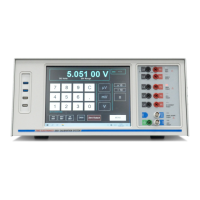
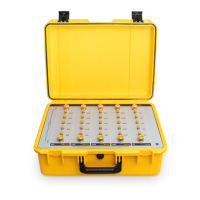
The Time Electronics 9814 is a high-performance programmable D.C. voltage calibrator designed for precision and stability. It combines advanced microprocessor and linear circuit technology to achieve exceptional long-term stability, guaranteed at 50 ppm/year. This instrument is built with a modular design based on the standard Euro card frame, allowing for easy access to all main sections like the Microprocessor control, IEEE interface, D-A converter, and Reference amplifier from the rear. The 9814 can be operated in both manual mode via front panel controls and remotely through an IEEE-488 interface.
Function Description:
The 9814 serves as a D.C. voltage calibrator, capable of generating precise DC voltage outputs across multiple ranges. Its programmable nature allows for automated calibration tasks, making it suitable for repetitive and accurate work, especially when integrated into computer-controlled systems. The device provides a true bi-polar output, meaning the 'Lo' output terminal can remain at earth for all output values and polarities, eliminating common mode errors or the need to reverse input connections.
Important Technical Specifications:
- Output: 0 to 10V in 4 ranges.
- D.C. Accuracy:
- 10V & 1V Ranges: 0.01% of setting, +/- 0.001% of range, +/-3uV.
- 100mV & 10mV Ranges: 0.02% of setting, +/- 0.005% of range, +/-2uV.
- Output Resistance:
- 10 mohms on 10V & 1V ranges.
- 10 ohms on 100mV and 10mV ranges.
- Output Current: Internally adjustable between 200mA and 20mA on 1V and 10V ranges. On 100mV and 10mV ranges, the limit is the short circuit current, but loads greater than 1 Kohm will cause errors exceeding 0.1% in the output voltage.
- Output Polarity: True bi-polar.
- Temperature Coefficient: 20ppm/°C on all ranges.
- Noise: 4ppm of full scale.
- Overload: Continuous short circuit can be withstood on all ranges.
- Settling Time:
- Less than 1ms between 0 and full scale.
- Less than 50ms with range change.
- Power Requirements: 220 - 240V A.C. 50 Hz OR 110 - 120V A.C. 60 Hz (Switch selectable).
- Interface: IEEE-488.
- Dimensions: 123 x 632 x 110mm.
- Weight: 5Kg.
Usage Features:
Local Operation:
The 9814 can be operated manually using the front panel controls.
- Switching On: Upon power-on, it defaults to the 10mV D.C. range with zero output.
- Range and Output Selection: Users can select ranges (10V to 10mV), output polarity (+/-), and increment/decrement output values using dedicated keys. Full scale or zero output can be selected directly.
- Zero Offset: An offset can be set and stored, which is then added to or subtracted from subsequent output values. A flashing horizontal bar on the left digit indicates an active offset.
- Percentage Deviation: A percentage deviation (from +9.999% to -9.999%) can be applied to the output. A flashing LED on the DEV key indicates active deviation.
- Keyboard Operating Modes: Four modes are available for carry-over (9 to 10 or 9 to 0) and auto-repeat functionality for held-down keys.
- Output Error Modes (Digit 8): The device can respond to output errors in four user-selectable ways, from immediately setting output to zero and displaying "OP ERROR" to continuing to drive output circuits while displaying the error.
- Self-Test Mode: Activated by setting all 8 IEEE switches to ON before power-up, this mode performs an internal test sequence. It displays "PASS" if no errors are found or "ERROR" with a number indicating the fault (e.g., RAM, GPIA, PIA, CAL RAM).
Remote Operation (IEEE-488 Interface):
The IEEE-488 (GPIB/HPIB) interface allows remote control by a suitable computer.
- Bus Limitations: Supports a maximum of 15 devices and a bus length not exceeding 20m or (number of devices x 2), whichever is shorter.
- Addressing: Each device on the bus requires an address. Addresses 0 and 16 are reserved for auto-calibration, and 31 for self-test. The address is read only at power-up.
- Local Lockout: The front panel LOCAL/REMOTE switch must be in the remote position for IEEE operation.
- Interface Clear (IFC): Resets the 9814, making it unresponsive for 1 second.
- Command Format: Commands are ASCII characters (A-Z), uppercase characters followed by a number, or signed decimal numbers (up to 8 digits). Commands can be strung together with a '/' separator and terminated by a line feed or carriage return.
- Key Commands:
D: Transmits display to bus controller.E1 to E4: Selects output error detection action.G1 or G2: Set/Cancel Group Execute Trigger response.H: Sets output to full scale.I: Sets serial poll request for service on 'OP ERROR'.K1 or K2: Enable/Disable Front panel controls.L: Sets output to zero.Pn: Changes output by 'n' percent.R1 to R4: Selects voltage range (10mV, 100mV, 1V, 10V). RA automatically selects the range.T1 or T2: Sets transmission terminator (carriage return or line feed).Z: Takes present output as Zero Offset.
Calibration:
The 9814 features automatic calibration (auto-cal) for zero, positive, and negative outputs across all DC ranges, either from the front panel or via the IEEE bus.
- Calibration Factors: Stored twice in memory and checked for corruption at power-on. "ERROR 6" indicates corrupted calibration RAM.
- Auto-Cal Mode: Activated by switching off, selecting IEEE address 0 or 16, then switching on and inserting the CAL key. A flashing 'C' on the display indicates auto-cal mode.
- Front Panel Calibration: Allows independent calibration of ranges. Zero calibration is performed by adjusting the output to zero and pressing SELECT then ZERO. Full scale calibration involves setting the display to full scale, adjusting to a standard value using DEV, and pressing DEV again.
- IEEE Bus Calibration: Involves sending commands to set zero offset (
Z) and adjust full scale with percentage deviation (PX.XXX).
Maintenance Features:
- Modular Construction: The Euro card frame design allows for easy access and replacement of individual boards (Microprocessor, IEEE interface, D-A converter, Reference amplifier, Power Module) from the rear of the instrument.
- Fuse Replacement: Three types of fuses are used: 5V supply (2A quick blow), Mains input (2A anti-surge), and +/- 18V supply (2.5A anti-surge). Locations are specified for easy replacement.
- Fault Diagnosis: A fault check list helps diagnose common issues, from a completely dead unit to problems with IEEE control or internal errors indicated by self-test codes (ERROR 1-6). "ERROR 6" specifically points to corrupted calibration RAM, which may require replacing the non-volatile RAM.
- Guarantee and Servicing: The 9814 comes with a one-year guarantee against material and workmanship defects. Time Electronics provides comprehensive after-sales facilities for servicing and recalibration. The guarantee is void if servicing is attempted by an unauthorized person.
- Returning Instruments: Emphasizes adequate packing, preferably in original packaging, and including full company details and service requirements.

 Need help?
 General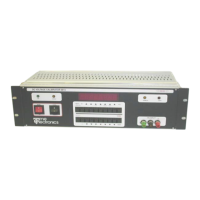

 To Next Page