Copyright by
CYTECH GmbH 2008
ENG 7
www.indoorcycling.com
Do not over tighten the connecting bolts.
Make sure the pop pin adjustment knob is
fully engaged and the handlebar post does
not wobble while riding.
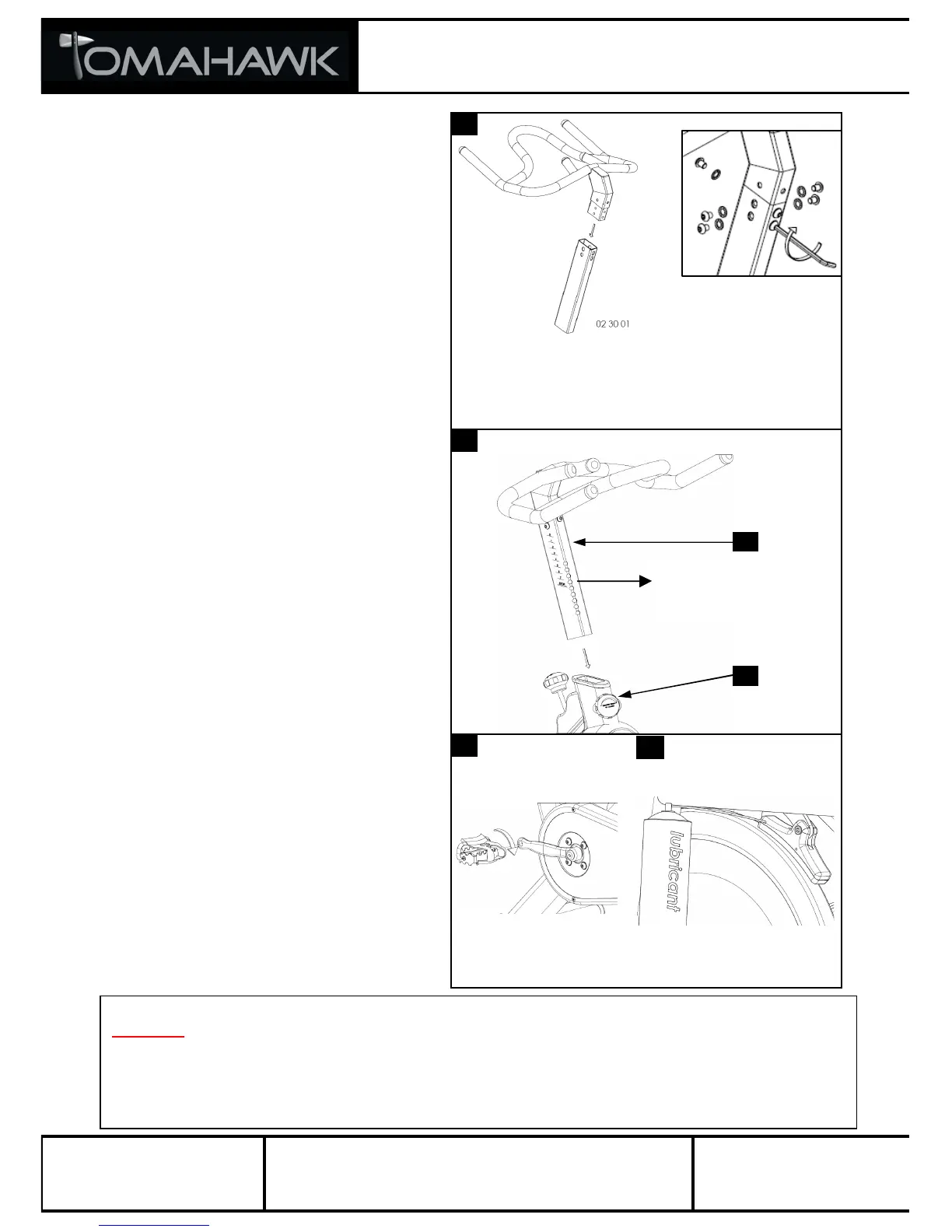
5. Orient the parts needed to
assemble the handlebar. Slide
upper part of the handlebar into
the handlebar stem and connect
the 2 pieces using the 7 allen bolts
and washers provided.
Make sure that the connecting
allen bolts are appropriately
tightened and handlebar does
not wobble because of a loose
connection.
6. Turn the front pop pin
adjustment knob (A) counter
clockwise, and pull the adjustment
knob to insert the handlebar post
(B) into the frame. Next, bring the
handlebar post to the desired
height, release the adjustment knob
so pin engages with the holes of the
vertical stem and turn the
adjustment knob clockwise to
retighten until it is secure.
Please don’t adjust the height of the
vertical saddle support beyond the
stop mark to avoid instability.
7. Identify the Right pedal.
Carefully insert the right pedal into
the crank arm by hand turning it
clockwise assuring that it is aligned
horizontally. Using a 15mm pedal
wrench, firmly tighten the right
pedal clockwise into the right crank
arm. Repeat the same procedure for
the left pedal but in a counter
clockwise motion.
The manufacturer recommends
the use of semi loctite to mount
the pedals and to avoid that
pedals become loose while
riding.
8. Make sure that the brake pad is thoroughly soaked with lubricant (WD-40)
BEFORE the indoor cycle is used. Also make sure there is a space (approx. as
thin as a credit card) between the brake pad and flywheel on the lowest
resistance setting. This precaution will avoid extensive wear on the brake
pad. To protect the floor or carpet, place a mat under the indoor cycle.


 To Next Page
 Loading...