EasyManua.ls Logo

Toolkraft 910A - Adjustments to Compensate for Wear; Clutch Assembly Adjustment

Default Icon
25 pages
Print Icon
To Next Page IconTo Next Page
To Previous Page IconTo Previous Page
Loading...
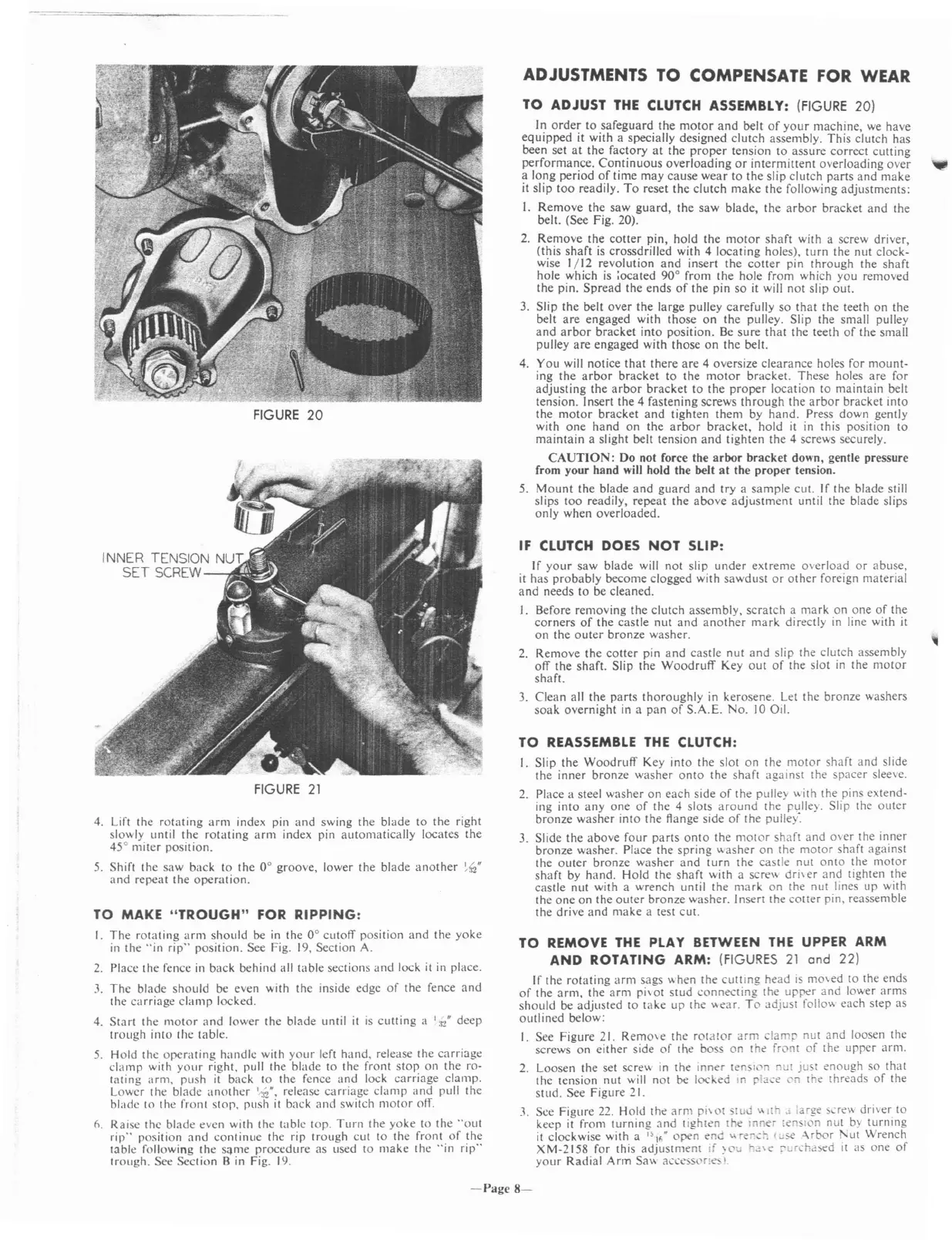
FIGURE
20
FIGURE
21
4. Lift
the
rotating
arm
index
pin
and
swing
the
blade
to
the
right
slowly
until
the
rotating
arm
index
pin
automatically
locates
the
45°
miter
position.
5.
Shift
the
saw
back
to
the
groove,
lower
the
blade
another
~'<2H
and
repeat
the
operation.
TO MAKE
"TROUGH"
FOR
RIPPING:
I.
The
rotating
arm
should
be
in
the
cutoff
position
and
the
yoke
in
the
"in
rip"
position.
See
Fig. 19,
Section
A.
2.
Place
the
fence
in
back
behind
all
table
sections
and
lock
it
in
place.
3.
The
blade
should
be
even
with
the
inside
edge
of
the
fence
and
the
carriage
clamp
locked.
4.
Start
the
motor
and
lower
the
blade
until
it
is
cutting
a I
:r/
deep
trough
into
the
table.
5.
Hold
the
operating
handle
with
your
left
hand.
release
the
carriage
clamp
with
your
right.
pull
the
blade
to
the
front
stop
on
the
roo
tating
arm.
push
it
back
to
the
fence
and
lock
carriage
clamp.
Lower
the
blade
another
'~12'.
release
carriage
clamp
and
pull
the
blade
to
the
front
stop,
push
it
back
and
switch
motor
off.
O.
Raise
the
blade
even
with
the
table
lOp.
Turn
the
yoke
to
the
"out
rip"
position
and
continue
the
rip
trough
cut
to
the
front
of
the
table
following
the
s'!me
procedure
as
used
to
make
the
"in
rip"
trough.
See
Section
B in Fig. 19.
ADJUSTMENTS
TO
COMPENSATE
FOR
WEAR
TO ADJUST
THE
CLUTCH
ASSEMBLY: (FIGURE 20)
In
order
to
safeguard
the
motor
and
belt
of
your
machine,
we
have
equipped
it
with
a
specially
designed
clutch
assembly.
This
clutch
has
been
set
at
the
factory
at
the
proper
tension
to
assure
correct
cutting
performance.
Continuous
overloading
or
intermittent
overloading
over
a
long
period
of
time
may
cause
wear
to
the
slip
clutch
parts
and
make
it
slip
too
readily.
To
reset
the
clutch
make
the
following
adjustments:
1.
Remove
the
saw
guard,
the
saw
blade,
the
arbor
bracket
and
the
belt.
(See
Fig.
20).
2.
Remove
the
cotter
pin,
hold
the
motor
shaft
with
a
screw
driver,
(this
shaft
is
crossdrilled
with
4
locating
holes),
turn
the
nut
clock-
wise
1/12
revolution
and
insert
the
cotter
pin
through
the
shaft
hole
which
is
:ocated
90°
from
the
hole
from
which
you
removed
the
pin.
Spread
the
ends
of
the
pin
so
it will
not
slip
out.
3.
Slip
the
belt
over
the
large
pulley
carefully
so
that
the
teeth
on
the
belt
are
engaged
with
those
on
the
pulley.
Slip
the
small
pulley
and
arbor
bracket
into
position.
Be
sure
that
the
teeth
of
the
small
pulley
are
engaged
with
those
on
the
belt.
4.
You
will
notice
that
there
are
4
oversize
clearance
holes
for
mount-
ing
the
arbor
bracket
to
the
motor
bracket.
These
holes
are
for
adjusting
the
arbor
bracket
to
the
proper
location
to
maintain
belt
tension.
Insert
the
4
fastening
serews
through
the
arbor
bracket
into
the
motor
bracket
and
tighten
them
by
hand.
Press
down
gently
with
one
hand
on
the
arbor
bracket,
hold
it in
this
position
to
maintain
a
slight
belt
tension
and
tighten
the
4
screws
securely.
CAUTION:
Do not force the arbor bracket down, gentle pressure
from your hand
will
hold the belt
at
the proper tension.
5.
Mount
the
blade
and
guard
and
try
a
sample
cut.
If
the
blade
still
slips
too
readily,
repeat
the
above
adjustment
until
the
blade
slips
only
when
overloaded.
IF
CLUTCH
DOES
NOT
SLIP:
If
your
saw
blade
will
not
slip
under
extreme
overload
or
abuse,
it
has
probably
become
clogged
with
sawdust
or
other
foreign
material
and
needs
to
be
cleaned.
1.
Before
removing
the
clutch
assembly.
scratch
a
mark
on
one
of
the
corners
of
the
castle
nut
and
another
mark
directly
in line
with
it
on
the
outer
bronze
washer.
2.
Remove
the
cotter
pin
and
castle
nut
and
slip
the
clutch
assembly
off
the
shaft.
Slip
the
Woodruff
Key
out
of
the
slot
in
the
motor
shaft.
3.
Clean
all
the
parts
thoroughly
in
kerosene.
Let
the
bronze
washers
soak
overnight
in a
pan
of
S.A.E.
No.
JO
Oil.
TO
REASSEMBLE
THE
CLUTCH:
1.
Slip
the
Woodruff
Key
into
the
slot
on
the
motor
shaft
and
slide
the
inner
bronze
washer
onto
the
shaft
against
the
spacer
sleeve.
2.
Place
a steel
washer
on
each
side
of
the
pulley
\\ ith
the
pins
extend-
ing
into
anyone
of
the
4
slots
around
the
pulley. Slip the
outer
bronze
washer
into
the
flange
side
of
the
pulley".
3.
Slide
the
above
four
parts
onto
the
motor
shaft
and
over
the
inner
bronze
washer.
Place
the
spring
"asher
on
the
motor
shaft
against
the
outer
bronze
washer
and
turn
the
castle
nut
onto
the
motor
shaft
by
hand.
Hold
the
shaft
with
a
scre\\
dri\
er
and
tighten
the
castle
nut
with
a
wrench
until
the
mark
on
the
nut
lines
up
with
the
one
on
the
outer
bronze
washer.
Insert
the
cotter
pin,
reassemble
the
drive
and
make
a
test
cut.
TO REMOVE
THE
PLAY BETWEEN
THE
UPPER
ARM
AND
ROTATING ARM: (FIGURES
21
and
22)
If
the
rotating
arm
sags
"hen
the
cutting
head
is
mo\ed
to
the
ends
of
the
arm,
the
arm
pi\
at
stud
connecting
the
upper
and
lower
arms
should
be
adjusted
to
take
up
the
"ear.
To
adjust
folio"
each
step
as
outlined
below:
I.
See
Figure
21.
Remo\e
the
rotate>r
arm
clamp
nut
and
loosen
the
screws
on
either
side
of
the
bo~
on
the
front
of
the
upper
arm.
2.
Loosen
the
set
sere\\
in
the
inner
te
Slon
r.
t
just
enough
so
that
the
tension
nut
will
not
be
laded
In
pla-.:e
l'f1
t e
threads
of
the
stud.
See
Figure
21.
3.
See
Figure
22.
Hold
the
arm
pi\ot
5!UJ
\
",;
" large S,'re"
driver
to
keep
it
from
turning
and
tighten
t e
Jnner
tenslI:,n
nut
by turn1l1g
it
clockwise
with
a
"I~'
open
enC
"re,.:;;
1.;;<
Arbor
l'ut
Wrench
XM-2158
for
this
adjustment
If
\0"
ra\
,wr'hased
it
as
one
of
your
Radial
Arm
Sa\\
H,Xl'SSOf!C"> I,
-Page
8-