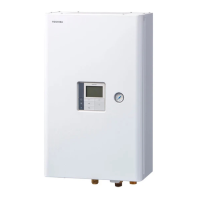
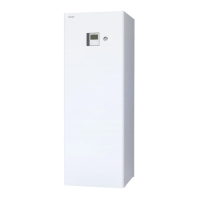
Hydro Unit
Installation Manual
– 10 –
H < 7 m
Hot water outlet
connection R1
Water inlet
connection R1
▼Fig.7-09
Local arrangement
Isolating Ball Valve
Strainer (30 to 40
meshes)
Drain cock for
water charge
and discharge
Inlet
▼Fig.7-10
Water pipe
Design the water pipe length within the QH
characteristics of the pump (Refer to “Fig. 7-14”,
“Fig. 7-15” and “Fig. 7-16” on page 11”).
The height of the pipe must be 7 m or less.
▼Fig.7-08
Water circuit
• Install a strainer with 30 to 40 meshes (locally
procured) at the water inlet of the Hydro Unit.
• Install drain cocks (locally procured) for water charge
and discharge at the lower part of the Hydro Unit.
• Make the piping route a closed circuit. (An open
water circuit may cause a failure.)
Piping to hot water cylinder (option)
Water supplied to the hot water cylinder is branched by
a motorized 3-way valve (locally procured).
For the specifications of the motorized 3-way valve,
refer to “Control parts specifications” on page 13.
Connect the hot water cylinder to port A (open when
energized) of the valve.
▼Fig.7-11
A
B
AB
Motorized mixing valve
(locally procured)
Water pump
(locally procured)
Zone
2
from Hydro
Unit
to Hydro Unit
Buffer tank (locally
procured)
Piping to 2-zone operation
To perform 2-zone temperature control, circulate water
by another pump (locally procured) through a
motorized mixing valve (locally procured) and a buffer
tank (locally procured).
For the specifications of the motorized mixing valve,
Refer to “Control parts specifications” on page 13.
▼Fig.7-12
Checking water volume and initial pressure
of expansion vessel for Heating
The expansion vessel of the Hydro Unit has a capacity
of 8 liters.
The initial pressure of the expansion vessel is
0.15 MPa (1.5 bar).
The pressure of the safety valve is 0.43 MPa (4.3 bar).
Verify whether the capacity of the expansion vessel is
sufficient using the following expression. If the volume
is insufficient, add the capacity locally.
Expression for expansion vessel selection
V: Necessarytotaltankcapacity(ℓ)
ε: Waterexpansioncoefficientateachhotwater
temperature
Vs: Total water amount in the system
P1: System pressure at tank setting position
(MPaabs.)
= water supply pressure = 0.25 (MPaabs.)
(recommended value)
P2: Maximum pressure used during operation at tank
setting position (MPaabs.)
= safety valve setting pressure = 0.53 (MPaabs.)
* The absolute pressure value (abs.) is obtained by
adding the atmospheric pressure (0.1 MPa (1 bar))
to the gauge pressure.
▼Tankselectionmethod
Water temperature and expansion coefficient
Hot water
temperature
(°C)
Expansion
rateε
Hot water
temperature
(°C)
Expansion
rateε
0 0.0002 50 0.0121
4 0.0000 55 0.0145
5 0.0000 60 0.0171
10 0.0003 65 0.0198
15 0.0008 70 0.0229
20 0.0017 75 0.0258
25 0.0029 80 0.0292
30 0.0043 85 0.0324
35 0.0050 90 0.0361
40 0.0078
45 0.0100
▼Fig.7-13
to Hydro Unit
room heating or cooling
to hot water cylinder
Open when energized
Open when de-
energized
A
B
AB
Vs:Totalwateramountinthesystem(ℓ)
V:Necessarytotaltankcapacity(ℓ)
0
2
4
6
8
*In case the maximum hot water temperature is 65ºC
Install an external expansion vessel when the capacity
of the expansion vessel is insufficient.
19-EN
20-EN


 To Next Page
 Loading...