8
3. Examine the lift point carefully and ensure that it is strong enough to resist the lifting force of the jack
without damaging the forklift or machinery.
• It is preferred to lift the forklift at a point where a structural member will be cradled in the lift arm
notch at the end of the lift arm (see Figure 5A).
• If no structural component on the forklift is present at the desired lifting point, weld a steel bar
to the forklift to create a structural member (as in Figure 5A).
• If no structural component exists and one cannot be created, ip the serrated lift pad into an
upward position and choose a lift point at least 3” inward toward the center of the vehicle on a
at surface (see Figure 5B).
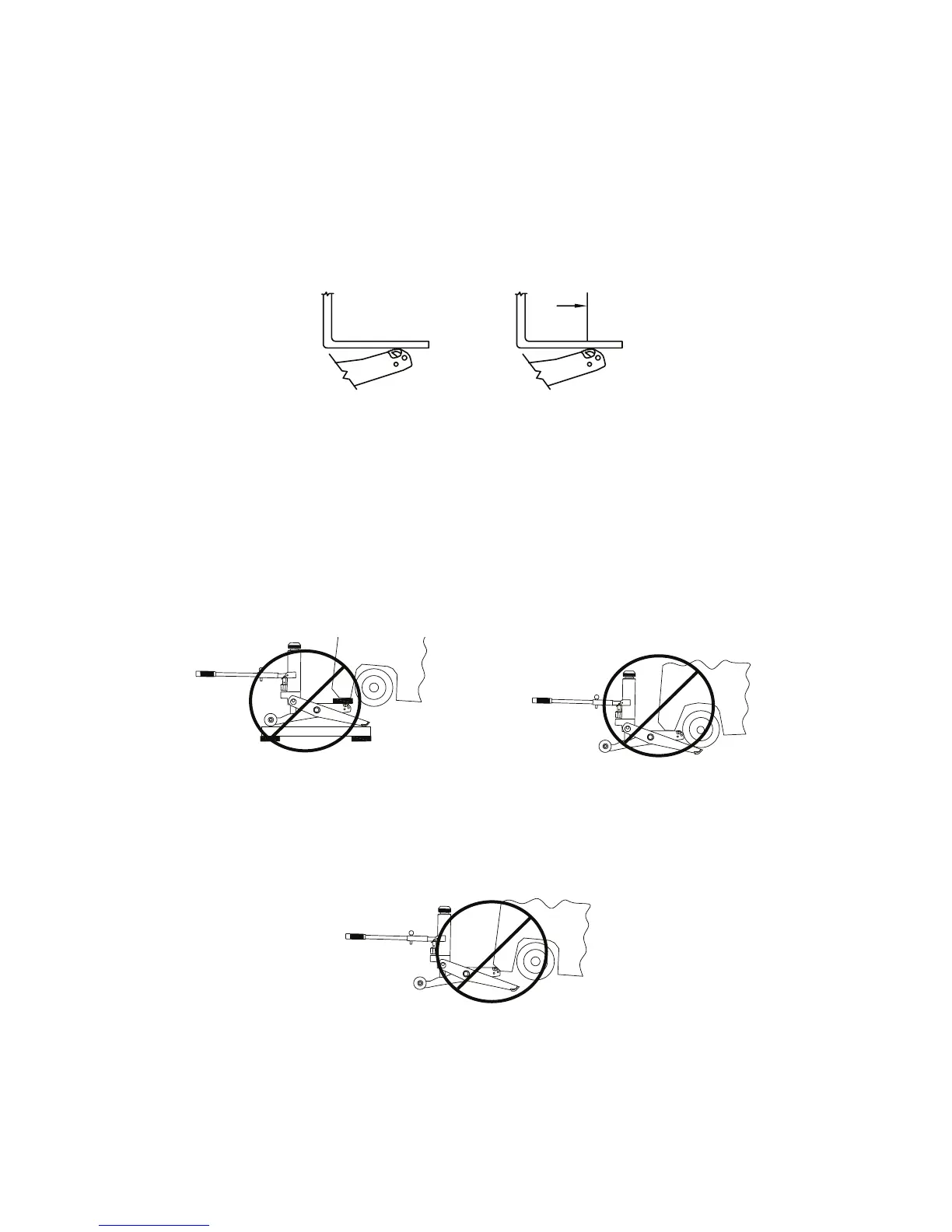
• The serrated lift pad or lift arm notch must be in direct contact with the forklift (see Figure 6A).
WARNING! Never use any other area on the jack as a contact point (see Figure 6B).
• The jack’s front footpad and rear wheels must ALWAYS remain in direct contact with the oor
(see Figure 4). WARNING! Never increase the lifting height of the jack by putting wood, pads, cinder
blocks, or any other objects above the lift pad or underneath the front footpad and/or wheels (See
Figure 6A).
• WARNING! NEVER lift with the jack positioned under a sloped or rounded surface, such as the
bottom surface of a forklift’s counterweights (see Figure 7).
• WARNING! NEVER push the jack under the load past the “red line” marked on the decal located on
top of the lift arm.
• WARNING! NEVER lift the forklift by its counterweight.
• WARNING! NEVER lift the forklift in a manner that is counter to the manufacturer’s recommendations.
Figure 5A
Figure 6A
Figure 7
Figure 5B
Figure 6B
• The serrated lift pad or lift arm notch must be in direct contact with the forklift .
WARNING! NEVER use any other area on the jack as a contact point (see Figure 6).
• The jack’s front footpad and rear wheels must ALWAYS remain in direct contact with the floor (see Figure 4).
WARNING! NEVER increase the lifting height of the jack by putting wood, pads, cinder blocks, or any other objects
above the lift pad or underneath the front footpad and/or wheels (See Fig. 7A).
• WARNING! NEVER lift with the jack positioned under a sloped or rounded surface, such as the bottom surface of
a forklift’s counterweights (see Figure 7B).
Figure 6
Figure 7A Figure 7B
• WARNING! NEVER push the jack under the load past the “red line” marked on the decal located on top of the lift
arm.
• WARNING! NEVER lift the forklift by its counterweight.
• WARNING! NEVER lift the forklift in a manner that is counter to the manufacturer’s recommendations.
6. Raise the Forklift
1. Make sure the forklift is not running before raising the forklift.
2. If lifting the forklift from the front or rear, the wheels remaining on the ground must be chocked.
3. Select a lift point as outlined in Step 4.
4. Make sure appropriate support stands and chocks are available for use in the immediate work area.
5. If the jack pump handle is not in the socket, insert the pump handle and lock it into position with the quick-release
locking pin provided. Remove the J-clip from the pump plunger shaft (see Figure 2).
6. Carefully begin pumping the jack handle to raise the load.
WARNING! NEVER raise the forklift higher than 1/4 its tread width when using the serrated lift pad (see Figure 8).
Figure 8
8
Tread Width
Height
• The serrated lift pad or lift arm notch must be in direct contact with the forklift .
WARNING! NEVER use any other area on the jack as a contact point (see Figure 6).
• The jack’s front footpad and rear wheels must ALWAYS remain in direct contact with the floor (see Figure 4).
WARNING! NEVER increase the lifting height of the jack by putting wood, pads, cinder blocks, or any other objects
above the lift pad or underneath the front footpad and/or wheels (See Fig. 7A).
• WARNING! NEVER lift with the jack positioned under a sloped or rounded surface, such as the bottom surface of
a forklift’s counterweights (see Figure 7B).
Figure 6
Figure 7A Figure 7B
• WARNING! NEVER push the jack under the load past the “red line” marked on the decal located on top of the lift
arm.
• WARNING! NEVER lift the forklift by its counterweight.
• WARNING! NEVER lift the forklift in a manner that is counter to the manufacturer’s recommendations.
6. Raise the Forklift
1. Make sure the forklift is not running before raising the forklift.
2. If lifting the forklift from the front or rear, the wheels remaining on the ground must be chocked.
3. Select a lift point as outlined in Step 4.
4. Make sure appropriate support stands and chocks are available for use in the immediate work area.
5. If the jack pump handle is not in the socket, insert the pump handle and lock it into position with the quick-release
locking pin provided. Remove the J-clip from the pump plunger shaft (see Figure 2).
6. Carefully begin pumping the jack handle to raise the load.
WARNING! NEVER raise the forklift higher than 1/4 its tread width when using the serrated lift pad (see Figure 8).
Figure 8
8
Tread Width
Height
• The serrated lift pad or lift arm notch must be in direct contact with the forklift .
WARNING! NEVER use any other area on the jack as a contact point (see Figure 6).
• The jack’s front footpad and rear wheels must ALWAYS remain in direct contact with the floor (see Figure 4).
WARNING! NEVER increase the lifting height of the jack by putting wood, pads, cinder blocks, or any other objects
above the lift pad or underneath the front footpad and/or wheels (See Fig. 7A).
• WARNING! NEVER lift with the jack positioned under a sloped or rounded surface, such as the bottom surface of
a forklift’s counterweights (see Figure 7B).
Figure 6
Figure 7A Figure 7B
• WARNING! NEVER push the jack under the load past the “red line” marked on the decal located on top of the lift
arm.
• WARNING! NEVER lift the forklift by its counterweight.
• WARNING! NEVER lift the forklift in a manner that is counter to the manufacturer’s recommendations.
6. Raise the Forklift
1. Make sure the forklift is not running before raising the forklift.
2. If lifting the forklift from the front or rear, the wheels remaining on the ground must be chocked.
3. Select a lift point as outlined in Step 4.
4. Make sure appropriate support stands and chocks are available for use in the immediate work area.
5. If the jack pump handle is not in the socket, insert the pump handle and lock it into position with the quick-release
locking pin provided. Remove the J-clip from the pump plunger shaft (see Figure 2).
6. Carefully begin pumping the jack handle to raise the load.
WARNING! NEVER raise the forklift higher than 1/4 its tread width when using the serrated lift pad (see Figure 8).
Figure 8
8
Tread Width
Height
5. Identify a Lift Point, Prepare the Load for Lifting, and Chock Wheels
Before lifting a forklift with the jack, you need to identify a lift point and prepare the load for lifting.
1. Remove any load from the forks of the forklift and lower the forks to the ground.
2. Identify a lift point at the rear or side of the forklift.
WARNING! When selecting a lift point, it is very important that you consider the following:
• Position the jack so that, as the forklift is lifted, the load will be balanced on the forklift tires that remain on the
ground.
• When raising a forklift from one end, always chock the wheels that will remain on the ground.
• Make sure at least two wheels of the forklift remain in contact with the floor at all times. NEVER raise a 3-wheeled
forklift from the 2-wheeled end or from the side. NEVER use the jack to raise all four wheels of the forklift from the
floor. NEVER raise the forklift higher than 1/4 its tread width (see Figure 4).
Figure 4
Tread Width
Height
3. Examine the lift point carefully and ensure that it is strong enough to resist the lifting force of the jack without
damaging the forklift or machinery.
• If is preferred to lift the forklift at a point where a structural member will be cradled in the lift arm notch at the end
of the lift arm (see Figure 5A).
• If no structural component on the forklift is present at the desired lifting point, weld a steel bar to the forklift to
create a structural member (as in Figure 5A).
• If no structural component exists and one cannot be created, flip the serrated lift pad into an upward position
and choose a lift point at least 3” inward toward the center of the vehicle on a flat surface (see Figure 5B).
Figure 5A Figure 5B
7
3"
Min.
5. Identify a Lift Point, Prepare the Load for Lifting, and Chock Wheels
Before lifting a forklift with the jack, you need to identify a lift point and prepare the load for lifting.
1. Remove any load from the forks of the forklift and lower the forks to the ground.
2. Identify a lift point at the rear or side of the forklift.
WARNING! When selecting a lift point, it is very important that you consider the following:
• Position the jack so that, as the forklift is lifted, the load will be balanced on the forklift tires that remain on the
ground.
• When raising a forklift from one end, always chock the wheels that will remain on the ground.
• Make sure at least two wheels of the forklift remain in contact with the floor at all times. NEVER raise a 3-wheeled
forklift from the 2-wheeled end or from the side. NEVER use the jack to raise all four wheels of the forklift from the
floor. NEVER raise the forklift higher than 1/4 its tread width (see Figure 4).
Figure 4
Tread Width
Height
3. Examine the lift point carefully and ensure that it is strong enough to resist the lifting force of the jack without
damaging the forklift or machinery.
• If is preferred to lift the forklift at a point where a structural member will be cradled in the lift arm notch at the end
of the lift arm (see Figure 5A).
• If no structural component on the forklift is present at the desired lifting point, weld a steel bar to the forklift to
create a structural member (as in Figure 5A).
• If no structural component exists and one cannot be created, flip the serrated lift pad into an upward position
and choose a lift point at least 3” inward toward the center of the vehicle on a flat surface (see Figure 5B).
Figure 5A Figure 5B
7
3"
Min.


 To Next Page
 Loading...