Need help?
Do you have a question about the TP-Link Tapo T100 and is the answer not in the manual?
Step-by-step guide for replacing the battery using a shim tool for easier removal and insertion.
Alternative method for replacing the battery by hand, detailing the process without a specialized tool.
Important safety guidelines including keeping the device away from water, fire, and avoiding disassembly or modification.
This document is a Quick Start Guide for the TP-Link Tapo Smart Motion Sensor, providing instructions for setup, testing, placement, and maintenance of the device.
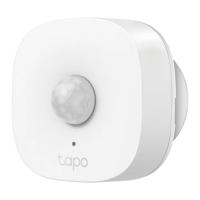
The Tapo Smart Motion Sensor is designed to detect movement within a specified area and trigger different actions in response, enhancing home safety and smart automation. It is a compact device with a sensor detector, an LED indicator, and a mounting stand. The sensor operates on a CR2450 battery, which is housed in a compartment accessible for replacement. A reset button is also included for troubleshooting and re-pairing the device.
Before starting the setup process, it's crucial to note that a Tapo Hub is required for the motion sensor to function. Users must ensure their Tapo Hub has been successfully added via the Tapo app prior to setting up the motion sensor. The Tapo app, available on both the Apple App Store and Google Play, is central to the entire setup and management process. A setup video is also available by scanning a QR code or visiting a specific URL provided in the guide, offering a visual walkthrough of the installation.
The initial step in setting up the sensor is to power it up. This involves removing the battery insulation tab. Once the tab is removed, the sensor's LED should begin to blink, indicating it is powered on and ready for the next step. If the LED does not blink, the guide advises referring to the reverse side for reset instructions, which typically involves pressing and holding the reset button for a few seconds.
The second step is to set up the sensor using the Tapo app. Users need to open the Tapo app, tap the '+' button to add a new device, select "Sensors," and then choose their specific motion sensor model. The app will then guide the user through the remaining instructions to complete the setup process, likely involving pairing the sensor with the Tapo Hub.
Once the sensor is set up, the guide recommends testing it. To do this, users should take the sensor to their preferred location and wave their hand in front of it. The Tapo app should then display whether the sensor has been triggered, confirming its functionality and detection capabilities. This step helps ensure the sensor is working correctly before final placement.
For placing the sensor, three options are provided to accommodate various installation needs. Option 1 allows for magnetic attachment to metallic objects, offering flexibility and ease of repositioning. Option 2 involves sticking the sensor to a clean wall using the included adhesive, providing a more permanent fixture. Option 3 is to simply place the sensor on a shelf or table, which is suitable for temporary setups or locations where mounting is not desired.
The guide also includes important information regarding the detection area of the sensor. It specifies that the sensor should be aligned with the detection area and placed as close as possible to the edge of a table or cabinet for optimal performance. Crucially, the installation height should not exceed 2 meters. Diagrams illustrating the side view and top view of the detection area are provided, showing a detection range of up to 7 meters and a 120-degree field of view from the top. These details help users position the sensor effectively to cover the desired space.
Maintenance features include instructions on how to replace the battery. Two methods are described: Option 1, using a shim, and Option 2, by hand. Both options involve carefully opening the sensor to access the CR2450 battery compartment, removing the old battery, and inserting a new one. This ensures the sensor remains operational over time.
Finally, the guide provides instructions on how to reset the sensor. If the sensor needs to be reset, users are instructed to use a pin to press and hold the Reset button for 5 seconds until the front LED starts blinking. This action typically restores the sensor to its factory default settings, allowing for re-pairing or troubleshooting.
For further assistance, the guide directs users to the TP-Link Tapo support website (www.tapo.com/support/), where they can find technical support, user guides, FAQs, and warranty information. The document also includes safety information, advising users to keep the device away from water, fire, humidity, or hot environments, and not to attempt to disassemble, repair, or modify it. It also warns against using the device where wireless devices are not allowed and emphasizes the importance of reading and following safety information. A critical safety warning is included regarding the battery: "Do not ingest battery, Chemical Burn Hazard."
 General
| Sensor type | - |
|---|---|
| Detection distance | 7 m |
| Connectivity technology | Wireless |
| Operating temperature (T-T) | 0 - 40 °C |
| Portable | Yes |
| Placement | Indoor |
| Mounting type | Ceiling/wall |
| Product color | White |
| Detection angle | 120 ° |
| Package type | Box |
| Package depth | 66 mm |
| Package height | 43.5 mm |
| Package weight | 50 g |
| Quantity per pack | 1 pc(s) |
| Battery life | 2 year(s) |
| Battery type | CR2450 |
| Power source type | Battery |
 Weight and Dimensions
| Depth | 34 mm |
|---|---|
| Height | 42.3 mm |

 To Next Page