Additional General Safety information
X3.1.2 Use a minimum of 6 inches of protective surfacing for play equipment less than
4 feet in height. If maintained properly, this should be adequate. (At depths less than 6
inches, the protective material is too easily displaced or compacted.)
NOTE: Do not install home playground equipment over concrete, asphalt, or any other
hard surface. A fall onto a hard surface can result in serious injury to the equipment user.
Grass and dirt are not considered protective surfacing because wear and environmental
factors can reduce their shock absorbing effectiveness. Carpeting and thin mats are
generally not adequate protective surfacing. Ground level equipment – such as a
sandbox, activity wall, playhouse or other equipment that has no elevated play surface –
does not need any protective surfacing.
X3.1.3 Use containment, such as digging out around the perimeter and/or lining the
perimeter with landscape edging. Don’t forget to account for water drainage.
X3.1.3.1 Check and maintain the depth of the loose-fill surfacing material. To maintain
the right amount of loose- fill materials, mark the correct level on play equipment support
posts. That way you can easily see when to replenish and/or redistribute the surfacing.
X3.1.3.2 Do not install loose fill surfacing over hard surfaces such as concrete or asphalt.
X3.1.4 Poured-In-Place Surfaces or Pre-Manufactured Rubber Tiles - You may be
interested in using surfacing other than loose-fill materials – like rubber tiles or poured-
in-place surfaces.
X3.1.4.1 Installations of these surfaces generally require a professional and are not “do-it-
yourself” projects.
X3.1.4.2 Review surface specifications before purchasing this type of surfacing. Ask
the installer/manufacturer for a report showing that the product has been tested to the
following safety standard: ASTM F 1292 Standard Specification for Impact Attenuation of
Surfacing Materials within the Use Zone of Playground Equipment. This report should
show the specific height for which the surface is intended to protect against serious head
injury. This height should be equal to or greater than the fall height – vertical distance
between a designated play surface (elevated surface for standing, sitting, or climbing)
and the protective surfacing below – of your play equipment.
X3.1.4.3 Check the protective surfacing frequently for wear.
X3.1.5 Placement - Proper placement and maintenance of protective surfacing is
essential. Be sure to:
X3.1.5.1 Extend surfacing at least 6 feet from the equipment in all directions.
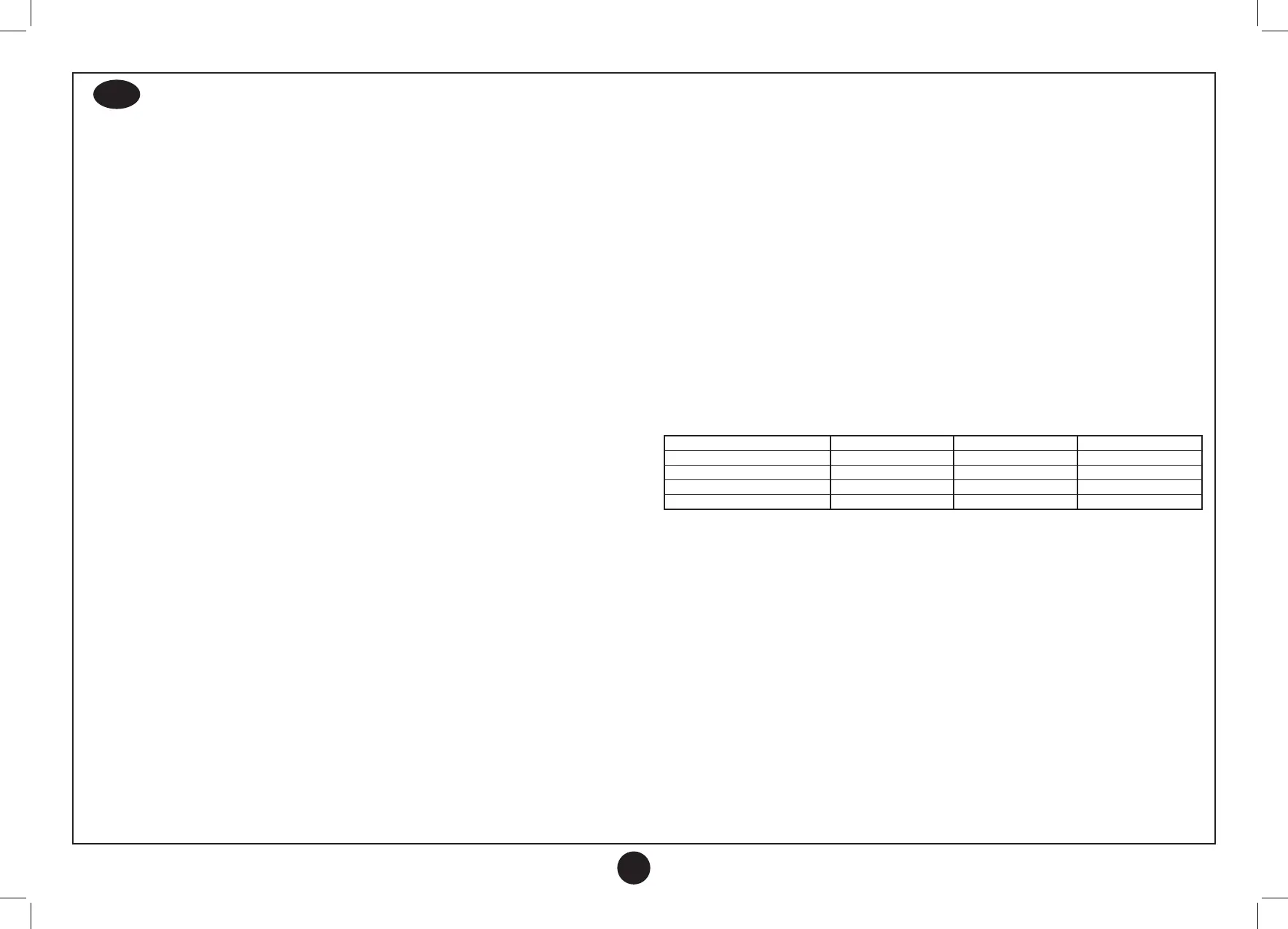
X3.2 Table X3.1 lists the maximum height from which a child would not be expected to
sustain a life-threatening head injury in a fall onto four different loose-fill surfacing
materials if they are installed and maintained at depths of 6, 9, and 12 in. However, it
should be recognized that all injuries due to falls cannot be prevented no matter what
surfacing material is used.
X3.3 It is recommended that a shock absorbing material should extend a minimum of
6 ft in all directions from the perimeter of stationary equipment such as climbers and
slides. However, because children may deliberately jump from a moving swing, the
shock absorbing material should extend in the front and rear of a swing a minimum
distance of 2 times the height of the pivot point measured from a point directly beneath
the pivot on the supporting structure.
X3.4 This information is intended to assist in comparing the relative shock-absorbing
properties of various materials. No particular material is recommended over another.
However, each material is only effective when properly maintained. Materials should be
checked periodically and replenished to maintain correct depth as determined necessary
for your equipment. The choice of a material depends on the type and height of the
playground equipment, the availability of the material in your area, and its cost.
9 This information has been extracted from the CPSC publications “Playground Surfacing
-Technical Information Guide” and “Handbook for Public Playground Safety.” Copies
of these reports can be obtained by sending a postcard to the: Office of Public Affairs,
U.S. Consumer Product Safety Commission, Washington, D.C., 20207 or call the toll-free
hotline: 1-800-638-2772.
TABLE X3.1 Fall Height in Feet From Which a Life Threatening Head Injury Would
Not Be Expected
(Maximum fall height for product = 102cm)
WARNING!
Please instruct children not to use the equipment in a manner other than intended.
Installation Instructions and Information -
Place the equipment on level ground, not less than 6ft (2m) from any structure or
obstruction such as a fence, Garage, house, overhanging branches, laundry lines, or
electrical wires.
Do not install home playground equipment over concrete, asphalt, packed earth, or
any other hard surface. A fall onto a hard surface can result in serious injury to the
equipment user.
Type of Material 6 inch depth 9 inch depth 12 inch depth
Double Shredded Bark Mulch 6 10 11
Wood Chips 6 7 12
Fine Sand 5 5 9
Fine Gravel 6 7 10
USA
8
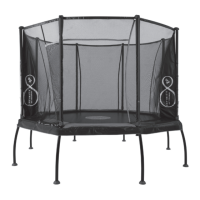
TP Infinity Octagonal Trampolines


 To Next Page
 Loading...