This document is an assembly guide for the Trévi Romy Pavilion, a 12' x 18' outdoor structure. The manual provides detailed instructions and parts lists to facilitate the construction of this pavilion.
Function Description
The Trévi Romy Pavilion is designed as a semi-permanent outdoor structure, likely intended for providing shade, shelter, and an aesthetic focal point in a garden, patio, or backyard setting. Pavilions typically serve as gathering spaces for relaxation, dining, or entertaining, offering protection from sun and light rain. The visual representation of the assembled pavilion suggests a robust and enclosed structure, possibly with glass or transparent panels, indicating its suitability for various weather conditions and extended outdoor use. The design appears to incorporate multiple window-like sections, which would allow for ample natural light and views of the surroundings, enhancing the outdoor living experience.
Important Technical Specifications
While explicit technical specifications such as material types, weight capacity, or wind resistance ratings are not detailed in the provided pages, the assembly steps and parts list offer insights into the structure's construction.
Dimensions:
- The pavilion measures 12' x 18' (3.66 m x 5.49 m). This size suggests a substantial footprint, capable of accommodating a significant amount of outdoor furniture or a small gathering.
Components and Construction:
The pavilion is constructed from numerous individual parts, categorized in the "PRE-ASSEMBLY / PRE-ASSEMBLY" sections (Parts List 1, 2, and 3). Key components include:
- Frame Elements: Parts A1 (x12), A2 (x2), B1 (x2), B2 (x2), E (x4), H (x2), I (x4), J (x1), K (x1), L1 (x4), L2 (x8), M (x8), M1 (x4), N (x12), O (x4), O1 (x8), P (x4), P1 (x4), P2 (x4), Q (x12), Z1 (x8), Z2 (x4), Z3 (x3). These likely form the main structural framework, including vertical posts, horizontal beams, and roof supports. The varying quantities suggest a modular design, with some parts used more frequently than others to build the overall structure.
- Panel Elements: The illustrations for A1, A2, B1, and B2 depict framed panels, resembling windows or wall sections. The quantities (e.g., A1 x12, B2 x2) indicate that the pavilion is composed of multiple such panels, which would contribute to its enclosed nature.
- Roof Elements: Parts W1a, W1b, W1c, W1d, Wa, Wb, Wc, Wd (all x4) are illustrated as trapezoidal or triangular shapes, strongly suggesting they are roof panels or sections. The presence of multiple distinct shapes indicates a multi-faceted or sloped roof design, likely for efficient water runoff and structural integrity. S (x8) and S1 (x4), S2 (x4) also appear to be related to the roof structure.
- Fasteners and Hardware: A wide array of fasteners is listed, indicating a secure and durable assembly:
- Bolts: W (M6x70, x12), X (M6x70, x12), V (M6x16, x58), V2 (M6x16, x8), B6 (M6x35, x8), U (M5x35, x56), V1 (M6x35, x3). The different sizes and types suggest specific applications for various structural connections.
- Screws: T (M4x6, x72), S (St4x16, x40), S1 (St4x30, x12), S2 (St5x16, x8). Screws are typically used for attaching panels, trim, or smaller components.
- Other Hardware: C (x24, possibly brackets or connectors), D (x24, possibly small connectors or clips), B5 (x4, possibly hinges or specialized brackets), Y (M6, x3, possibly hooks or hanging points).
- Tools: Z3 (x1) is depicted as a wrench, indicating that basic hand tools are required for assembly, and at least one is provided.
The extensive list of components and fasteners implies a sturdy construction, designed to withstand outdoor elements. The use of different bolt and screw sizes suggests a carefully engineered structure where specific fasteners are chosen for optimal strength and stability at different connection points.
Usage Features
The Trévi Romy Pavilion, once assembled, offers several usage features:
- Enclosed or Semi-Enclosed Space: The presence of numerous panel-like components (A1, A2, B1, B2) suggests that the pavilion can provide a relatively enclosed space, offering protection from wind, rain, and insects, depending on the specific infill material of these panels (e.g., glass, polycarbonate, or screens).
- Ample Natural Light: If the panels are transparent or translucent, the pavilion would allow for significant natural light, creating a bright and inviting interior space.
- Versatile Outdoor Living Area: The 12' x 18' dimensions make it suitable for various functions, such as:
- Dining Area: Large enough to accommodate a dining table and chairs for outdoor meals.
- Lounge Area: Can house comfortable seating for relaxation and socializing.
- Garden Room: A protected space to enjoy the garden views year-round.
- Hot Tub Enclosure: Providing privacy and shelter for a hot tub.
- Aesthetic Appeal: The detailed assembly implies a well-designed structure that can enhance the visual appeal of any outdoor space. The multi-faceted roof design (indicated by the W-series parts) often adds a sophisticated architectural element.
- Potential for Customization: While not explicitly stated, many pavilions allow for customization with curtains, lighting, or heating elements to further enhance comfort and functionality. The presence of "Y" parts (hooks) could suggest intended hanging points for such accessories.
Maintenance Features
The manual does not explicitly detail maintenance features, but based on the typical construction of such pavilions, some general maintenance aspects can be inferred:
- Material Durability: The extensive use of fasteners and the implied robust framing suggest materials designed for outdoor exposure. Common materials for pavilions include aluminum, steel, or treated wood, often with powder-coated finishes for corrosion resistance. These materials generally require minimal maintenance.
- Cleaning: Regular cleaning of the frame and panels (if transparent) would be necessary to maintain appearance and clarity. This typically involves mild soap and water.
- Fastener Checks: Over time, fasteners in outdoor structures can loosen due to environmental factors (e.g., wind, temperature changes). Periodic checks and tightening of all bolts and screws (W, X, V, V2, B6, U, V1, T, S, S1, S2) would be a recommended maintenance practice to ensure structural integrity and safety.
- Roof Maintenance: The roof panels (W1a-Wd series) would likely require occasional cleaning to remove debris, leaves, or snow, and inspection for any damage or leaks.
- Panel Integrity: The window-like panels (A1, A2, B1, B2) would need to be inspected for cracks, damage, or seal integrity, especially if they are made of glass or polycarbonate.
- Drainage: The design of the roof and overall structure should facilitate proper water drainage to prevent pooling and potential damage. Ensuring that drainage channels (if any) remain clear of debris is important.
In summary, the Trévi Romy Pavilion is a substantial 12' x 18' outdoor structure designed to provide a versatile and aesthetically pleasing enclosed or semi-enclosed space. Its assembly involves numerous components and fasteners, indicating a sturdy construction. While specific material details are not provided, the design suggests durability and a need for routine checks and cleaning to ensure longevity and continued enjoyment.

 Need help?
 General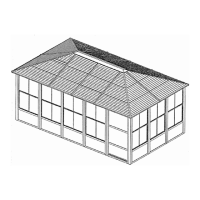

 To Next Page