
 Need help?
Do you have a question about the tron SART and is the answer not in the manual?
Instructions for activating the SART unit via button press and testing.
Details instructor messages, signal reception by other ships, and radar display changes based on SART proximity.
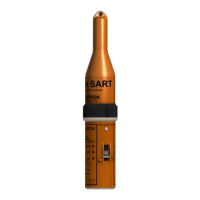
The Tron SART is a simulated Search and Rescue Transponder (SART) designed for use within the Poseidon Pharos GMDSS Simulator. This instrument manual provides an overview of its operation and how it is viewed through the maneuver console, allowing for realistic training scenarios in maritime search and rescue. The SART plays a crucial role in distress situations by providing a clear indication of a vessel's or survival craft's location to nearby radar-equipped ships and aircraft, thereby significantly enhancing the chances of a successful rescue.
The primary function of the Tron SART within the simulator is to emulate the behavior of a real SART, transmitting a distinctive signal that appears on radar displays. When activated, the SART sends out a series of twelve equally spaced dots on the radar screen, extending outwards from the SART's position. This unique signature allows rescuers to easily identify the distress signal amidst other radar clutter. The simulator accurately replicates this visual representation, providing trainees with a realistic experience of detecting and interpreting SART signals.
The SART operates on the 9 GHz (X-band) radar frequency, which is commonly used by marine radars. When a radar signal from a searching vessel or aircraft sweeps across the activated SART, the SART responds by transmitting its own signal. This response is designed to be easily distinguishable from normal radar returns. The simulated Tron SART faithfully reproduces this interaction, ensuring that trainees understand how a SART functions in a real-world scenario.
A key aspect of the SART's functionality is its ability to indicate proximity to the searching vessel. As the searching vessel approaches the SART, the appearance of the SART's signal on the radar display changes. Initially, when the SART is more than 1.0 nautical mile away, it appears as a series of distinct dots. As the distance closes to less than 1.0 nautical mile, these dots begin to merge and transform into arcs. This visual cue provides rescuers with an immediate indication that they are getting closer to the distress location. Further approach, to less than 0.5 nautical miles, causes the arcs to merge further, forming complete circles on the radar display. This progressive change in the radar signature is a critical feature for pinpointing the exact location of the SART, and the simulator effectively demonstrates these visual transitions.
The activation of the simulated Tron SART also triggers a notification to the instructor within the Poseidon Pharos GMDSS Simulator environment. This notification includes vital information such as the ship's name and its current position, allowing the instructor to monitor the training exercise and assess the trainees' response to a distress situation. This instructor feedback mechanism is essential for effective simulation-based training, enabling instructors to guide and evaluate trainees' performance.
The Tron SART in the simulator is designed for straightforward operation, mirroring the simplicity required for real-world distress situations. To activate the SART, trainees simply need to press the designated button on the simulated unit. This action initiates the SART's transmission, making it detectable by other simulated vessels within range. The ease of activation is crucial, as in a real emergency, complex procedures could hinder a timely response.
For testing purposes, the simulated SART offers a double-click function. This allows trainees to perform a quick check of the SART's functionality without fully activating it for a distress scenario. A test function is a standard feature on actual SARTs, ensuring that the device is in working order before an emergency arises. The simulator's inclusion of this feature reinforces best practices for equipment readiness.
The visual feedback on the radar display is a core usage feature. Trainees learn to interpret the changing radar signature of the SART – from dots to arcs to circles – to accurately gauge their distance from the distress source. This skill is fundamental for effective search and rescue operations, as it allows rescuers to efficiently home in on the SART's position. The simulator provides a dynamic and interactive environment for developing this crucial skill.
The integration of the SART with the broader GMDSS simulator environment means that its activation and detection are part of a comprehensive training scenario. Other simulated ships equipped with radar will receive the SART signals, allowing for multi-ship rescue exercises. This collaborative aspect of the simulation enhances the realism and complexity of the training, preparing trainees for coordinated rescue efforts.
While the Tron SART is a simulated device, its design incorporates elements that reflect the maintenance considerations of a real SART, primarily focusing on battery life. A critical aspect of SART readiness is the battery expiration date. The simulated SART includes a visual representation of a label indicating the battery expiration month and year. This feature serves as a constant reminder to trainees about the importance of checking and replacing SART batteries regularly.
The manual explicitly states, "Check label for battery expiration month and year," and provides an image of a label with months (JAN-DEC) and years (2014-2017) highlighted. This visual cue reinforces the practical maintenance task of verifying the battery's validity. In a real-world scenario, an expired battery would render the SART useless in an emergency, making this a vital maintenance check.
The inclusion of this "maintenance feature" within the simulator, even if it's a simulated check, educates trainees on the operational readiness requirements of safety equipment. It instills the habit of routine inspection and awareness of critical expiry dates for life-saving devices. This pedagogical approach ensures that trainees not only know how to operate the SART but also understand the responsibilities associated with its upkeep. By simulating the presence of such a label and emphasizing its importance, the simulator contributes to a holistic understanding of maritime safety equipment management.
 General
| Frequency Range | 9.2 - 9.5 GHz |
|---|---|
| Battery Life Standby | 96 hours |
| Battery Life Operating | 8 hours |
| Operating Temperature | -20°C to +55°C |
| Effective Radiated Power (ERP) | ≥ 400 mW |
| Standards | IMO A.802(19), IEC 60945, IEC 61097-1 |
| Type | SART (Search and Rescue Transponder) |
| Compliance | MED |
| Detection Range | ≥ 5 nautical miles (9.26 km) |

 To Next Page