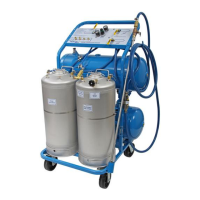
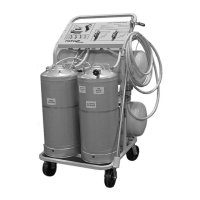
Models: 08-4049C0013
08-4049-0013-A2, 08-4049-0013-A6, 08-4049-0013-A7
Engine Compressor Washer
11/2023 | Rev. 02 Page | 4
6.0 MAINTENANCE
6.1 CLEANING FLUID TANKS
NOTE: For tank cleaning, wand must be attached to output hose to let fluid discharge.
After each use, complete the following:
1. Close supply air valve.
2. Open air bleed valve, let tanks de-pressurize.
3. Remove cleaning tank lid and fill with approximately one gallon (3.8 L) of water.
4. Close cleaning tank lid and air bleed valve. Open supply air valve.
5. Open clean selector valve and wand valve.
6. Close supply air valve when tank is empty.
7. Close clean selector valve, wand valve. Open air bleed valve.
6.2 HOSES
Replace worn hoses as required.
6.3 AIR TANK MAINTENANCE
Periodically drain air tank by opening plug valve at bottom of air tank to remove any condensation that may have
accumulated during use.
Hydrostatically or pneumatically test tank(s) as required due to physical damage, or as required by local law.
6.4 HYDROSTATIC TANK TEST
Hydrostatically test tank as required due to physical damage, or as required by local law.
A hydrostatic test is the most common way in which a cylinder is checked for leaks or flaws. During a hydrostatic
test, the cylinder is examined to ensure it can safely hold its rated pressure. Testing is crucial as such containers
can explode if they fail when containing compressed gas.
A hydrostatic test consists of filling the cylinder with a nearly incompressible liquid, usually water, and examining it
for leaks or permanent changes in shape. The test pressure is always considerably more than the operating
pressure to give a margin for safety. Typically, 150% of the operating pressure is used. Water is commonly used as
it is almost incompressible, and will only expand by a very small amount. If high pressure gas was used, the gas
could expand up to several hundred times its compressed volume, running the risk of serious injury.
6.5 OUTPUT FILTER
1. Periodically inspect filter for cleanliness. Clean with fresh water.
2. Replace filter element when fluid flow is hindered.
7.0 PROVISION OF SPARES
7.1 SOURCE OF SPARE PARTS
Spare parts may be obtained from the manufacturer:
TRONAIR, Inc. Telephone: (419) 866-6301 or 800-426-6301
1 Air Cargo Pkwy East Fax: (419) 867-0634
Swanton, Ohio 43558 USA E-mail: sales@tronair.com
Website: www.tronair.com
For Spare Parts, Operations & Service Manuals or Service Needs:
Scan the QR code or visit Tronair.com/aftermarket
7.2 RECOMMENDED SPARE PARTS LISTS
Reference the following page(s) for Replacement Parts and Kits available.
8.0 IN-SERVICE SUPPORT
Contact Tronair, Inc. for technical services and information. See Section 1.3 − Manufacturer.


 To Next Page
 Loading...