
 Need help?
Do you have a question about the Tronographic Rusty Box and is the answer not in the manual?
Connect instrument to Input, and next device to Main Out using standard guitar cables.
Use Main Out with a balanced TRS cable to connect to mixing boards or audio devices.
Connect Line Out to power amp input for unbalanced audio signal at full volume.
Input Gain controls drive level; HI/LO toggle adjusts impedance and signal amplitude.
Activates extra volume and drive; LED indicates Boost mode status.
Mid, Bass, Treble knobs shape tone; Vol knob controls master output volume.
Toggles between effect mode (LED lit) and True-Bypass (LED off).
Audio input for instrument or previous effects. Offers 250kΩ (HI) or 18kΩ (LO) impedance.
Unbalanced audio output at full volume, unaffected by Vol knob; muted in bypass.
Main audio output, usable balanced or unbalanced. Vol knob affects this jack only.
Requires standard 9VDC center-negative power supply (130mA draw).
Covers manufacturer defects or normal use damage for up to 2 years from purchase.
Details FCC compliance, potential interference, and user correction measures.
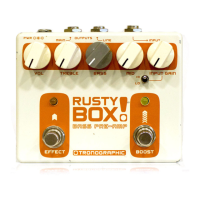
The Tronographic Rusty Box is a versatile instrument pre-amp designed in a compact effect pedal format, primarily optimized for bass guitar but also highly effective with standard guitar. It meticulously recreates the distinctive "hi-gain" solid-state bass amp tone of the 1970s while integrating modern functionalities such as a balanced line out, true-bypass switching, and a Master volume control. This combination allows musicians to achieve a classic sound with contemporary flexibility and control.
The core function of the Rusty Box is to act as a pre-amplifier, shaping and boosting your instrument's signal. It features an Input Gain Knob that allows precise control over the input amplifier stage. Turning this knob clockwise increases signal loudness and drive, with distortion achievable above the 9 o'clock position, especially when the BOOST function is active. This knob works in conjunction with the HI/LO Toggle Switch, which emulates the high and low input jacks found on traditional amplifiers. The HI setting provides high impedance with full signal amplitude, similar to plugging into a high input jack, resulting in a louder output. Conversely, the LO setting attenuates the input signal and reduces impedance, offering a lower volume with slight treble attenuation, akin to a low input jack.
The Rusty Box incorporates a passive EQ section with dedicated Middle, Bass, and Treble Knobs, all specifically tailored for bass guitar frequencies. The MID Knob adjusts the level of middle frequencies; turning it clockwise increases their presence, while turning it down below 12 o'clock can achieve a "scooped" sound. The BASS Knob controls the low frequencies, with clockwise rotation increasing bass presence. The TREBLE Knob is the final EQ control, boosting high frequencies when turned clockwise.
A VOL Knob serves as the master volume control, regulating the output volume at the Main Out jack. It's important to note that this knob does not affect the output volume at the Line Out jack.
The device includes a BOOST Footswitch and LED. When activated, the Boost switch increases the gain of the input stage, providing extra volume and drive. The LED above the footswitch illuminates when Boost mode is active. When Boost is inactive or the Rusty Box is in True-Bypass mode, the LED is off.
The EFFECT Footswitch and LED manage the overall effect status. This footswitch toggles the Rusty Box between Effect mode and True-Bypass. When the LED above the Effect footswitch is lit, the Rusty Box effect is active. In True-Bypass mode (LED off), the Input jack is directly connected to the Main Out jack, bypassing the internal circuitry. In this mode, the Line Out jack is muted, and the Main Out jack operates as an unbalanced output.
The Rusty Box offers multiple configurations for diverse musical setups:
As an Effects Pedal: It can be easily integrated into an existing effects chain, an effects loop, or used as a standalone effect before an amplifier with a pre-amp section. To set this up, connect your instrument or the output of the preceding device to the Input jack using a standard ¼-inch guitar cable. Then, connect the Main Out jack to the input of the next device in your chain, also with a standard ¼-inch guitar cable.
As a DI Box: The Main Out jack provides a balanced signal. For this configuration, connect your instrument or the output of the previous device to the Input jack using a standard ¼-inch guitar cable. For the Main Out jack, a balanced ¼-inch TRS cable is essential for proper DI functionality. The other end of this balanced cable can be connected directly to a mixing board or other balanced audio devices. Additionally, the Rusty Box's Line Out jack can be used to connect to a monitor amplifier near the musician for local monitoring. When using the Rusty Box as a DI box, it is recommended to keep it in effect mode at all times and avoid switching to bypass mode, as the Main Out jack becomes unbalanced in True-Bypass mode.
As a Pre-Amp for a Power Amp: The Line Out jack outputs an unbalanced audio signal at full volume, independent of the Vol knob. This connection is ideal for driving a power amp that has its own input volume control. To configure this, connect your instrument or the output of the previous device to the Input jack, then connect the Line Out jack to the input of the power amp using standard ¼-inch guitar cables for both connections. The volume of the signal from the Line Out jack can be adjusted using the Input Gain knob, Boost footswitch, or HI/LO toggle switch.
The Tronographic Rusty Box is designed for durability and reliability. In terms of power, it requires a standard 9VDC, center-negative effects pedal power supply. While its current draw is 130mA, it is recommended to use a power supply capable of providing at least 150mA to ensure stable operation. The power jack can accept voltages up to 12VDC, but it is crucial not to connect voltages greater than 12.5VDC to prevent damage. The polarity of the 9V Rusty Box's power jack is center-negative.
Tronographic provides a warranty for the Rusty Box, offering free repair due to manufacturer defect or damage incurred during normal use for up to 2 years from the date of purchase. For warranty claims or further information, customers can contact Tronographic via email. This commitment to post-purchase support ensures the longevity and continued performance of the device.
 General
| Technology | Analog |
|---|---|
| Inputs | 1 x 1/4" |
| Outputs | 1 x 1/4" |
| Controls | Volume, Tone, Gain |
| Power Requirements | 9V DC |
| Bypass | True Bypass |
| Type | Distortion |
| Power Source | 9V DC (center negative) |
| Input Impedance | 1M ohms |
| Dimensions | 4.7" x 3.7" |
| Output Impedance | 10k ohms |

 To Next Page
