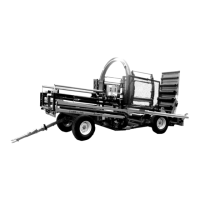
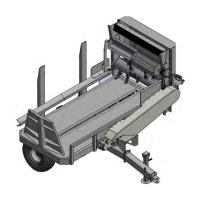
The Tube-Line Bale Wrapper TLR 5000X2 is an agricultural implement designed to wrap a continuous line of round bales in plastic film, providing a method for creating high-quality silage. This operator's manual, published in 2010, provides comprehensive information on the machine's operation, safety, maintenance, and parts.
Function Description:
The primary function of the TLR 5000X2 is to efficiently wrap round bales with plastic film to create silage. This process aims to preserve forage quality by creating an airtight seal, reducing dependence on weather conditions for hay drying, and extending the harvesting window. The machine is designed to handle bales up to 5' x 5.5' in size, although operators often reduce the diameter of silage bales to 4-4.5' due to their increased weight. The wrapper is not suitable for square bales.
Important Technical Specifications:
- Bale Size: Wraps round bales up to 5' x 5.5'.
- Power Options: Available with 13 HP Honda Electric Start or 20 HP Honda Engine Electric Start.
- Hydraulic System: Utilizes AW32 Hydraulic Oil. The hydraulic oil tank has a 10 Micron Filter, Filter Base, Suction Strainer, Breather Cap, Magnetic Plug, Filler Plug, and Sight Gauge.
- Electrical System: Includes a control panel with a 15 AMP Fuse, LED Light, 11 Pin Relay Base, Diode 1N5406 3amp 600V, DIN Rail Terminal Block, DIN Rail Fuse Holder, PVC Wire Holder, On/Off Switch, Man/Auto Switch, Steering Switch, Rotate Switch, Forward/Reverse Switch, and an Emergency Stop Button.
- Running Lights: Equipped with a 7 Pin Plug, Junction Box, Strain Relief, 7 Wire Conductor, Red Lamp, and Amber Lamp for road transport.
- Optional Features:
- Single Power Drive (TLHPD5000 / TLHPD50001)
- Dual Power Drive (TLHPDD5000 / TLPDD50001)
- Light Kit (TLNWLK)
- Remote Control (TLR SSKX2HD)
- Guide Roller Kit (TLGR)
- Twin Wrap Kit (TL TWK)
Usage Features:
- Silage Quality: Aims to provide high-quality forage by wrapping bales tightly and airtight.
- Harvest Flexibility: Reduces dependence on dry weather, allowing for timely harvest and extending the working day.
- Bale Wrapping Procedure: Bales should be well-shaped, firm, and wrapped as soon as possible after baling (ideally within four hours, or 12-16 hours in an emergency).
- Moisture Range: Successful silage can be made with 40-50% moisture for dairy cows, or 60-70% for beef farmers. Drier silage results in lighter bales, more desirable fermentation, less freezing, and higher dry matter intake.
- Wrapping Site Selection:
- Requires room for an adequate bale row length (at least 50 bales).
- Must be accessible in winter and not prone to flooding.
- Requires a firm surface for smooth forward movement; avoid soft ground.
- A site free from grass and debris reduces rodent damage to plastic.
- Operating Procedure:
- Park the wrapper at the desired end of the row, facing the appropriate direction, with the wrapper in the up position.
- Apply the parking brake and fold in the first section of the tongue, fastening it into the hydraulic steering slider.
- Maintain proper tire pressure. Replace tires with the same type and brand, or at least the same outside diameter.
- Installation of Plastic: Plastic has a natural tack on the inside. To determine the tack side, pull apart a folded piece of plastic. The roll of plastic should be installed with the tack side on the inside of the film path. The two metal rollers on the Tensioner should turn at different speeds to stretch the plastic.
- Wrapping Bales (Manual Mode): Place an end cap on the first bale. Pull about 4 ft of plastic through each stretcher and tie it under the twine or in the hoop brace slots. Set the control panel switch to "man" and turn the forward switch to advance the bale without applying plastic. Once the bale is pushed through the hoop, start the hoop rotating by pressing the "Rotate" button. The forward motion stops when the ram hits the switch at the end of the stroke. The reverse switch retracts the ram and opens the bale pusher for the next bale. Wrap the first few bales in "man" mode until the first bale overhangs by 6 inches.
- Wrapping Bales (Automatic Mode): Lower the machine to the ground and disengage the parking brake (and hydraulic lever if equipped with power drive). Switch the "auto/man" switch to "auto" and place a bale on the bale table. The table trigger ram will start automatically. Adjust the second slider switch to start the wrap cycle when the bale contacts other bales on the machine.
- Stopping the Cycle (Automatic Mode): Turn the "auto/man" switch to "man" or use the "stop" button on the remote kit. After rectifying the problem, finish the cycle in "man" mode before returning to "auto."
- Steering: Hydraulic steering keeps the wrapper in a straight line or directs it around obstacles. Avoid sharp turns when steering around obstacles to ensure bales are tightly packed. Steering speed can be adjusted with the needle valve at the manifold block. Align the wrapper in the desired direction and ensure steering is centered when starting a row.
- Remote Control (Optional): Allows control with a handheld unit. The table trigger switch should be unplugged. With the control panel "auto/man" switch on "auto," bales can be placed on the table without starting the cycle. Press the start button on the hand unit to begin the wrap cycle. Two remote buttons control steering, and a fourth is for cycle stop. The "on/off" switch on the control panel turns off all electric current and the engine stop.
- Slider Switch: Adjust the second slider switch to start the rotate motor when bales make contact. Adjust the rear switch so the junction of two bales is in the middle of the wrap chamber. The front slider switch stops the ram retract stroke after the engine throttles down.
- Brake: Equipped with a manual parking brake on the rear left wheel. If equipped with POWER DRIVE, it is used as a parking brake. Ensure the brake is disengaged before transport.
- Pushing Off Bales: To push off bales, switch to "man" position. Open the bale pusher, remove the linchpin from the front push plate arms, unfold the arms, and secure the X bar. Push the bale through the wrapper using the forward button. Retract the bale pusher, refold the push plate arms, and secure with linchpins. Open the safety doors, remove 2x3 tubes from the hydraulic tank side, and lay them across the top of the pushoff brackets. Close the pusher, open the pusher, and move the 2x3 tubes to the sockets at the rear end of the arms. Close the pusher to finish pushing off bales.
- Maximum Transport Speed: 32 km/h (20 mph). Exceeding this speed can result in loss of control, damage, or serious injury/death.
- Build-up on Stretchers: In hot weather, adhesive build-up can cause plastic to break. Remove adhesive with soap and water.
- Wrapping Straw: The TLR 5000X2 can be used to weather-protect straw. Two layers of plastic are necessary. If straw is dry, it can be wrapped continuously without spacers. Straw with higher moisture is best wrapped with spaces in the plastic.
- After Wrapping: Inspect rows of silage regularly for damage from birds, rodents, or livestock.
- Feeding Out: A loader can pick up bales without cutting the plastic. Plastic breaks away between bales and can be removed from the side of the bales before dropping them into the feeder.
- Disposal of Plastic: Users are encouraged to collect and recycle plastic. Do not burn plastic. Dispose of all plastic in an environmentally friendly manner.
Maintenance Features:
- Safety Decals: Keep safety signs clean and legible. Replace missing or illegible decals.
- Daily Maintenance (Lubrication):
- Slider Tube: Lightly grease once a week.
- Hoop Axle: Twice a day, all 8 bolts.
- Ram Axle: Once a week.
- Gear Box: 1 or 2 times every 2 months.
- DO NOT OVER GREASE.
- Oil Points: Oil Bottom Door Rollers, Top Door Roller, Rollers, Throttle Shaft, and Bearings on Last 2 Rollers occasionally to keep parts moving freely.
- Hydraulic Oil: Use AW32 Hydraulic Oil.
- Film Sensor Installation: Install and adjust the film sensor bracket. Locate the pre-wired film sensor wire, remove the plug, and connect to the film sensor switch. Install the toggle switch in the control panel. Remove the jumper wire between terminals 18 & 19 and connect wires from the toggle switch to terminals 18 & 19.
- Safety Alert Symbol: Indicates instructions involving personal and others' safety. Failure to follow these can result in injury or death.
- Signal Words:
- Caution: Potentially hazardous situation that may result in injury.
- Warning: Potentially hazardous situation that could result in serious injury or death.
- Danger: Hazardous situation that needs to be avoided.
- General Safety Guidelines:
- Always read and understand the manual and machine before operation.
- Keep all shields and safety doors in place. Replace them if faulty.
- Do not operate the equipment with shields removed.
- Replace any decals that are missing or unreadable.
- Do not operate under the influence of drugs or alcohol.
- Review safety instructions with all users annually.
- Do not allow children or unauthorized persons to operate the machine.
- Do not paint over, remove, or deface safety signs or warning decals.
- Ensure the bale sits firmly on the deck to prevent plastic tearing.
- High-pressure hydraulic oil leaks can penetrate skin, causing serious injury or death. Check for leaks with cardboard, never use hands. Lower loads, release pressure, and ensure oil is cool before loosening fittings. Consult a physician if skin penetration occurs.
- Before Operation:
- Study and understand the manual.
- Do not wear loose clothing that may get caught in moving parts.
- Visually inspect the machine for loose or missing parts.
- Ensure no tools are left on the machine.
- Make sure no hay is lying on the engine or cooling fins.
- Do not hurry the learning process.
- Practice running the machine through its paces in manual mode.
- Do not reach in and push the switch paddle down by hand.
- Installation of Plastic: Never ride on the machine while being used or transported. Never climb on the table or inside the wrap chamber with the engine running. Turn the control panel to "man" or stop the engine when changing plastic rolls. Never leave it in "auto" as your helper may set a new bale on the table or press the start button on the remote.
- Safety Switches: Safety switches are installed in the doors. In "auto" mode, doors must be closed. In "man" mode, these switches are bypassed.
Warranty and Limitation of Liability:
All equipment is warranted to be free from defects in materials and workmanship for one year from the purchase date. The company's liability is limited to replacing or repairing defective parts at its discretion. The company is not liable for special, indirect, or consequential damages. Warranty coverage is null and void unless the Warranty Registration form is completely filled out and on file at Tube-Line Manufacturing Ltd.

 Need help?
 General

 To Next Page