
 Need help?
Do you have a question about the Twyford GEO-6 and is the answer not in the manual?
Includes prior checks, alcove positioning, profile alignment, marking, and drilling.
Steps cover screwing profiles to the wall and sliding the unit into place.
Focuses on pivoting the assembly, screwing the second profile, and centering the screen.
Includes fitting cover caps, applying badges, adjusting doors, and installing handles.
Covers sealing enclosure joints and specific steps for corner installations.
Details connecting the side panel and fitting the towel rail.
Final step involves placing the enclosure on the tray and completing sealing.
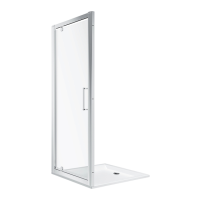
This document provides comprehensive instructions for the installation and maintenance of Twyford Geo-6 Pivot Doors, designed for shower enclosures, available with or without a side panel. The manual emphasizes safety, proper installation techniques, and routine care to ensure the longevity and optimal performance of the shower screen.
The primary function of the Twyford Geo-6 Pivot Door is to create a secure and functional shower enclosure, preventing water from escaping the showering area. It is designed to be installed either in an alcove or with an additional side panel, offering flexibility for various bathroom layouts. The pivot mechanism allows the door to open smoothly, providing easy access to the shower.
The installation process begins with crucial preparatory steps. Before installing the shower screen, it is essential to install the shower tray according to the manufacturer's instructions, ensuring it is level in all directions. This foundational step is critical for the proper alignment and sealing of the shower enclosure.
For installation in an alcove, the first step involves positioning the wall profiles approximately 8mm in from the edge of the tray or inside of the up-stand. If installing with a side panel, specific instructions are provided in a later step (step 14). Once the wall profiles are positioned, it is vital to ensure both are upright using a spirit level, confirming vertical alignment.
The next step involves marking the positions on the wall through the pre-drilled holes in the wall profiles using a pencil. After marking, the wall profiles should be carefully moved away from the wall and placed safely to prevent damage during drilling. Holes are then drilled where marked using a 6mm masonry drill bit. The manual advises seeking professional advice if drilling into tiles. Once the holes are drilled, the provided wall plugs are installed.
Following the preparation, one wall profile is screwed to the wall, ensuring it remains vertical, using the provided 30mm screws. If installing with a side panel, the same procedure is repeated for the second profile, ensuring the distance from the edge of the tray is consistent with the first profile.
For alcove installations, the unfixed wall profile is loosely located into the vertical door profile, and the entire unit is then slid into the fixed wall profile. The assembly is then pivoted around the fixed profile to its final position. By parting the loose profiles, the other wall profile can be screwed into the pre-drilled holes.
Ensuring the screen is central between the walls and vertical, holes are drilled through the pre-drilled holes in the shower profile into the wall profile using a 3.2mm diameter drill. The components are then secured together using the provided 10mm screws. Once tightened, the screw cover strip is installed. Finally, the profile cover caps are fitted as shown in the diagrams, and the badge is applied.
Adjusting the door is a critical step to ensure smooth operation. This involves slackening the hinge block screws at the top and bottom. The glass door should be square in the frame and operate smoothly. If the door does not shut positively, the polarity of the magnets should be checked and corrected. The handles are then installed according to the provided diagram.
A crucial step for water tightness is sealing the enclosure. Using good quality clear silicon sealant, the enclosure is sealed to the wall and tray along specific joints:
For corner installations with a side panel, the left and right wall profiles are positioned as shown in the diagram. Once positioned, the installation continues with steps 2-5.
When installing with a side panel, holes are drilled through the pre-drilled holes in the shower profile into the side panel profile using the provided 3.2mm drill bit. The components are secured with 10mm screws, and then the screw cover strip and profile cover caps are installed. The towel rail is then installed onto the external face of the side panel. Finally, the shower enclosure is placed on the tray and moved into the wall profiles. Once this is complete, the installation continues with steps 8-13.
Proper maintenance is essential to keep the shower enclosure in optimal condition and prevent the build-up of limescale and residues.
By following these detailed installation and maintenance instructions, users can ensure the safe, proper, and long-lasting performance of their Twyford Geo-6 Pivot Door shower enclosure.
 General
| Product Type | Toilet |
|---|---|
| Flush Type | Dual Flush |
| Material | Vitreous China |
| Water Inlet | Bottom Inlet |
| Color | White |

 To Next Page