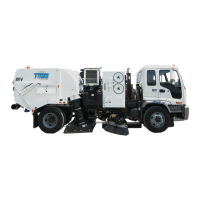
A TYMCO REGENERATIVE AIR SWEEPER can be expected to clean normal debris that
may accumulate on streets, parking lots, and other fl at paved surfaces. Using the machine
for more than it was originally designed will cause excessive wear and failure to achieve the
desire results.
This sweeper is not a Vacuum Cleaner. Cleaning is actually done by a stream of high velocity
air the full width of the pick-up head. A blower furnishes both pressure and suction. Air
pressure from the blower passes over the surface being swept within the pick-up head,
blows up debris in its path, and the suction pulls it into the hopper, where it is separated. Air
continues on into the blower and the cycle is repeated.
The TYMCO REGENERATIVE AIR SWEEPER is not intended nor is it expected to replace
a shovel crew or a front end loader. An inspection at the dump site, however, may reveal that
there are rocks and large objects in the hopper. This is due to air currents in the TYMCO
REGENERATIVE AIR SYSTEM having the potential to pick up various large objects and
retain them. The mixture of light debris will sometimes boost the large objects into the air
stream and carry them into the hopper. Objects such as cans, bottles, glass, paper, leaves
and light stringy refuse or normal daily accumulation of debris are easily picked up by the
sweeper’s unique REGENERATIVE AIR SYSTEM.
We can not say what blower RPM or truck speed at which you can achieve your sweeper’s
full capabilities because of the various types of sweeping encountered. However, engine
RPM should not exceed 2000. For parking lot sweeping consisting of paper, broken glass,
cans, leaves, etc., engine RPM can be reduced as desired. The sweeper can be operated at
truck speeds up to 10 MPH without changing blower RPM. The above limits are intended for
smooth wide open spaces that are sparsely scattered with debris. Slower truck speeds are
advisable for curb and gutter work or where there are many obstacles. This prevents damage
and wear to pick-up head and gutter broom. Faster speeds may be necessary under your
particular conditions. However, you may expect considerably more wear, not only by the hour
as a result of more coverage, but also by the mile. The heat generated at higher speeds will
result in softening of the materials in contact with the surface. We would advise consideration
of these facts before allowing high speed operation, overloading and machine neglect.
SAVE FUEL, REDUCE NOISE, WEAR AND DUST.
OPERATE AT THE LOWEST POSSIBLE R.P.M. TO ADEQUATELY DO THE JOB.
D4OPTRS 2 2013


 To Next Page
 Loading...