EasyManua.ls Logo

Uelfer SM 2-L Series - User Manual

Uelfer SM 2-L Series
12 pages
Print Icon
To Next Page IconTo Next Page
Loading...
[5]
[4]
[3]
[2]
[1]
Application
For double-wing doors only
SM 2- xL- A2x0
Operation
|049|
8 0.0.0.1
..//OM/Bedienung
Deutsch
Die Statusanzeige am Türalarmgerät signalisiert
den Überwachungszustand der Fluchttür:
i
n
[1] AN = Fluchttür überwacht
[2] AUS = Fluchttür nicht überwacht
[3] Blinkt = Fluchttür nicht überwacht
- Tür-Offen-Alarm-Stummschaltung aktiviert
- Dauer-Unscharfschaltung aktiviert
- Störungsmeldung , Sicherung F1 defekt
- Tür offen
SM 2- -L
1
:
2
AN AUS
SM 2- -L-
2
:
1
AN AUS
SM 2- L-
1
:
1
AN AUS
SM 2- BL-
Statusanzeige
Die Türalarmgeräte SM 2- xL- sichern Fluchttüren
gegen unberechtigte Benutzung. Für eine ständi-
ge Überwachung ist es wichtig, dass das Tür-
alarmgerät immer scharfgeschaltet, d.h. überwa-
chungsbereit, ist. Die Statusanzeige signalisiert
den Überwachungszustand. Für eine berechtigte
Benutzung können Sie den Türalarm über den in-
tegrierten Profilzylinder oder über evtl. zusätzli-
SM 2- -L-
che externe Bedienteile unscharfschalten
und die Fluchttür öffnen. Nach der Benutzung
schalten Sie den Türalarm über das Bedienele-
ment oder einfach über den Schnell-Scharf-
schalttaster wieder scharf. Damit nach einer be-
rechtigten Benutzung das Wiedereinschalten
nicht vergessen werden kann, verfügt der Tür-
alarm über eine Automatische Scharfschalt-
funktion bzw. eine Zwangsscharfschalt-
funktion . Bleibt die Fluchttür versehent-
lich offen stehen, meldet der Türalarm ein Erinne-
rungssignal – den Tür-
SM 2- -L-
SM 2- BL-
D
D
SM
2- -L-
Für eine zuverlässige Überwachung ist es erforderlich, dass die
Schlüssel nicht in falsche Hände gelangen. Die Türalarmgeräte
können beim Einsatz von mehreren Geräten als Liefervariante
mit gleichschließenden Zylindern (SM PV PZ/GS) geliefert wer-
den.
Offen-Alarm .
akustischer
[1] Optischer Alarmgeber
[2] Statusanzeige
[3] Akustischer Alarmgeber
[4] Profilzylinder
[5] Schnell-Scharfschalttaster
Ist es erfor-
derlich, eine Fluchttür berechtigt offen zu lassen,
z.B. zur Warenanlieferung, so aktivieren Sie die
Tür-Offen-Alarm-Stummschaltung und unter-
drücken damit das Erinnerungssignal. Eine unbe-
rechtigte Nutzung der Fluchttür wird sofort als op-
tischer und Alarm gemeldet. Ein
ausgelöster Alarm muss über das integrierte Be-
dienelement oder über ein externes Bedienteil
zurückgestellt werden.
i
Bedienung
Funktions-, Bedienungsbeschreibung
|034|
Español
..//OM/Manejo
El indicador de estado en el aparato de alarma
para puerta muestra el estado actual de la
puerta de escape.
i
n
[1] ENCENDIDO = Puerta de escape vigilada
[2] APAGADO = Puerta de escape no vigilada
[3] Parpadeo = Puerta de escape no vigilada
- Enmudecimiento de la alarma de puerta abierta
activado
- Desarmado permanente externo
activado
,
- Aviso de avería fusible F1 defectuo-
so
- Puerta abierta
SM 2- -L
1
:
2
ENCENDIDO APAGADO
SM 2- -L-
2
:
1
ENCENDIDO APAGADO
SM 2- L-
1
:
1
ENCENDIDO APAGADO
SM 2- BL-
Indicador de estado
Los aparatos de alarma para puerta SM 2- xL-
protegen las puertas de escape contra un uso no
autorizado. Para una vigilancia permanente es ne-
cesario quel aparato de alarma para puerta se en-
cuentre siempre armado, es decir, lista para reali-
zar las tareas de vigilancia. El indicador de esta-
do muestra el estado de vigilancia. Para un uso
autorizado de la puerta de escape se podrá des-
armar la alarma para puerta a través del cilindro
del perfil integrado o de los elementos de manejo
SM 2- -L-
adicionales y abrir la puerta de escape.
Una vez finalizada la utilización, arme de nuevo
la alarma a través del elemento de manejo o sim-
plemente accionando la tecla de armado rápido.
La alarma para puerta dispone de una función
de armado automático o una función de
armado de obligatoriedad para evitar
que la alarma pueda quedar desactivada despu-
és de un uso autorizado. Si la puerta de escape
quedara abierta por descuido, la alarma para
puerta emitirá una señal recordatoria - alarma de
puerta abierta
SM 2- -L-
SM 2- BL-
D
D
SM 2- -L-
Una vigilancia segura requiere que las llaves no pararán en
malos manos. Cuando utilice múltiples aparatos los aparatos de
alarma para puerta pueden ser suministrado como variante de
entrega con cilindros con misma cerradura (SM PV PZ/GS).
.
[1] Avisador óptico de alarma
[2] Indicador de estado
[3] Avisador acústico de alarma
[4] Cilindro de perfil
[5] Tecla de armado rápido
Cuando se necesite dejar abier-
ta una puerta de escape de forma autorizada, por
ej., para la recepción de mercancía, active el en-
mudecimiento de la alarma de puerta abierta
silenciando con ello la señal recordatoria. Un uso
no autorizado de la puerta de escape será anun-
ciado inmediatamente mediante una alarma ópti-
ca y acústica. Una alarma disparada debe ser re-
puesta a través del elemento integrado de mane-
jo o a través de un elemento externo de mane-
jo .
i
Manejo
Descripción de funcionamiento y manejo
The status indication informs about the state of
surveillance of the escape door:
i
n
[1] ON = Escape door monitored
[2] OFF = Escape door not monitored
[3] Blinking = Escape door not monitored
- Door-open-alarm muting circuit activated
- Continuous disarming activated
- Malfunction message , Fuse F1 faulty
- Door open
SM 2- -L
1
:
2
ON OFF
SM 2- -L-
2
:
1
ON OFF
SM 2- L-
1
:
1
ON OFF
SM 2- BL-
Status indication
The SM 2- xL- Door Alarm Devices safeguard es-
cape doors against unauthorised use. For perma-
nent surveillance, it is essential that the door
alarm device is permanently armed i.e. ready to
monitor. The status indication signals the state
of surveillance. For authorised use you can dis-
arm the door alarm by means of the integrated
profile cylinder or any additional external opera-
SM 2- -L-
ting devices and open the escape door. Af-
ter use, rearm the door alarm using the operating
element, or simply press the rapid-arming button.
The door alarm is provided with an automatic ar-
ming function or a forced arming func-
tion to ensure that the device is not acci-
dentally left switched off after authorised use. If
the escape door remains open unintentionally, the
door alarm responds with a reminder signal - the
door-open alarm
SM 2- -L-
SM 2- BL-
D
D
SM 2- -L-
For a reliable surveillance, it is necessary to prevent the key
from falling into the wrong hands. If more than one device will
be employed, the door alarm devices can be delivered as pro-
duct variation with cylinders with uniform closing characteristics
(SM PV PZ/GS).
.
[1] Optical alarm transmitter
[2] Status indication
[3] Acoustic alarm transmitter
[4] Profile cylinder
[5] Rapid-arming button
If an escape door needs to be
kept open with authorisation, for example when
delivering goods, you should activate the door-
open-alarm muting circuit . Doing this suppres-
ses the reminder signal. Unauthorised use of the
escape door is immediately indicated by an
acoustic and optical alarm signal. An alarm that
has been triggered must be reset with the integra-
ted operating element or via an external operating
device .
i
Operation
Function description, description of operation
..//OM/Operation
English
|044|
Technical Support
E-mail support@uelfer-security.com
Web www.uelfer-security.com
© UELFER electronic GmbH
<11.6>
Typ Revision Doc. Revision
Chapter Language Index Doc Vers. PagePage
OM
Building Security Systems (BSS) /
- Door Surveilance Systems (DSS) /
- Emergency Escape Surveilance (EES) /
- SM 2 Door Alarm System /
- Door Alarm

Question and Answer IconNeed help?

Do you have a question about the Uelfer SM 2-L Series and is the answer not in the manual?

Overview

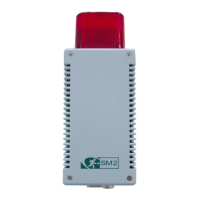
The SM 2-XL- Door Alarm Devices are designed to safeguard escape doors against unauthorized use, ensuring permanent surveillance. The device signals its surveillance status via a status indicator. For authorized use, the door alarm can be disarmed using the integrated profile cylinder or any additional external operating devices (SM 2-L-), allowing the escape door to be opened. After use, the door alarm can be rearmed using the operating element or by simply pressing the rapid-arming button.

The door alarm is equipped with an automatic arming function (SM 2-L-) or a forced arming function (SM 2-BL-) to prevent accidental deactivation after authorized use. If the escape door remains unintentionally open, the door alarm triggers a reminder signal, known as the "door-open alarm." If an escape door needs to be kept open with authorization (e.g., for goods delivery), the "door-open-alarm muting circuit" can be activated to suppress this reminder signal. Unauthorized use of the escape door is immediately indicated by an acoustic and optical alarm signal. Triggered alarms must be reset using the integrated operating element or an external operating device (SM 2-L-).

Function Description:

  • Disarming: Deactivates the surveillance state of the escape door.
    • Short-time disarming: The device is armed, and the red status indicator glows. Turn the key from [A] to [B] and back to [A], then remove it. The red status indicator will no longer glow, and the escape door can be opened without triggering an alarm.
    • Continuous disarming: Only possible via external operating devices. The procedure depends on the specific operating device and is described in its accompanying instructions.
  • Arming: Activates the surveillance state of the escape door.
    • Manual arming: Allows for arming/disarming operation. Turning the key from [A] to [B] and back to [A] switches between states. This function requires specific programming during installation.
    • Automatic arming (SM 2-L-): Ensures constant surveillance. Actuating the profile cylinder once disarms the device. After the door is closed and a delay of approximately 30 seconds, the system automatically returns to the monitoring state. This eliminates the need for manual rearming and prevents accidental deactivation. This is the factory-provided delivery status.
    • Forced arming (SM 2-BL-): If the door alarm device is disarmed and the red status indication does not glow, close the door. The surveillance state is automatically restored after 30 seconds, and the status indication glows.
    • Rapid-arming function: When the door is closed, the device can be manually armed at any time using the rapid-arming button. This allows rearming by unauthorized personnel (e.g., for goods delivery). Disarming via this button is not possible and requires proof of authorization.
  • Door-Open Alarm: Ensures escape doors are not left open unnoticed.
    • Door-open alarm (SM 2-L-): If an escape door is not properly closed, the door alarm system triggers a reminder signal (door-open alarm) at approximately 20-second intervals. This message can be signaled via the internal acoustic and optical alarm transmitter, the relay output, and the external alarm output.
    • Door-open alarm (SM 2-BL-): If an escape door is not properly closed after the forced arming period of 10 minutes, the door alarm system triggers an acoustic and optical reminder signal (door-open alarm) at approximately 30-second intervals.
  • Door-Open-Alarm Muting Circuit: Deactivates the door-open alarm, allowing an escape door to remain open intentionally for a desired period (e.g., for goods delivery).
    • Door-open-alarm muting circuit (SM 2-L-): Activated for a single opening operation and automatically canceled when the door closes. To activate, with the device armed and the red status indicator glowing, turn the profile cylinder key from [A] to [B] and hold it for approximately 4 seconds until a second acknowledgment beep is heard. Then, turn the key back to [A] and remove it. The status indicator will blink, and the escape door can be left open.
    • Door-open-alarm muting circuit (SM 2-BL-): Automatically activated when the device is disarmed. If the door remains open after the forced arming time has elapsed, the door-open alarm is triggered. If the door needs to remain open for an additional period, the muting circuit can be reactivated.
    • Muting via rapid-arming button: Actuating the rapid-arming button mutes the door-open alarm for an additional 10 minutes.
  • Main Alarm: Triggered upon unauthorized opening of the escape door. Signaled via the internal acoustic and optical alarm transmitter, relay output, and external alarm outputs (SM 2-L-).
  • Alarm Reset: An alarm triggered by unauthorized use, manipulation, or sabotage must be reset manually.
    • Reset via profile cylinder: Turn the key from [A] to [B] and back to [A], then remove it. The alarm is reset. Close the escape door and rearm the device.
    • External alarm reset (SM 2-L-): An alarm can alternatively be reset via an external operating device. The operation depends on the specific device and is described in its instructions. It is crucial that an alarm can only be reset by the integrated operating element or an external operating device with proof of authorization. Resetting via a door release button without authorization is not permitted, as it compromises the supervisory measure.
  • External Operation (SM 2-L-): External operating devices can be used with or without proof of authorization, or as central operating devices.
    • Devices with proof of authorization: Key or numerical code operating devices, access control readers with authorization tokens (TAGs), or fingerprint readers.
    • Devices without proof of authorization: Door release buttons or automatic detection of the using direction.
    • Central operating device: E.g., the SM 60 Alarm, Operation, and Indication Panel.
    • These devices allow for disarming, arming, door-open-alarm muting, alarm reset, and continuous disarming. Different authorization levels can be assigned, allowing some employees to open doors briefly without a door-open alarm, while others can activate the muting circuit for longer periods.
  • Short-time disarming (SM 2-L-RMT): Enter the numerical code and confirm with key [A] (e.g., 4711 + A). The red status indication will no longer glow, and the door can be opened.
  • Alarm reset (SM 2-L-RMT): Enter the numerical code and confirm with key [A] (e.g., 4711 + A). The alarm is reset, and the red status indication no longer glows.
  • Authorised use against the direction of escape (SM 2-L-RMT): With the device armed and the red status indication glowing, actuate the door-release button. The indication glows green, and the escape door can be opened.

Important Technical Specifications:

  • Optical Alarm Transmitter: [1]
  • Status Indication: [2]
  • Acoustic Alarm Transmitter: [3]
  • Profile Cylinder: [4]
  • Rapid-Arming Button: [5]
  • Sabotage Surveillance: Monitors the internal cover contact of the door alarm device. The sabotage alarm is signaled by an internal acoustic interval signal, internal optical alarm, relay output (SM 2-L-), and external alarm output (SM 2-L-). It can be reset via the integrated operating element and all external operating devices with authorization control (SM 2-L-).
  • Malfunction Message (SM 2-L-): Monitors fuse failure F1 (output voltage). The malfunction message is signaled by a rapid blinking (1 ON:1 OFF) of the integrated status indication and by an external status output for triggering an external status indication (e.g., at a central SM 60 panel).
  • Key Position Surveillance (SM 2-L-): Checks if the key has been turned back and removed after use. The message is given as an acoustic interval signal at the door alarm device. The key should always be removed immediately to prevent theft.
  • Operation-Error Surveillance (SM 2-L-): Signals operation errors at the device itself and at external operating devices/panels with an error message. A short error beep signals errors at the device itself. Errors at external devices/panels are signaled only to those external devices/panels.
  • Function Test (SM 2-L-): An automatic test routine runs after every system reset. The number of acoustic signals indicates the system status:
    • 2 signals: System status OK
    • 3 signals: Alarm line door open
    • 4 signals: External operation input activated (continuous disarming)
    • 5 signals: Malfunction for 3 and 4
    • 6 signals: Profile cylinder actuated (key not taken out)
    • 7 signals: Fuse F1 output voltage failure
  • System Reset (SM 2-L-): Occurs automatically when operating voltage is connected or manually via the operating elements. To perform a manual reset, actuate and hold the rapid-arming button, then turn the key once from [A] to [B] and back to [A]. The device confirms the reset with two short acoustic acknowledgment signals.

Usage Features:

  • Reliable Surveillance: Keys must not fall into the wrong hands. For multiple devices, they can be supplied with uniform closing characteristics (SM PV PZ/GS).
  • Status Indication: The status indicator on the door alarm device shows the current surveillance state of the escape door:
    • ON: Escape door monitored
    • OFF: Escape door not monitored
    • Blinking: Escape door not monitored (e.g., when door-open-alarm muting circuit is activated, continuous disarming is active, malfunction message, or door is open with SM 2-BL-).
  • Numerical Code Programming (SM 2-L-RMT): For general information on programming functions and numerical codes, refer to the SM RC Security Operating Devices manual. For this application, the following programming should be carried out:
    • Delete all codes: To delete all previously stored codes, enter the master code (e.g., 4711) followed by [B] Confirm + [8] Menu + [99] All codes + [A] Confirm + [B] Confirm.
    • Change user code: To change a user code, enter the master code (e.g., 4711) followed by [B] Confirm + [0] Menu + [01] Memory cell + [XXXX...X] User code + [A] Confirm + [3] Menu + [01] Memory cell + [2] Output + [A] Confirm + [2] Output + [01] Sec. [A] + [B] Confirm.
    • After programming, it is essential to verify that disarming can only be activated with the programmed numerical codes and not by pressing key [A] due to faulty programming.

Maintenance Features:

  • Technical Support: Available via email (support@uelfer-security.com) and web (www.uelfer-security.com).
  • Regular Checks: Ensure the system is functioning correctly, especially after programming changes.
  • Key Management: Always remove the key from the profile cylinder immediately after use to prevent theft.
  • External Device Integration: When using external operating devices, refer to their specific operating instructions for proper maintenance and usage. Ensure that alarm resets are only possible with authorized devices to maintain security integrity.

Uelfer SM 2-L Series Specifications

General IconGeneral
BrandUelfer
ModelSM 2-L Series
CategorySecurity System
LanguageEnglish