(4)Start tuning.
Step 1. Tuning the G string.
Pluck the strings one at a time, starting with the G string (the 4th string).
If it feels too tight, start by loosening the 4th string tuning peg until it
feels moderately tensioned. Conversely, if it feels too loose, tighten it
gradually by turning the tuning peg. You can turn it in small increments;
there's no need to be overly cautious (starting from a neutral tension
helps beginners avoid over-tightening the string, which can lead to
breakage). While plucking the 4th string, continue to turn the tuning peg
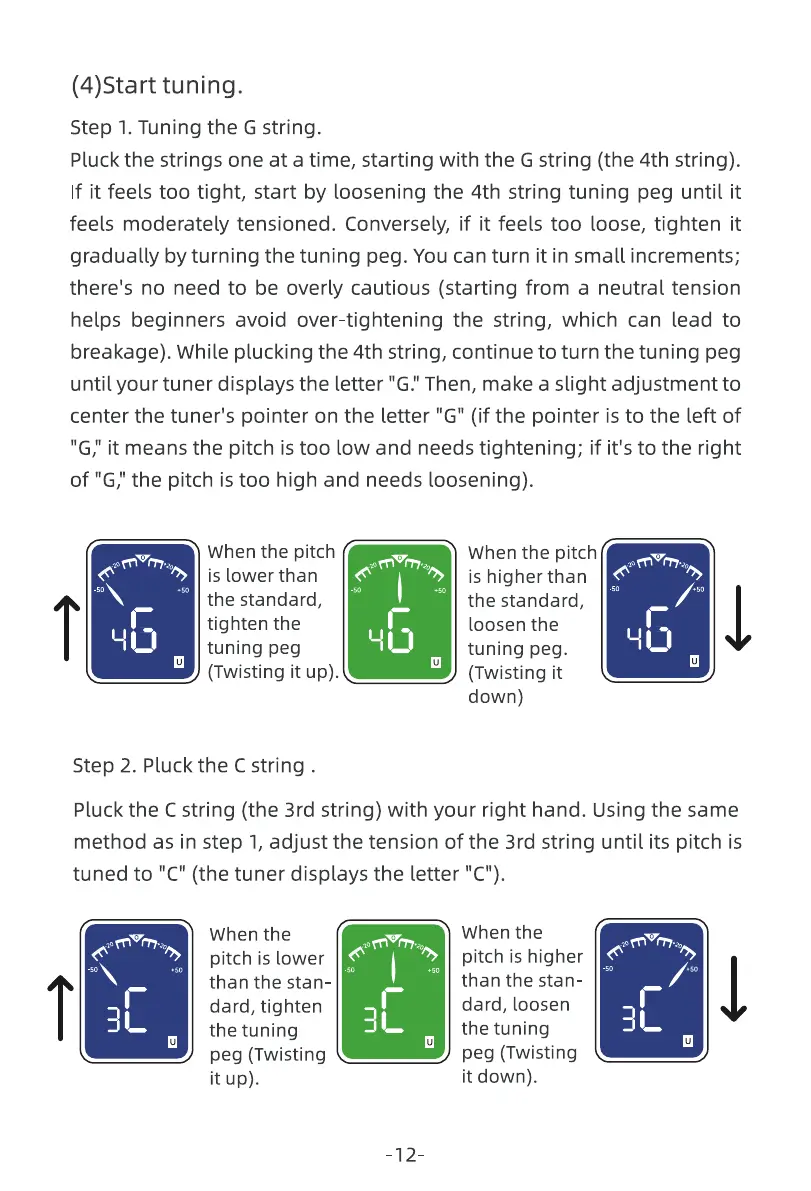
until your tuner displays the letter "G." Then, make a slight adjustment to
center the tuner's pointer on the letter "G" (if the pointer is to the left of
"G," it means the pitch is too low and needs tightening; if it's to the right
of "G," the pitch is too high and needs loosening).
When the pitch
is lower than
the standard,
tighten the
tuning peg
(Twisting it up).
Step 2. Pluck the C string .
When the pitch
is higher than
the standard,
loosen the
tuning peg.
(Twisting it
down)
Pluck the C string (the 3rd string) with your right hand. Using the same
method as in step 1, adjust the tension of the 3rd string until its pitch is
tuned to "C" (the tuner displays the letter "C").
When the
pitch is lower
than the stan
dard, tighten
the tuning
peg (Twisting
it up).
-12-
When the
pitch is higher
than the stan-
dard, loosen
the tuning
peg (Twisting
it down).


 To Next Page
 Loading...