Your First Strumming Pattern
Strumming can feel very awkward at first and a bit of a juggling act. Not
only are you trying to switch chords but you're also trying to keep the
strumming pattern going while you're doing this. This can be really hard.
I've noticed the tendency might be to jump right in and start learning
a strumming pattern. Before we do this, we really need to cover some
important thinking that goes behind strumming. If we understand this,
strumming becomes easier.
The Basis of Strumming
Strumming is a form of rhythm. Rhythm depends completely upon good
timing and consistency. Strumming is not about how complicated or
how fast you can play. If you're not keeping good time and consistency,
you've completely defeated the purpose of strumming.
This is why as we learn our first strumming pattern, we need to be very
intentional about counting out loud. Eventually, we will build an internal
"clock" of sorts where it becomes easier to keep time without thinking
much about it.
Strumming Pattern #1: Down, Down, Down, Down
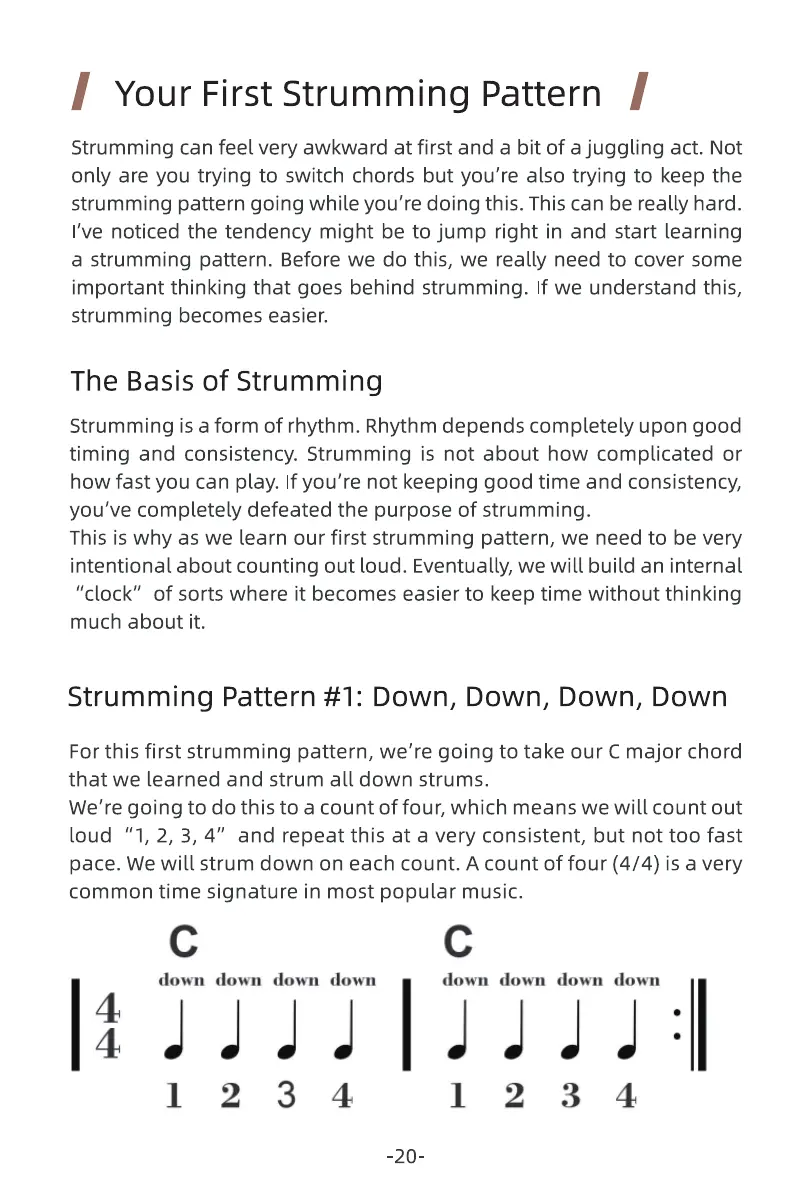
For this first strumming pattern, we're going to take our C major chord
that we learned and strum all down strums.
We're going to do this to a count of four, which means we will count out
loud "1, 2, 3, 4" and repeat this at a very consistent, but not too fast
pace. We will strum down on each count. A count of four (4/4) is a very
common time signature in most popular music.
c
down down down down
c
down down down down
1 2
3
4
1
-20-
2 3 4


 To Next Page
 Loading...