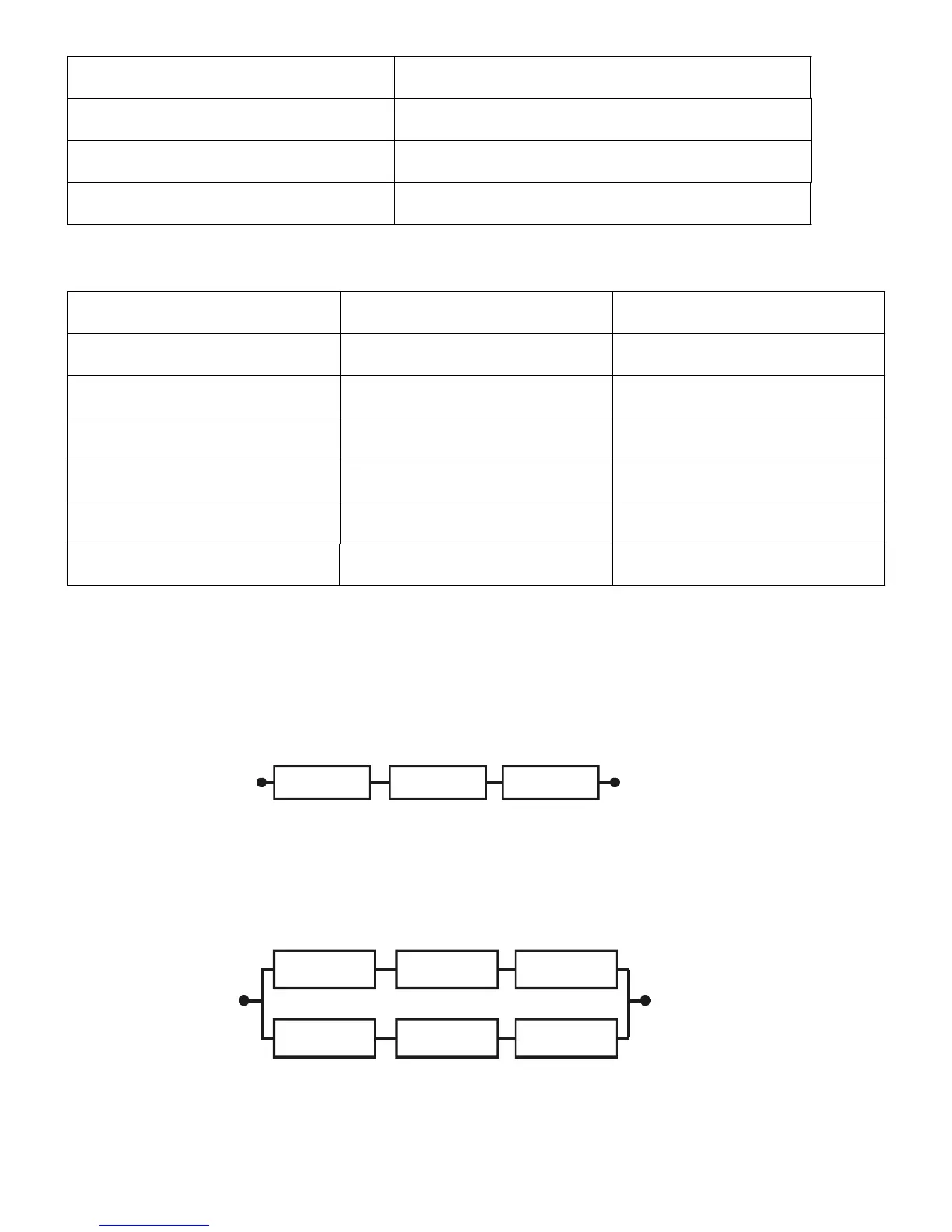
Battery Chemistry Nominal Cell Voltage (Volts per cell)
NiCd or NiMH 1.2 V
SLA, lead acid or gel cells 2 V
Lithium ion or lithium polymer 3.6 V
Same battery examples:
12V Lead Acid 6 cells
4.8V NiCd or NiMH 4 cells
7.2V NiCd or NiMH 6 cells
9.6V NiCd or NiMH 8 cells
12V NiCd or NiMH 10 cells
3.7V Li-ion or Li-polymer 1 cell
7.4V Li-ion or Li-polymer 2 cells
Sometimes the battery pack manufacturer prints a nominal voltage that’s a bit higher then the standard values, in this
case round down the number of cells to a whole number.
In general, NiCd, NiMH, lead acid and gel cell battery packs have all the cells in series. Therefore, the number of cells
that you enter is the number of cells in the battery pack and the capacity is the capacity of each cell, not the sum of the
capacity of all the cells (i.e. the cell capacity is the same as the pack’s capacity). For example, the following pack,
which consists of three 1Ah cells, has a rated capacity of 1Ah and a cell count of three.
Lithium-ion packs can have cells in parallel and series. The number of cells that you enter is the number of cells in
series and the capacity is the rated capacity of the pack (sum of the capacity of parallel cells). For example, the
following pack, which consists of six 1Ah cells, has a capacity of 2Ah and a cell count of three.
The UBA Let's Get Started Guide Page 9
Figure 13: Example battery pack. Pack capacity: 1Ah, cell count: 3.
Figure 14: Example battery pack. Pack capacity: 2Ah, cell count 3.
1Ah 1Ah
1Ah 1Ah
1Ah 1Ah


 To Next Page