Need help?
Do you have a question about the VeriFone UX400 and is the answer not in the manual?
Defines the intended reader for this installation guide and the information provided.
Outlines the structure and chapters of the installation guide for easy navigation.
Lists other VeriFone documents relevant to the UX400 reader, including VPNs.
Explains document conventions, symbols, and acronyms used throughout the guide.
Provides definitions for acronyms used in the manual, such as CTLS, EMV, NFC.
Describes the key features and advantages of the UX400 CTLS Reader.
Highlights user-friendly aspects and design elements that simplify transactions.
Mentions EMVCo features ensuring secure contactless transactions.
Details the device's contactless features and supported protocols like NFC.
Provides guidelines for choosing an optimal and convenient location for the reader.
Describes the device's resistance to dust, rainfall, and sun exposure (IP65).
Instructions on how to open and inspect the package contents for damage or tampering.
Details the front and rear components, connectors, and indicators of the UX400 reader.
Explains how to connect the UX400 reader to the UX300 host device using specific cables.
Lists the contactless payment standards and protocols supported by the device.
Provides instructions and precautions for flush-mounting the UX400 CTLS Reader to a surface.
Explains how the contactless reader operates and when it becomes active.
Details the steps for performing a contactless payment transaction with the reader.
Details power consumption, operating/storage temperatures, and humidity requirements.
Lists dimensions, weight, ports (RJ45, SMA), communication (SPI, I2C), and CTLS LEDs.
Provides advice on handling, storage, and cleaning to protect the device and warranty.
Offers extra safety advice, especially regarding potentially explosive environments.
Outlines the procedure for returning the CTLS reader for repair/replacement, including MRA.
Lists available accessories, cleaning kits, and related documentation with part numbers.
Details the specific cables required for connecting the UX400 to the UX300 unit.
Provides steps to diagnose and resolve issues when contactless transactions are unsuccessful.
Details the product's compliance with FCC Part 15 rules for digital devices.
Describes RF exposure compliance and minimum separation distances required.
Explains legal terms and conditions related to PCI SSC approvals for the device.
The VeriFone UX400 CTLS Reader is a contactless payment peripheral designed to work in conjunction with a UX300 host device. This reader facilitates payment transactions in various environments, particularly outdoor and unattended markets, offering an economical solution for merchants seeking to expand their payment acceptance options.
The UX400 CTLS Reader enables customers to quickly pay for items by tapping their contactless card or NFC-enabled phone near or on the device. It processes transactions with speed and ease, requiring no further input from the customer once the tap is made. The device's contactless capabilities are built on VeriFone's advanced architecture, which supports a Single Contactless Interface (SingleCI) and side-by-side application architecture systems, ensuring future-proof investment. It supports a wide range of contactless cards and NFC phones, adhering to various protocols including ISO 14443 A&B, MiFare (MiFare + / DESfire), ISO 18092 Active Communications (NFC — peer-to-peer mode), FeliCa, PayPass, and payWave. The device is EMV CTLS Level 1 and Level 2 Type Approved, ensuring secure contactless transactions.
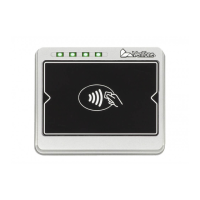
The UX400 CTLS Reader is designed for exceptional ease of use, simplifying transactions in diverse environments. It incorporates integrated proximity sensors that enable the system to wake up from a low power mode when a card is present. The device features a CTLS logo prominently placed for an optimized user experience, guiding customers on where to tap their cards. Bright LEDs are integrated to display the progress of card transactions, providing clear visual feedback to the user. Additionally, a buzzer provides audio confirmation for contactless transactions, enhancing the user experience.
The device boasts a compact, sleek, and stylish shape, making it suitable for various installations. Its design is rugged and reliable, built to withstand the demands of different payment situations, including transportation, vending, and kiosk environments. The front panel is dustproof and designed to allow rainfall to run off, ensuring durability in outdoor settings. It is also fade-proof from sun exposure, meeting IP65 ratings.
Installation involves flush-mounting the reader to a mounting surface without the need for external mounting devices. To connect the UX400 to a UX300 controlling device, an RJ-45 8-pin host connector and an SMA (RF) antenna connector are used. The RJ-45 plug connects to the rear of the contactless unit, and the 8-pin connector connects to the UX300 unit. The SMA connector screws into the rear of the contactless unit and the UX300 unit. When active, the device's contactless logo lights up, indicating readiness for a transaction. To conduct a transaction, the card should be held within 4 cm or gently tapped against the contactless antenna, marked by the logo. The unit provides various audible and visual confirmations to indicate successful transactions.
The UX400 CTLS Reader is a product of superior design and craftsmanship, and it contains no user-serviceable parts. Users are advised not to attempt any service, adjustments, or repairs on the equipment, as this may void the product warranty. Instead, any issues should be directed to a local VeriFone distributor or service provider.
To ensure the longevity and proper functioning of the device, several maintenance guidelines are provided:
 General
| Connectivity | USB |
|---|---|
| Card Types Supported | Magnetic stripe, EMV chip cards |
| Payment Options | Credit, Debit |
| Processor | ARM-based processor |
| Power Supply | USB powered |
| Operating Temperature | 0°C to 50°C |
| Certifications | PCI PTS 3.x |

 To Next Page