reading will rarely be reliable after 15 seconds.
Tips for Use with a Faraday Pail and Ground Plane
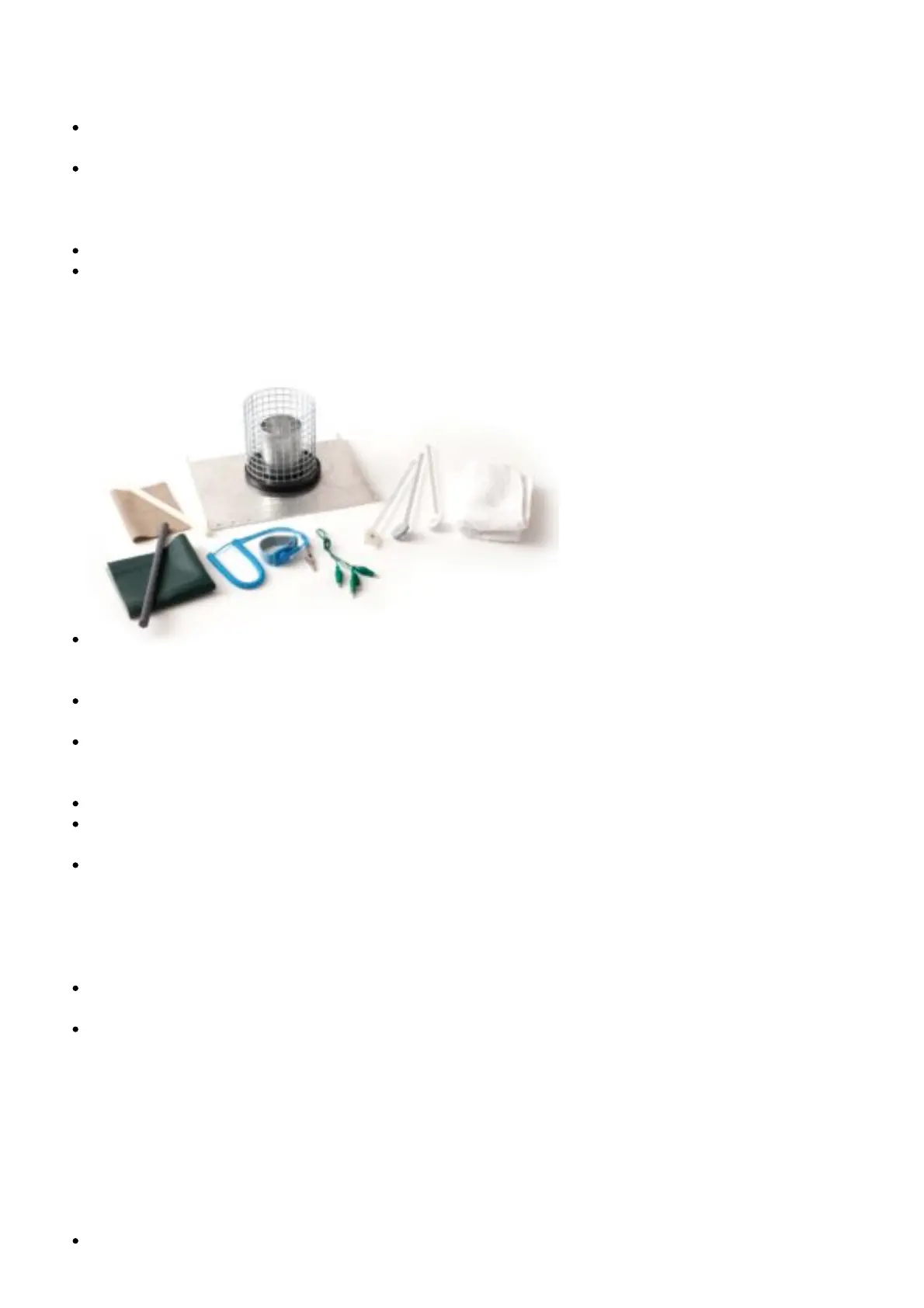
Use of this sensor is simplified with the aid of a Faraday pail and ground plane such as found in
the Vernier Electrostatics Kit (ESK-CRG).
Since the sensor is capable of measuring very small amounts of charge, it is important to begin
experiments by zeroing (resetting) the sensor. Simply press the Reset (Q=0) button on the sensor
for a few seconds to zero the equipment. (Pressing the Reset button internally shorts the wires,
shorts the internal input capacitor, and the internal integrator capacitor.)
The sensor should be zeroed after initial power up and before collecting data.
During data collection, monitor the sensor reading. If an excess charge develops on the sensor,
zero the sensor prior to a new data-collection run.
Experiment Ideas
Use the sensor with a Faraday pail to
investigate charging by induction. Bring a charged object near the pail. What charge is
measured? Ground the pail and remove the charged object. What charge is measured?
Use a Faraday pail to investigate charging by contact. Do this by dropping a charged object into
the can. All of the charge on the object will be transferred to or induced in the can.
Without a grounding strap, scuff your feet on carpet or pull off a sweater. Hold your hand near a
Faraday pail. Do you induce a charge? What sign? Does a ground strap remove or reduce this
effect?
Charge various objects and determine the sign of the charge.
Measure how quickly objects lose charge. Plot the charge as a function of time; this will take
some minutes on a dry day.
Use Go Direct Static Charge and Faraday pail to observe the separation of charge when two strips
of invisible tape are pulled apart. On two 3-inch pieces of tape, make a tab by folding over the top
of each. Stick the combination to the table top. Pull the combination off the table and run your
thumb or finger along the smooth side of the tape to neutralize the combination. Then pull the top
strip off the bottom strip. Individually insert each strip into the Faraday pail to measure the
charge. Simultaneously insert them in the pail to measure the charge.
Charge a Faraday pail by contact on the inside; add more charge. How much charge can you add
from the inside of the can? Can you add as much from the outside? More? Less? Investigate.
Use a second pail (not connected to the red lead as a detector) and charge it by induction. Do this
by charging an insulating object, holding it inside the pail (inducing a charge on the outside of the
can) and then briefly grounding the pail. Remove the charged insulator and you’ve got a charged
pail. Measure the charge by testing it
by induction or by touching it to the inside of the detector pail.
Many of these tips are based on suggestions from Robert Morse, PhD.
Channels
Go Direct Static Charge has two measurement channels:
Charge—The default channel that is active when the sensor is connected is Charge. This channel



 To Next Page