EasyManua.ls Logo

Vertical Technologies DeltaQuad V1 - User Manual

Default Icon
67 pages
Print Icon
To Next Page IconTo Next Page
Loading...
DeltaQuad V1
Introduction
Introduction
This document describes how to setup, operate and maintain your DeltaQuad series VTOL UAV.
Safety & Legal notice
The vehicle must be operated in accordance with local laws and regulations.
The vehicle may not be operated or flown near or over people, roads, vehicles, buildings or anything
that could result in damage or danger to people or property.
All missions must be validated and pass the DeltaQuad Mission Validator
Radio or video transmitters might require special licensing and/or permits.
Vertical Technologies or its affiliates can not be held responsible for vehicles that have not been
operated or maintained in accordance with the guidelines set forth in this manual, or for behavior
resulting from changes made to the vehicle.
This operations manual is provided "As-Is". No rights can be obtained from the contents of this manual.
Software used in conjunction with the vehicle is provided under their respective license and warranty.
The vehicle is provided in accordance with the Vertical Technologies and under the Vertical
Technologies
Warranty
Terms & Conditions
Vehicle specifications
Dimensions:
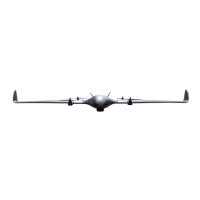
Wingspan 235 cm
Question and Answer IconNeed help?

Do you have a question about the Vertical Technologies DeltaQuad V1 and is the answer not in the manual?

Overview

The DeltaQuad V1 is a VTOL (Vertical Takeoff and Landing) UAV (Unmanned Aerial Vehicle) designed for autonomous flight missions, payload integration, and various operational scenarios. It is part of the DeltaQuad series and is controlled primarily through QGroundControl, a Ground Control Station (GCS) software, and an optional dedicated DeltaQuad Controller.

Function Description

The DeltaQuad V1 is engineered for autonomous operation, allowing users to plan, execute, and monitor missions with minimal manual intervention. Its VTOL capability enables vertical takeoff and landing, eliminating the need for runways and expanding operational flexibility. The UAV supports various payloads, including camera systems for mapping and a Payload Drop Mechanism (PDM) for cargo delivery. Safety features are integrated into both the flight controller and the optional DSPS (DeltaQuad Safety & Performance System) to ensure reliable operation.

Important Technical Specifications

  • Dimensions:
    • Wingspan: 235 cm
    • Height: 17 cm
    • Wing area: 90 sq. dm.
    • Payload bay: 20 x 12 x 9 cm (dimensions)
    • Flightcase dimensions: 114 x 48 x 44 cm
    • Flightcase weight: ~25 Kg (including vehicle)
  • Weight and Payload:
    • Empty weight: 3.3 Kg
    • Empty weight including battery: 5 Kg
    • Maximum takeoff weight: 6.2 Kg
    • Payload capacity (without Aux LiPo): 1.2 Kg
    • Payload capacity (with Aux LiPo): 400g
    • Payload bay height: 80mm minimum (oval shaped)
    • Payload bay length: 120mm
    • Payload bay width: 200mm minimum (oval shaped)
  • Flight Characteristics (at no payload):
    • Cruise speed: 18 m/s (65 Km/h)
    • Maximum speed: 28 m/s (100 Km/h)
    • Stall speed: 12 m/s (43 Km/h)
    • Maximum flight time*: 2+ hours (assuming 90% battery usage, low wind, low altitude VTOL takeoff/landing at sea level; EU Export versions locked to 59 minutes)
  • Connectors:
    • VTOL module to fuselage connector: 2 x power + 5 x signal + 5 x signal positions available
    • VTOL module to wing connector: 3 x signal + 3 x signal positions available
  • Battery: Compatible with DeltaQuad High Grade LiPo Battery (default 23Ah / 23000 mAh capacity).
  • Telemetry: Supports Radio Telemetry Bundle and 4G Telemetry Bundle (VPN-based).
  • Onboard Computer: Exposes Mavlink locally and over 4G VPN on UDP port 14550.

Usage Features

  • Assembly: The DeltaQuad V1 is designed for straightforward assembly, involving inserting carbon spars, mounting VTOL modules, and attaching wings. Propellers (2 CW, 2 CCW VTOL, 1 composite pusher) are typically pre-attached but guidelines are provided for replacement.
  • Simulator: A DeltaQuad Simulator is available for familiarization with the Ground Control Software and flight modes, mimicking actual flight conditions. It is compatible with most operating systems, though increasing CPU cores in virtual appliance settings is recommended for Mac users. Virtualization must be enabled in the BIOS to run the simulator.
  • Ground Control Station (QGroundControl): The primary interface for planning, executing, and monitoring missions. It features a main menu bar with buttons for Settings, Setup, Plan, Fly, Log, Notifications, GPS Status, RC Status, Battery Status, Flight Mode, and Arm Status.
  • Mission Planning: Missions are planned autonomously through QGroundControl. Users can create, load, or save mission plans. Key steps include inspecting the mission site, adhering to local regulations, ensuring clear flight paths, maintaining appropriate altitudes (minimum 60m for takeoff, 50m above ground level for fixed wing flight, 25m for landing), and considering weather conditions. The DeltaQuad Mission Validator helps check mission feasibility and safety.
  • Flight Modes: Supports Mission, Position (with joysticks), Hold, and Return modes. Other flight modes are not supported.
  • Safety Features: Includes Low Battery Failsafe (default: Land, warn at 15%, failsafe at 7%), RC Loss Failsafe (default: Disabled), Data Link Loss Failsafe (default: Disabled, 10s timeout), and Geofence Failsafe (default: Warning, max radius/altitude Disabled). Return Home settings include a default climb of 60m and immediate land action. DSPS (DeltaQuad Safety & Performance System) provides additional mission feasibility checks, parameter sanity verification, system temperature monitoring, and permissible weather condition monitoring.
  • Payload Integration: Optimized for payloads with a large bay on the CG, expandable blind mate connectors, open-source flight control with Mavlink, and an accessible secondary onboard computer. Payload integration best practices include staying within the bay, increasing cruise speed for external objects, installing additional BEC units for power, and performing sensor calibration.
  • Camera Systems:
    • DeltaQuad Pro #VIEW: Equipped with a Nighthawk2 camera system and Microhard Digital Data Link. Operated via a Video Control Station (VCS) laptop and a joystick. Supports RGB/IR video, zoom, onboard recording, and object tracking.
    • DeltaQuad Pro #MAP: Configurable for mapping missions with various camera models (e.g., Sony A7R, RX1R, A6000). Allows setting sensor/image dimensions, focal length, image overlap, and altitude for desired ground resolution. Supports manual grid planning for survey missions.
  • Geo-referencing: For mapping payloads, images can be post-processed to add geographic coordinates using RedToolBox (for Emlid Reach systems) or QGroundControl (for onboard log files).
  • Payload Drop Mechanism (PDM) - DeltaQuad Pro #CARGO: Allows dropping payloads from the UAV. Requires special permits. Payload bay dimensions: 10 cm x 15 cm x 9 cm, capacity: 1 Kg. Doors open for 3 seconds and close automatically. Can be triggered manually or via mission command (using camera trigger functionality).
  • DeltaQuad Controller: An optional dedicated controller with joysticks and buttons for various functions, including flight mode selection (Position, Mission, Return), gimbal zoom, camera gimbal control (retract/deploy, GRR, OBS, STOW), and flight control (move forward/backward, yaw, climb/descend, bank).

Maintenance Features

  • Sensor Calibration: Required upon first receipt, after transport over 300km, when indicated by events, or when telemetry readings are inconsistent. Calibrations include Compass, Gyroscope, Accelerometer, and Level Horizon, performed via QGroundControl.
  • Firmware Upgrade: Notifications and instructions for upgrades are provided via email. Upgrades are performed using QGroundControl on Windows or MacOS with a micro-USB cable.
  • Battery Charging and Storage: Use specific Lithium Polymer chargers. Never charge unattended. Observe for swelling. Charge in an isolated area at ambient temperature. Store at approximately 50% charge in a safe, dark location between 5-25 degrees Celsius for long-term storage.
  • Flight Logs: Onboard logs containing flight information are stored on an SD-Card and should be retrieved and processed after flights. A logbook is recommended for professional use (e.g., AlarisPro) or self-designed, including serial number, flight hours, maintenance cycles, and flight details.
  • Preventative Maintenance (After Every Flight): Clean propellers, fuselage, and wings. Inspect avionics, connectors, motor, and servo linkage screws.
  • Preventative Maintenance (After 50 Flights): Replace propellers and perform sensor calibration.
  • Scheduled Maintenance (After 200 Flights or 12 Months): A thorough inspection and test flight are required, potentially involving component replacement. Vertical Technologies offers an Extended Maintenance Service for refurbishment and warranty extension.
  • Replacing Components: Components are designed for easy replacement. Lock bond is required for motor/elevon linkages and pusher motor propeller nuts. VTOL module propellers are self-tightening.

Vertical Technologies DeltaQuad V1 Specifications

General IconGeneral
BrandVertical Technologies
ModelDeltaQuad V1
CategoryDrones
LanguageEnglish