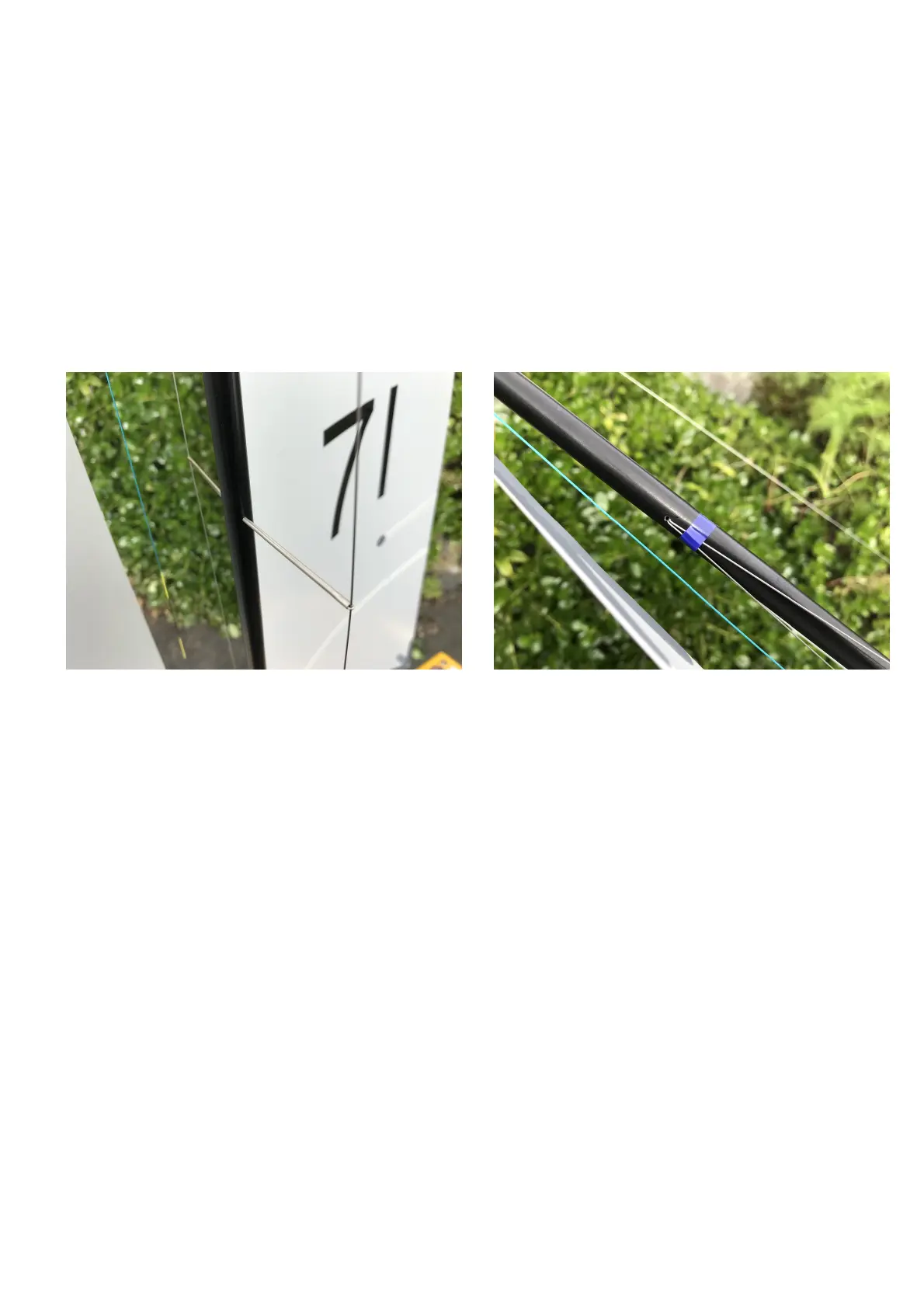
Spreaders- The Spreaders need to be rigid. I like to make them from stainless or brass tube with
1.5mm inside diameter and with a 1.5mm stainless rod connecting them through the mast and
glued into one of the spreaders so they are removable. They may need some angle backwards
although I mine have ended up virtually straight. Use the following method to find an appropriate
spreader angle.
Get the mast centered sideways in the boat, with max. side stay tension. Site down the mast on
both tacks to ensure it is centered.
Adjust ram and backstay so the mast suits the mainsail as best you can. There may well be a flat
spot in the middle of the mast at the spreaders, so carefully bend the spreaders aft until the flat
spot looks uniform.
The captive pins holding the shroud at the spreader ends should be crimped into the spreader
end to keep the orientation of the spreader angled aft. My captive pins are side stay wire bent to a
U shape with a bend radius that suits the side stay diameter. If done accurately, the jib topper
should not catch the spreader, although it is recommended to have a bungie on the jib topper to
manage the slack in the line when the jib boom lifts.
Forestay height should be as high on the mast as possible (close to the band), and the backstay
crane kept as short as practical. This helps achieve maximum forestay tension.
Side stays should hook into a single hole in the front of the mast. I use 105lb monofilament wire
with a tightish bend of about 1mm radius and a 30mm tail. They hook straight into the hole in the
mast. It is good to hold them captive with a piece of tape so they dont cross over.


 To Next Page
 Loading...