SET-UP AND SAFE OPERATING PROCEDURES
4-23
0056-0114
Welding Nozzle
The welding nozzle is usually an assembly consisting of a welding elbow, a gas mixer, and a coupling
nut. A wide range of tip and nozzle configurations are available for attachment to the torch handle.
Typical tip and nozzle applications include welding, brazing, soldering, heating, and hard facing.
Welding Elbow
The welding elbow is a tellurium copper tube that has been swaged to a specific orifice size on one
end. Like cutting tips, welding tips have a calibrated orifice for welding various thicknesses of metal.
For further information on nozzle sizes and selections, please refer to the chart located on page 57.
In the oxy-fuel welding process, slag can splatter and clog the tip orifice. Remove spatter from the
orifice with a round file (tip cleaner).
NOTE
Repeated cleaning may alter the orifice size, requiring adjustments to the gas supply.
Multi-Flame Heating Nozzles (Rosebuds)
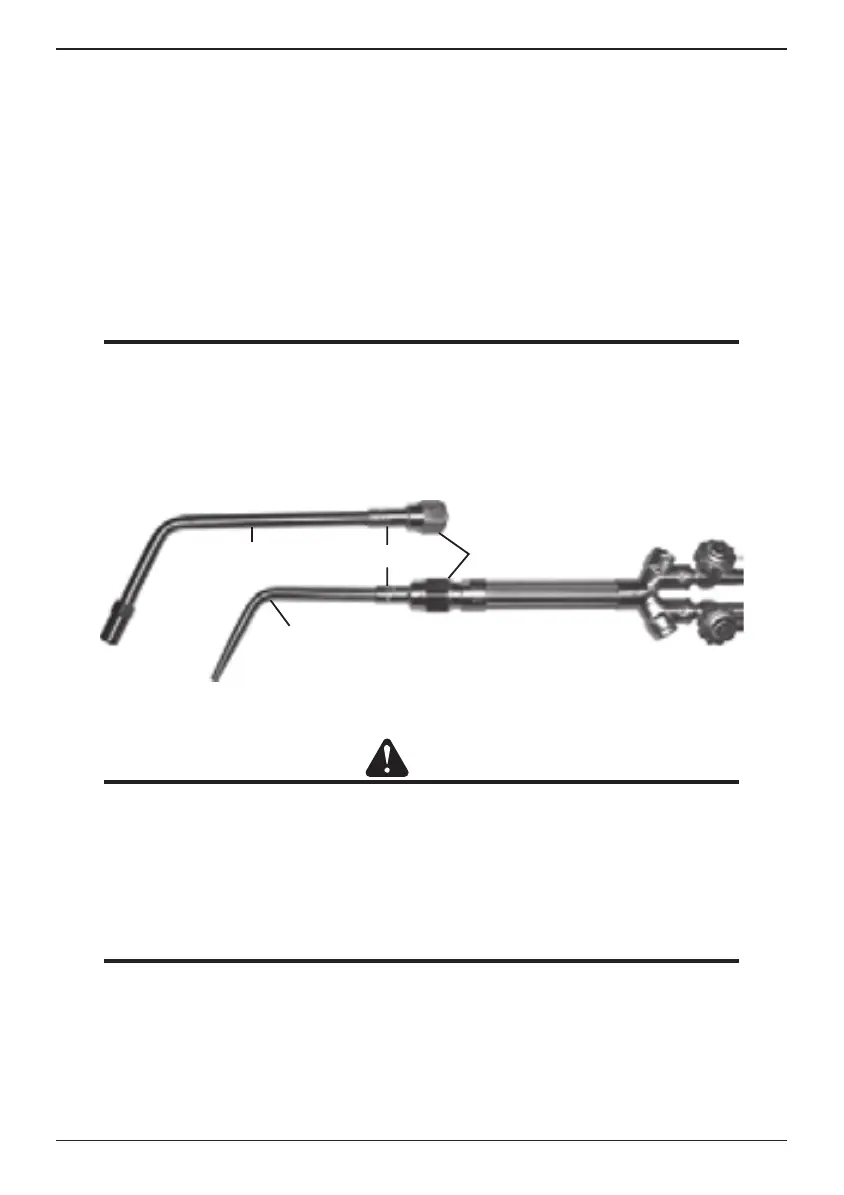
The multi-flame heating nozzle is basically a large welding nozzle (see Figure 7). The coupling nut
and mixer assembly are similar in design to a welding nozzle. The multi-flame head is machined to
utilize numerous flames. This provides additional heating capacity for heavy heating applications.
HEATING NOZZLE
(ROSEBUD)
MIXER
COUPLING NUT
WELDING ELBOW
dwg-00382
Figure 7: Welding Nozzle
CAUTION
Never starve or choke a multi-flame heating nozzle. This causes overheating of the head
and a backfire or sustained backfire may result. Should a backfire occur (flame pops
and disappears and/or a hissing sound is heard, the flame is burning inside the nozzle),
immediately turn off the oxygen valve on the torch handle. Then, turn off the fuel valve.
Allow the nozzle to cool before using it. If a backfire recurs, have the apparatus checked
by a qualified technician before using again.
NOTE
It is better to use a smaller size welding, brazing or heating tip at its full capacity than
a larger tip at its minimum flow capacity.
Gas Mixer
The welding / heating nozzle cone end is similar to that of the cutting attachment cone end. The
difference is that the welding / heating nozzle cone end is designed to mix the oxygen and fuel gases,
whereas the cone end in the cutting attachment is not. When the oxygen meets with the fuel gas,
a homogenizing mixing effect occurs. This complete mixing of the gases results in a well-balanced
Oxy-fuel Apparatus


 To Next Page
 Loading...